State Key Laboratory for Mechanical Behavior of Materials Achieves Major Advance in 500°C-Class Heat-Resistant, High-Strength Aluminum Alloys
Aerospace, advanced energy, and high-end equipment manufacturing increasingly demand structural materials that combine light weight with the ability to withstand high-temperature service-two properties that are usually difficult to achieve together. Lightweight, high-strength, heat-resistant aluminum alloys are therefore among the leading candidates for structural weight reduction. Commercial high-strength aluminum alloys derive their room-temperature strength from nanoprecipitates formed by fast-diffusing elements such as Cu, Mg, Zn, and Si, which impede dislocation motion. These precipitates, however, are thermodynamically unstable. Above 200°C, they rapidly coarsen or even dissolve into the aluminum matrix, causing a precipitous loss of strength. Heat-resistant aluminum alloys have become a major research focus, and new alloys capable of operating above 200°C have gradually emerged. The heat-resistant aluminum alloy research team at Xi'an Jiaotong University previously proposed a design strategy that couples fast- and slow-diffusing solute atoms, leading to a family of high-strength alloys for service at 300–400°C and breakthroughs in their engineering application. For more demanding applications, however, 500°C (approximately 0.83Tₘ, where Tₘ is the absolute melting temperature) has long been regarded as an almost insurmountable service-temperature ceiling for aluminum alloys. As a result, high-temperature components such as those surrounding engines still rely on titanium alloys or superalloys, leaving limited room for further weight reduction. Aluminum alloys capable of operating at 500°C would therefore represent a transformative breakthrough in both materials and manufacturing technology.
Recently, the heat-resistant aluminum alloy research team at the State Key Laboratory for Mechanical Behavior of Materials, Xi'an Jiaotong University, working with Shanghai Jiao Tong University and Université Grenoble Alpes, has made important progress in 500°C-class heat-resistant, high-strength aluminum alloys through additive manufacturing. The team proposed a new strategy termed “thermally stable dual-phase interlocking stabilization”: two types of heat-resistant nanoparticles grow in pairs throughout the three-dimensional microstructure and effectively lock each other in place, producing a synergistic stabilization effect greater than the sum of the individual phases. By exploiting solute trapping during non-equilibrium solidification in additive manufacturing, the researchers added trace amounts of Sc and Zr to form dense nanoscale Al-V-Sc-Zr amorphous structures around the as-built cellular structure (Fig. 1). After a short-term heat treatment at 400°C, driven by V diffusion, a coupled in situ phase transformation occurred between the cellular structure and the surrounding amorphous phase (Fig. 2): V atoms diffused across the interface into the Al₁₂Fe₃Si phase within the cells, converting it into the more structurally stable Al₁₂(Fe,V)₃Si phase, while the amorphous phase simultaneously transformed into thermally stable Al₃(Sc,Zr) nanoparticles. The two phases are tightly bonded and distributed in pairs, forming composite nanoprecipitates with a total volume fraction of approximately 37.7 vol% and an average size of only 56 nm-both the precipitate content and the level of refinement far exceed those of heat-resistant aluminum alloys produced by conventional processes (Fig. 3).
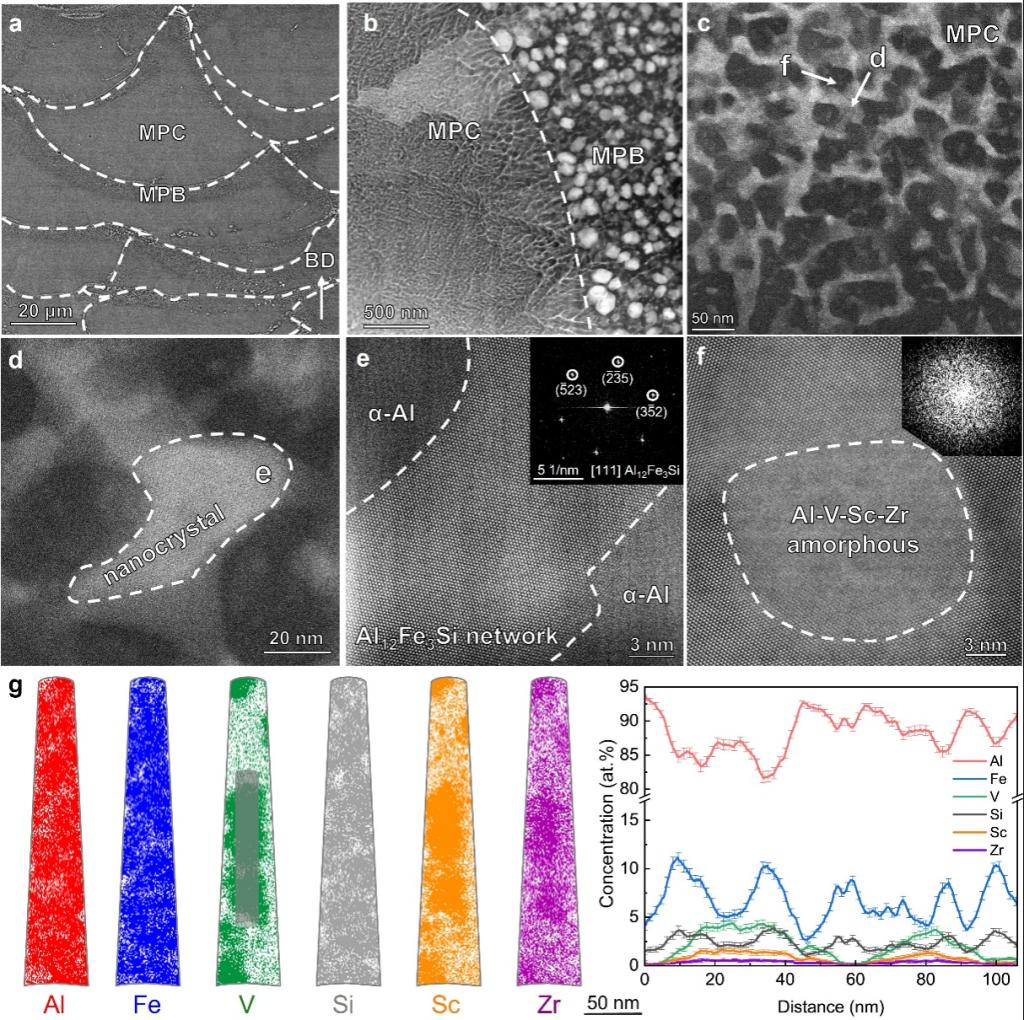
Fig.1| a, A representative back-scattered scanning electron microscopy (SEM) image showing the microstructures in a low magnification, where BD indicates the build direction and white dash lines outline the melt-pool boundaries. b-f, Representative HADDF-STEM images to show the interface between melt pool centers (MPC) and melt pool boundaries (MPB) (b), and the microstructural features within the MPC (c). Representative HAADF images showing the Al12Fe3Si phase (d) and its atomic-resolution images and fast Fourier transform patterns (FFT) (e), and the (Al, V, Sc, Zr) amorphous phase (f), respectively.
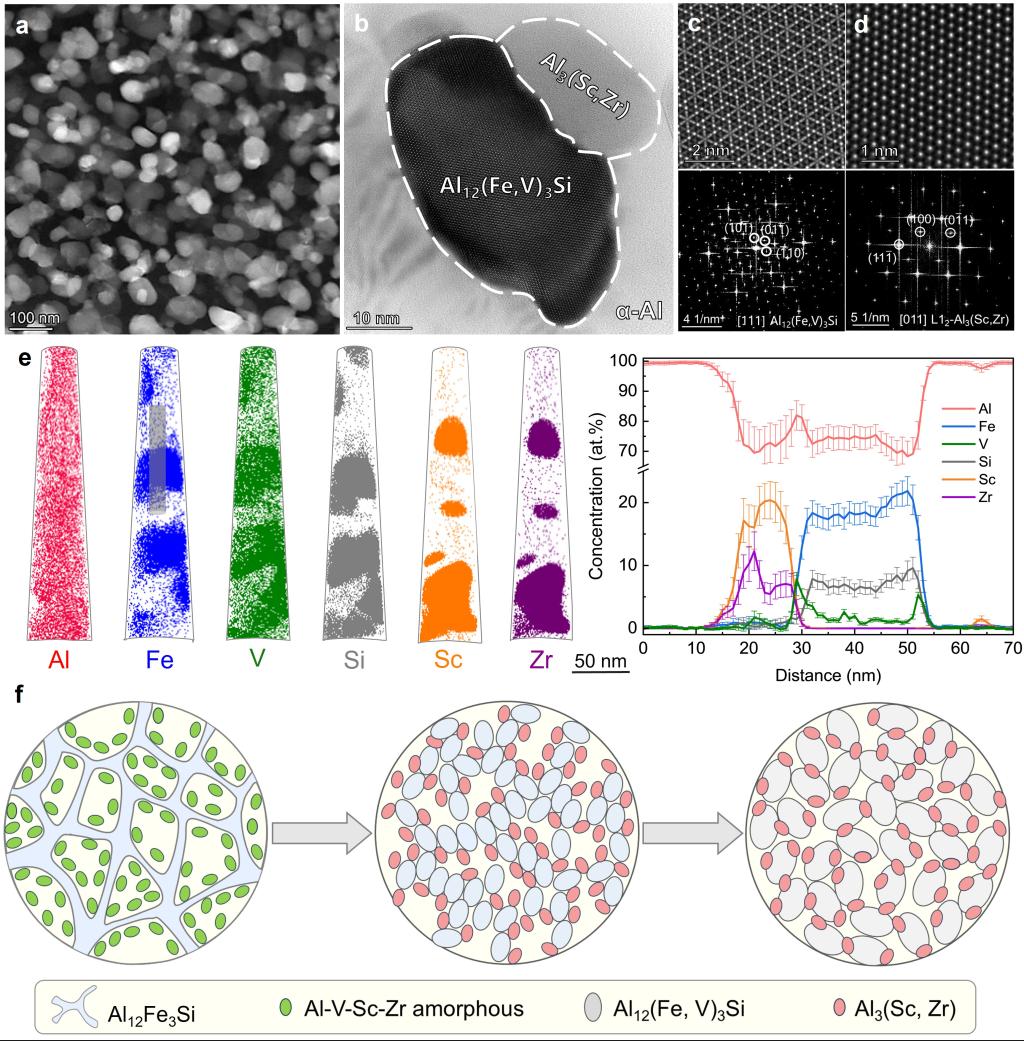
Fig.2| a-d, Representative HADDF-STEM image to show the Al12(Fe, V)3Si/Al3(Sc, Zr) complex nanoprecipitates in a large volume fraction (a), and TEM image to show complex nanoprecipitates in details (b), with atomic-resolution images and fast Fourier transform patterns (FFT) of the Al12(Fe, V)3Si (c) and Al3(Sc, Zr) (d), respectively. e, Representative APT images showing the elemental distribution within the nanoprecipitates. f, Schematical illustration showing the microstructural evolution via in-situ phase transformation upon post-build heat treatment.
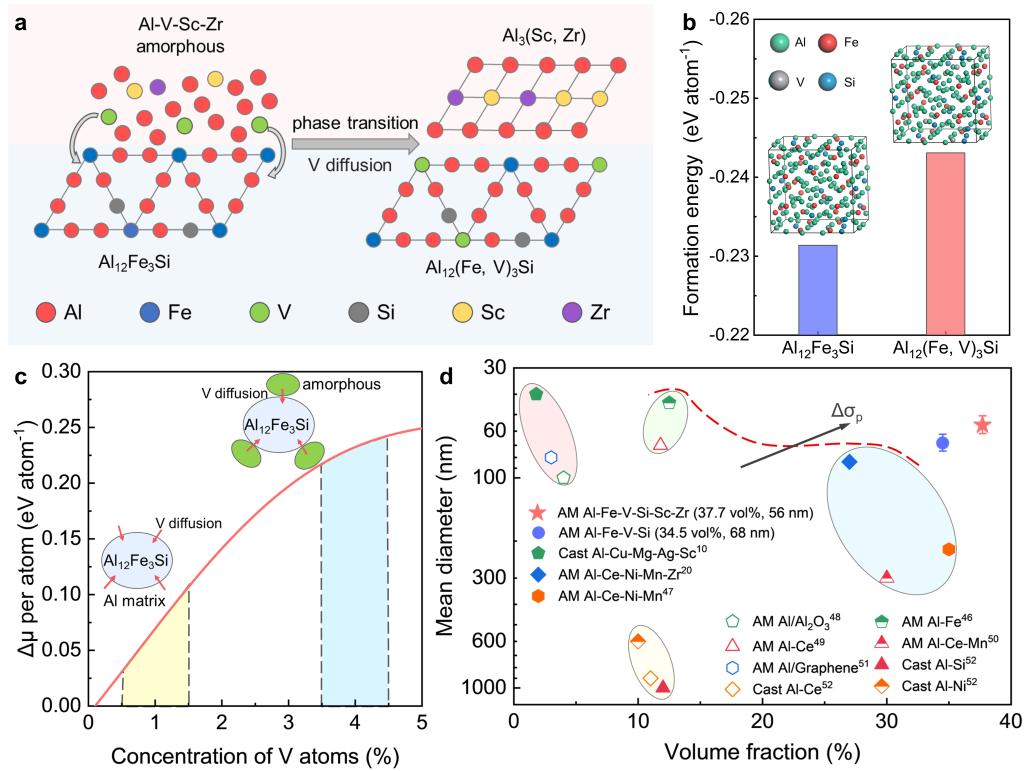
Fig. 3| a, Sketches to show the V diffusion into Al12Fe3Si, triggering an in situ phase transformation from Al12Fe3Si to Al12(Fe, V)3Si, and the V out-diffusion allowing the amorphous phase in situ crystalized into Al3(Sc, Zr) nanoparticle. b, DFT simulation results on the formation energy per atom of Al12(Fe, V)3Si and Al12Fe3Si phases for comparison. c, DFT simulation results in the chemical potential difference of supersaturated V atom concentration and equilibrium concentration in Al matrix. d, Volume fraction vs average diameter of nanoprecipitates in present AM-derived Al-Fe-V-Si-Sc-Zr alloy compared with those in other Al alloy.
The study further shows that this coexisting two-phase structure produces a distinctive “mutual growth constraint” effect: the interfaces of the two nanoparticle phases pin one another, kinetically suppressing precipitate coarsening at high temperatures. Unlike conventional stabilization strategies that rely primarily on thermodynamics-such as interfacial solute segregation or stronger lattice bonding-this mechanism stabilizes the composite precipitates through kinetic constraint and gives them unprecedented coarsening resistance. This exceptional microstructural thermal stability translates into breakthrough elevated-temperature mechanical properties (Fig. 4). The alloy achieves a tensile strength of up to 230MPa at 400°C and retains approximately 120MPa at 500°C, significantly outperforming existing cast and additively manufactured aluminum alloys at high temperatures. Its steady-state creep rates at 400 and 500°C are two to three orders of magnitude lower than those of existing heat-resistant aluminum alloys; indeed, its creep resistance at 500°C exceeds that of most conventional heat-resistant aluminum alloys tested at 400°C. This work is the first to raise the service temperature of near-net-shape additively manufactured aluminum alloys (parts printed close to their final geometry with little or no subsequent machining) to the 500°C range. It overturns the long-held assumption that heat-resistant, high-strength aluminum alloys cannot break through the 500°C service limit, establishes “kinetically constrained stabilization” as a new paradigm for high-temperature microstructure design in light alloys, and offers the potential for substantial weight savings and energy-efficiency gains in aerospace high-temperature structures and heat-exchange components.
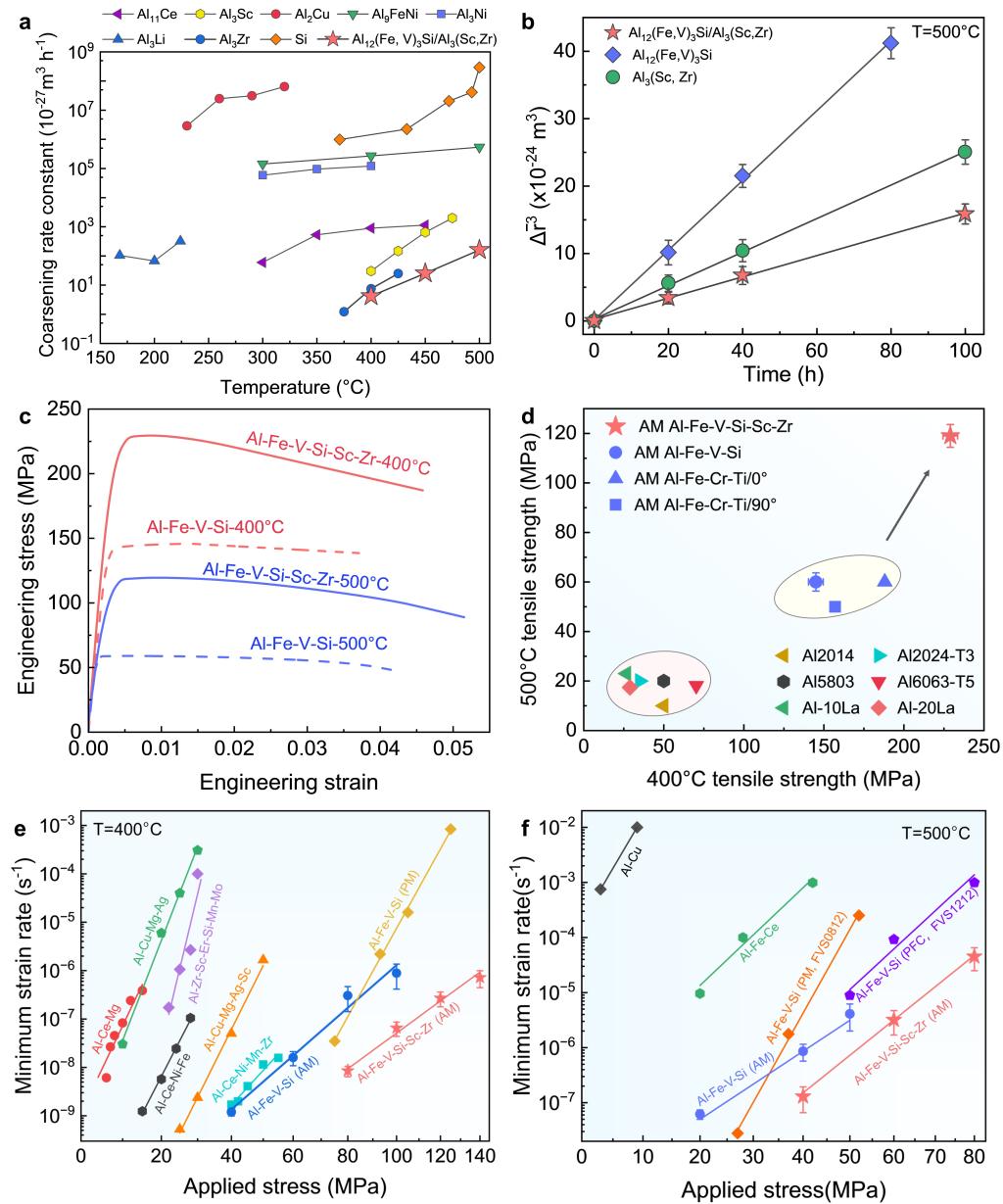
Fig. 4 | a, coarsening rate constant (κ) vs temperature for representative precipitate of Al alloys. b, The increase of r3 of Al12(Fe, V)3Si/Al3(Sc, Zr) complex nanoprecipitates vs exposure time at 500 °C, in comparison with the Al12(Fe, V)3Si and Al3(Sc, Zr) nanoprecipitates. c, The Engineering stress-strain curves of the Al-Fe-V-Si-Sc-Zr and Al-Fe-V-Si alloys, tensile tested at 400 °C and 500 °C. d, The 500 °C-tested tensile ultimate strength versus 400 °C-tested ultimate tensile strength of the present Al-Fe-V-Si-Sc-Zr alloy (red star) compared with aluminum alloys in the literature. e,f, The applied stress dependence of the steady-state tensile creep rates of the Al-Fe-V-Si-Sc-Zr alloy tested at 400 °C (e) and 500 °C (f), in comparison with the Al-Fe-V-Si alloy (blue) and previously reported Al-based alloys with relatively high creep resistance tested at 400 °C and 500 °C.
The findings were published in Materials Today (99 (2026) 103453), under the title 500°C-resistant Al alloys achieved by additive manufacturing. Zhilu Wang, a PhD student at Xi'an Jiaotong University, and Zhe Yan, a postdoctoral researcher at Shanghai Jiao Tong University, are co-first authors. The co-corresponding authors are Professors Sichuang Xue and Gang Liu, Professor Jun Sun-an academician of the Chinese Academy of Sciences-at Xi'an Jiaotong University, and Professor Alexis Deschamps of Université Grenoble Alpes, France. Other co-authors include PhD students Wenweijiao Wang and Shang Huang of Xi'an Jiaotong University and Associate Professor Mingyu Gong of Shanghai Jiao Tong University. The research was supported by the National Natural Science Foundation of China, the Open Fund of the Shaanxi Laboratory of New Materials, and the “111” Project. The characterization work was performed with support from the Shanghai Synchrotron Radiation Facility and the Instrumental Analysis Center of Xi'an Jiaotong University.


