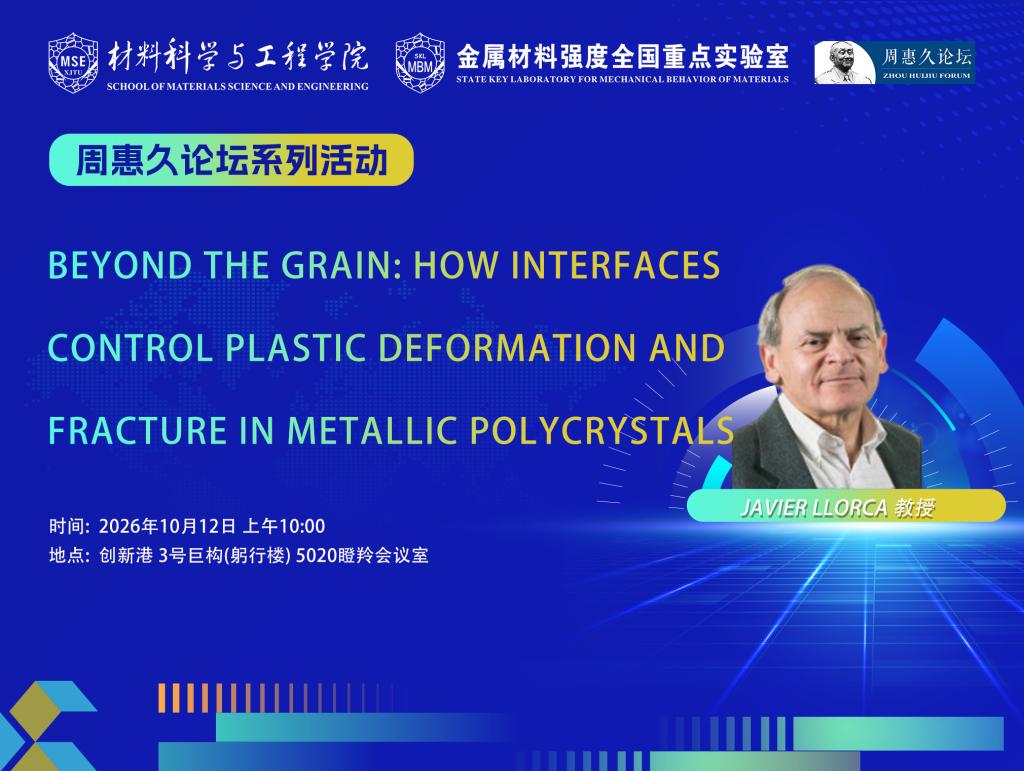
Invited Speaker:Prof. Javier LLorca
Report Title: Beyond the grain: How interfaces control plastic deformation and fracture in metallic polycrystals
Time: 10:00 a.m., October 12, 2026
Location: Innovation Harbour Campus, Building 3 (Gongxing Building), Gazelle Meeting Room 5020
Introduction:
Prof. Javier LLorca is scientific director and founder of the IMDEA Materials Institute, where he leads the research group on Bio/Chemo/Mechanics of Materials, and Professor of Materials Science at the Polytechnic University of Madrid.
A Fulbright scholar, Prof. LLorca is Fellow of the European Mechanics Society and of the Materials Research Society, member of the Academia Europaea and has held visiting positions at Brown University, Indian Institute of Science, China Central South University, Yanshan University and Shanghai Jiaotong University. He has received -among many others- the Leonardo Torres Quevedo National Research Award in Engineering, the Research Award from the Spanish Royal Academy of Sciences, the Morris Cohen Award of TMS, the Distinguished Scientist Award of the Structural Materials Division of TMS, the Science and Technology Award of the International Mg Society.
His current research interests – within the framework of Integrated Computational Materials Engineering – are aimed at the design of advanced materials for engineering applications in transport, health care (implants) as well as energy (catalysis), so new materials can be designed, tested and optimized in silico before they are actually manufactured in the laboratory.
Abstract:
It is well recognized that grain boundaries and twin boundaries play a critical role in the deformation of metallic polycrystals. They may hinder slip transfer (leading to the formation of dislocation pile-ups and Hall-Petch effect strengthening) or allow slip transfer, facilitating strain localization. They are also preferential sites for twin and fatigue crack nucleation, absorb and/or emit dislocations, and can accommodate through grain boundary sliding. While the dominant plastic deformation mechanisms in metallic single crystals are well established, the role of grain boundaries is less understood because they are three-dimensional, disordered structures whose behavior is difficult to characterize and simulate.
In this talk, state-of-the-art in situ micromechanical characterization techniques as well as atomistic simulations and machine learning tools are used to ascertain the role of grain and twin boundaries on the mechanical behavior of metallic polycrystals. The include the influence of basal-twist gran boundaries on the nucleation of fatigue cracks in Ti alloys, the role of grain boundaries on the nucleation of twins in Mg and the accommodation of deformation through grain boundary sliding in Zn. These results show how the combination of experimental tools and simulation strategies can be used to understand the roles of interfaces on the deformation of metallic polycrystals.
讲座可盖章


