As the global transition toward carbon neutrality accelerates, a major challenge is how to safely, economically, and reliably store electricity generated from intermittent renewable sources, such as wind and solar power. Aqueous organic redox flow batteries (AORFBs), which offer intrinsic safety, low cost, and independently scalable power and energy capacities, are regarded as a promising technology for large-scale energy storage.
However, translating AORFBs into practical applications requires overcoming two fundamental challenges: improving the long-term cycling stability of catholyte materials and increasing the number of electrons transferred per anolyte molecule. Recently, Professor Jiangxuan Song’s team at Xi’an Jiaotong University has made significant progress in addressing these challenges through complementary advances in electrolyte engineering and molecular design. These findings, published in Advanced Materials and National Science Review, offer new strategies for developing AORFBs with both high energy density and long life.
1. Suppressing Electrochemical Acidification to Extend the Lifetime of TEMPO-Based Catholytes
For TEMPO-based nitroxide radical catholytes, a major challenge to long-term stability lies in the surrounding electrolyte environment. During cycling, irreversible electrolyte acidification can accelerate the disproportionation and ring-opening degradation of TEMPO molecules, leading to rapid capacity fading. Previous studies have primarily focused on modifying the molecular structures of TEMPO derivatives. However, the team recognized that understanding and controlling the underlying acidification process was essential to addressing the problem at its source.
Through in-situ pH monitoring and ion chromatography, the team elucidated a two-stage electrochemical acidification mechanism. In the first stage, a rapid and irreversible pH decrease originates from the formation of reactive chlorine species through the chlorine evolution reaction (CER) in chloride-based supporting electrolytes, followed by their hydrolysis. In the second stage, the electrolyte pH exhibits reversible oscillations governed by the redox interconversion between nitroxyl radicals and their corresponding N-oxoammonium species.
Guided by these mechanistic insights, the team introduced a Hofmeister-type anion regulation strategy, replacing chaotropic chloride anions with kosmotropic sulfate anions. Sulfate anions show substantially stronger ion-water interactions, reducing water availability for hydrolysis and suppressing the formation of reactive chlorine species associated with the chlorine evolution side reaction. This approach effectively mitigates electrolyte acidification at the source.
In a 1.0 M TMA-T system, the battery exhibited an outstanding cycling stability of 97.6% capacity retention after 300 cycles (413 h). The daily capacity decay rate decreased from 0.429% to 0.143%, corresponding to a threefold extension in cycling lifetime. Importantly, the strategy also demonstrated broad applicability across TEMPO derivatives with different molecular structures, highlighting its potential as a general approach to improving the stability of TEMPO-based AORFBs.
The study, entitled “Hofmeister-Effect Regulation Suppresses Electrochemical Acidification for Long-Life TEMPO-Based Aqueous Flow Batteries”, was published in the internationally renowned journal Advanced Materials. Ph.D. candidate Kai Liu is the first author, while Associate Professor Hao Fan and Professor Jiangxuan Song are the co-corresponding authors. The State Key Laboratory for Mechanical Behavior of Materials, Xi’an Jiaotong University is the sole corresponding institution.
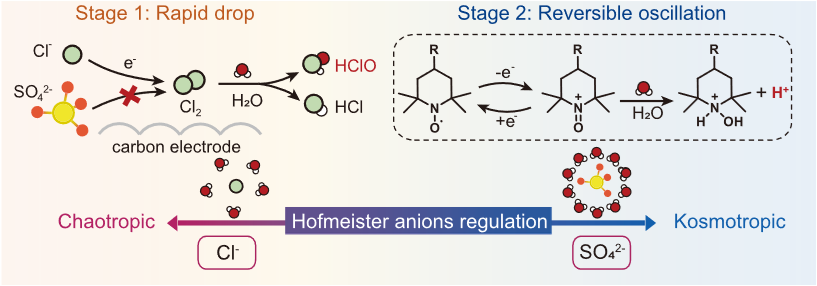
Figure 1.Two-stage electrochemical acidification mechanism in TEMPO-based electrolytes and the corresponding anion regulation strategy.
2. Integrating Multiple Redox-Active Centers to Achieve Reversible Six-Electron Transfer
Most reported organic molecules rely on a single redox-active center and typically support one- or two-electron transfer, fundamentally limiting their energy storage capacity. Increasing the number of transferred electrons transferred per molecule presents a considerable molecular design challenge. As more electrons are transferred, the accumulation of negative charge in the reduced molecular states can destabilize radical intermediates, promote molecular rearrangement and degradation, and ultimately leading to rapid capacity fading.
Rather than simply connecting multiple redox-active units, the team designed and synthesized two fused redox-active structures that integrate the distinct functionalities of fluorene and phenazine moieties into a single fused conjugated framework, leading to development of the DQ-DC molecule. This molecular architecture enables electronic coupling between distinct redox-active centers. The incorporation of the heterocyclic unit effectively reduces the localized polarization of the carbonyl group, helping the conjugated framework maintain its structural integrity even in multi-electron reduction states.
An AORFB employing DQ-DC as the anolyte achieved a volumetric capacity of 79.3 Ah/L and a peak power density of 250.2 mW/cm2. Impressively, the battery operated stably for more than 198 days, with a remarkably low-capacity decay rate of 0.038%/day. These results demonstrate the potential of integrating multiple redox-active centers into a conjugated molecular framework to achieve high-energy-density, durable organic materials.
The significance of this study has also attracted attention from the international research community. Professor Yi-Chun Lu of The Chinese University of Hong Kong published a Highlight article in National Science Review, acknowledging the importance of this molecular design strategy. The highlight emphasized that integrating different redox-active centers into a single conjugated molecular framework enables reversible six-electron redox reactions and provides a new molecular design strategy for overcoming the limitations of electron-transfer numbers in organic flow batteries.
The study, entitled “Multiple Hetero-Redox Centers in a Phenazine-Ketone Scaffold for High-Energy-Density Aqueous Flow Batteries toward Durable Energy Storage”, was published in the prestigious journal National Science Review. Associate Professor Hao Fan and Professor Jiangxuan Song from Xi’an Jiaotong University, together with Professor Duanyang Kong from Beijing University of Chemical Technology, are the co-corresponding authors. The State Key Laboratory for Mechanical Behavior of Materials at Xi’an Jiaotong University is the primary corresponding institution, while the State Key Laboratory of Chemical Resource Engineering at Beijing University of Chemical Technology serves as the co-corresponding institution.
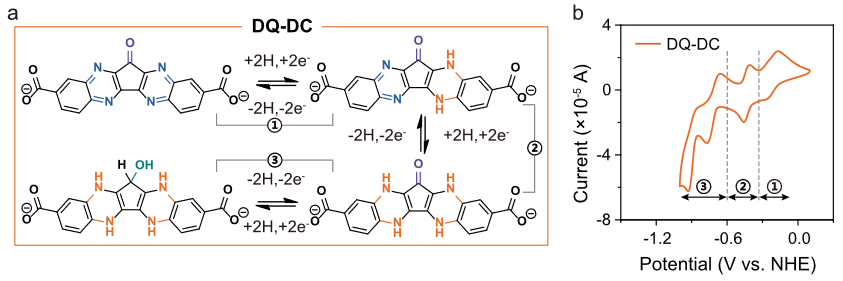
Figure 2. Six-electron transfer mechanism and redox behavior of the DQ-DC molecule.
Paper link:
(1) Advanced Materials:https://doi.org/10.1002/adma.75077
(2) National Science Review: https://doi.org/10.1093/nsr/nwag423
Professor Jiangxuan Song’s group website:
https://jxsong.xjtu.edu.cn/


