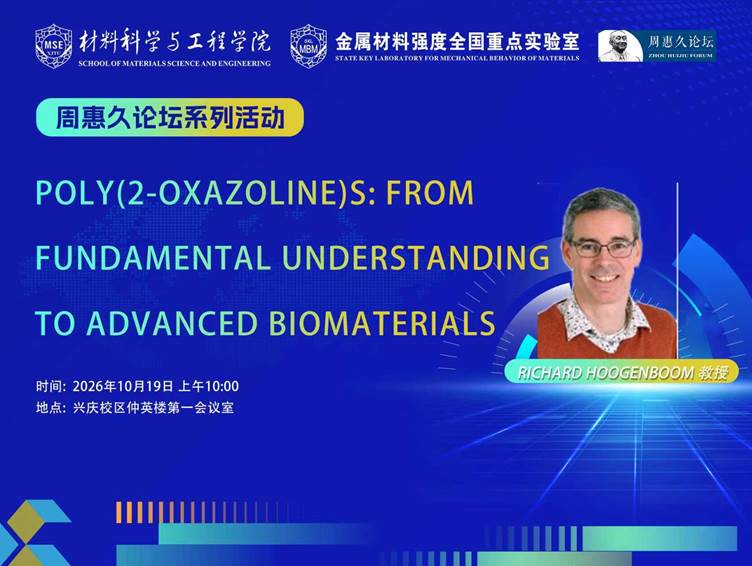
Invited Speaker: Prof. Richard Hoogenboom
Report Title: Poly(2-oxazoline)s: From Fundamental Understanding to Advanced Biomaterials
Time: October 19, 2026, 10:00 AM
Location: Xingqing Campus, Zhongying Building, No.01 Meeting Room
Introduction: Prof. Richard Hoogenboom is full professor at Ghent University. He obtained his PhD degree in 2005 from Eindhoven University of Technology under supervision of Prof. Ulrich S. Schubert and performed postdoctoral research with Prof. Martin Möller (RWTH Aachen) and Prof. Roeland Nolte (Radboud University Nijmegen). His research focuses on development of poly(2-oxazoline)s as biomaterials, dynamic supramolecular materials and responsive polymers, resulting in 580+ scientific articles (34,000+ citations). He holds 27 patent families and is cofounder of Avroxa BV. Prof. Hoogenboom is editor-in-chief of European Polymer Journal and received several awards, including the ACS Carl S. Marvel Award (2021), the ACS POLY (2022) and PMSE (2025) fellows awards and the SPSI 3rd Dr. Sivaram endorsement lecture award (2022) and is an elected member of the Academia Europaea.
Abstract: The living cationic ring-opening polymerization of 2-oxazolines has been studied in great detail since its discovery in 1966. The versatility of this polymerization method allows copolymerization of a variety of 2-oxazoline monomers to give a range of tunable polymer properties that enable, for example, hydrophilic, hydrophobic, fluorophilic, as well as hard and soft materials. Moreover, the chemical versatility allows orthogonal end-group and side-chain modification of the polymers. However, this class of polymers was almost forgotten in the 1980s and 1990s because of the long reaction times and limited application possibilities. In the new millennium, a revival of poly(2-oxazoline)s has arisen because of their potential use as biomaterials and thermoresponsive materials, as well as the easy access to defined amphiphilic structures for (hierarchical) self-assembly.
In this lecture, I will present the ongoing efforts from our research group to broaden the scope and understanding of poly(2-oxazoline)s enabling the preparation of advanced polymer structures for a broad range of, often biomedical, applications. Specific topics will range from fundamental studies aimed at expanding the monomer scope and elucidating polymerization mechanisms, through the synthesis of well-defined high-molar-mass polymers, to the development of functional poly(2-oxazoline)s as pharmaceutical excipients for oral dosage forms, micellar drug delivery systems, building blocks for polymer therapeutics, hydrogels, and medical devices, including the clinically approved Ethizia hemostatic patch.
Overall, the lecture will illustrate how advances in the mechanistic understanding of poly(2-oxazoline) synthesis, monomer reactivity, and polymerization kinetics drive the rational design of advanced polymer structures, ultimately expanding opportunities in functional materials, biomedicine, and beyond.
The lecture can be stamped
讲座可盖章


