By CAMP-Nano
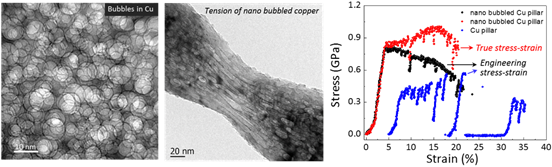
The workability and ductility of metals usually degrade with exposure to irradiation, hence the phrase “radiation damage”. Here, we found that helium (He) radiation can actually enhance the room-temperature deformability of submicron-sized copper. In particular, Cu single crystals with diameter of 100−300 nm and containing numerous pressurized sub-10 nm He bubbles become stronger, more stable in plastic flow and ductile in tension, compared to fully dense samples of the same dimensions that tend to display plastic instability (strain bursts). The sub-10 nm He bubbles are seen to be dislocation sources as well as shearable obstacles, which promote dislocation storage and reduce dislocation mean free path, thus contributing to more homogeneous and stable plasticity. Failure happens abruptly only after significant bubble coalescence. The current findings can be explained in light of Weibull statistics of failure and the beneficial effects of bubbles on plasticity. These results shed light on plasticity and damage developments in metals and could open new avenues for making mechanically robust nano and microstructures by ion beam processing and He bubble engineering.
The work was published in Nano letters and the first author is a master student in MSE Camp-nano. The project is supervised by Prof. Zhiwei Shan, Prof. Weizhong Han from our faculty. Prof. Evan Ma and Prof. Ju Li, PhD student Liang Wan, PhD student Lin Tian and PhD student Junping Du from Osaka University also made a significant contribution to this work.
The article can be accessed at:
http://pubs.acs.org/doi/abs/10.1021/acs.nanolett.6b00864


