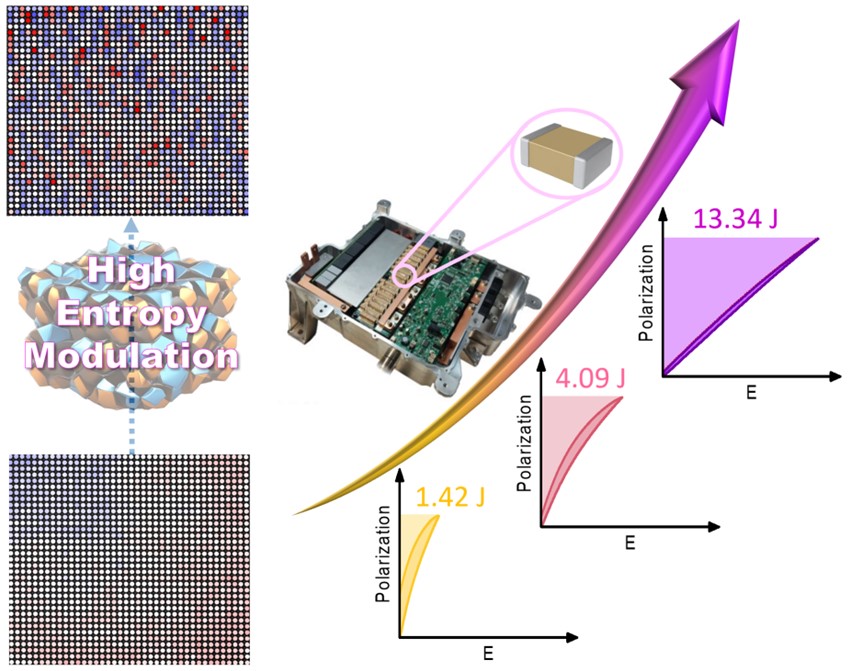
With the rapid evolution of the global electric vehicle (EV) industry towards the 800V high-voltage platform, key electronic components in automotive systems face stringent challenges. Dielectric capacitors, as core components for energy conversion, urgently need to achieve breakthroughs in energy storage density, charge/discharge efficiency, and cyclic stability. To address this critical national strategic need, Xi’an Jiaotong University (XJTU), Professor Haijun Wu’s group, in collaboration with Professor Haitao Huang’s group from The Hong Kong Polytechnic University, successfully developed a next-generation energy storage material system based on quantum paraelectric-ferroelectric/antiferroelectric solid solutions with high entropy modulation. Their findings were recently published in the renowned journal Nature Communications under the title "High Entropy Modulated Quantum Paraelectric Perovskite for Capacitive Energy Storage".
The research team employed an innovative “three-in-one” technological approach:
1. Entropy engineering: Modulating B-site element fluctuations to enhance the stability of high-field responses in perovskite structures.
2. Atomic-level microstructure design: Constructing nanostructured domain architectures to optimize polarization responses.
3. Electrical microstructure engineering: Reducing leakage current losses to improve energy conversion efficiency.
Through these strategies, the team successfully increased the energy storage density of NaNbO3-based dielectric capacitors to 13.3 J/cm3 (with efficiency >90%) and achieved breakthrough cyclic stability, with over one million cycles. The material’s comprehensive performance reached an internationally leading level. Reviewers highly praised the work, stating: “This work is of importance for further research and development in this field.”
This research, conducted with the combined efforts of top universities, is led by Xi’an Jiaotong University and The Hong Kong Polytechnic University, in collaboration with Northwestern Polytechnical University and Xi’an University of Electronic Science and Technology, and has attracted the support of industry partners, including The Shenzhen Institute of Advanced Technology, Chinese Academy of Sciences, accelerating the material’s industrial application in fields such as 800V high-voltage platforms for new energy vehicles and high-power pulse power devices.
The first authors of this work are Yongbo Fan, a postdoctoral researcher at The Hong Kong Polytechnic University (soon to join the School of Materials Science and Engineering, XJTU), and Wanbo Qu, a PhD student at Xi'an Jiaotong University. Professor Haijun Wu from the School of Materials Science and Engineering, XJTU, is the co-corresponding author. This research was supported by the XJTU Analytical & Testing Center in terms of electron microscopy microstructure characterization.
Paper link:https://doi.org/10.1038/s41467-025-59081-x
Author Biography:

Yongbo Fan: Postdoctoral researcher at The Hong Kong Polytechnic University, with a PhD from the University of Sheffield, Professor Ian Reaney’s group. He has published numerous papers in journals such as Nature Communications, Advanced Materials, Energy & Environmental Science, Advanced Functional Materials, and Applied Physics Letters. He has 6 highly cited papers in ESI, 3 authorized patents, and has received several prestigious awards, including the Henry Royce Scholarship and Hong Kong Innovation and Technology Postdoctoral Fellowship. He also serves as a young editor for Nano-Micro Letters and Journal of Advanced Dielectrics.
Haijun Wu: Professor and doctoral supervisor at Xi’an Jiaotong University, affiliated with the State Key Laboratory for Mechanical Behavior of Materials. He received his bachelor’s and master’s degrees from Xi’an Jiaotong University and his PhD from the National University of Singapore. He has been recognized in the National Youth Talent Program and Shaanxi Province’s “Sanqin Talents” program. As the principal investigator, he leads the Smart Sensors project funded by the National R&D Program and has hosted two NSFC general projects. He has received the Charles Hatchett Award and the Xiaomi Young Scholar Award. He is a board member of the Chinese Materials Research Society and serves as a young editor for several leading journals, including Journal of Advanced Dielectrics, Science China Materials, SusMat, and InfoMat. He has published over 100 papers, including in Science, Nature Communications (14 papers), Advanced Materials (20 papers), and Journal of the American Chemical Society (9 papers), with a total citation count of ~16,400 and an H-index of 69.


