Sodium-ion batteries have emerged as an important technology for energy storage and electric transportation, owing to the abundance of sodium resources, their low-cost potential, and promising safety characteristics. However, their relatively low energy density and the cost of hard-carbon anodes remain significant barriers to commercialization. To address the growing demand for higher energy density, anode-free sodium batteries eliminate the need for a pre-installed anode active material. Instead, sodium ions from the cathode are deposited directly onto the current collector during charging, reducing cell weight and volume while potentially increasing energy density and lowering costs. Their practical application, however, remains severely constrained by irreversible sodium loss during cycling, which leads to limited cycle life.
To address this challenge, a research team led by Professor Weijiang Xue at the Center for Advancing Materials Performance from the Nanoscale (CAMP-Nano), State Key Laboratory for Mechanical Behavior of Materials, School of Materials Science and Engineering, Xi’an Jiaotong University, has proposed an electrolyte molecular-design strategy based on the cyclic ether 1,3-dioxane (DOX), featuring ‘controlled interfacial polymerization’ (Fig. 1). By simultaneously promoting highly reversible sodium deposition and suppressing electrolyte decomposition, this strategy mitigates the loss of active sodium, enabling anode-free sodium batteries to achieve long cycle life and operate across a wide temperature range. Specifically, the weak coordination between DOX and Na⁺ facilitates Na⁺ desolvation and reversible sodium deposition, while controlled interfacial oligomerization of DOX produces a thin, stable solid-electrolyte interphase (SEI). This interphase not only suppresses continuous electrolyte decomposition but also stabilizes sodium plating and stripping. With a high cathode mass loading of approximately 20 mg cm⁻², 300 mAh pouch cells retained approximately 80% of their initial capacity after 1,400 cycles. Even at −40 °C, the cells maintained approximately 88% of their room-temperature capacity, demonstrating excellent low-temperature performance (Fig. 2). This work offers a new electrolyte-design approach for developing high-energy-density, long-life anode-free sodium batteries and opens up new possibilities for affordable, high-energy-density energy storage.

Fig. 1 | Molecular design strategy for DOX-based electrolytes through controlled interfacial polymerization.
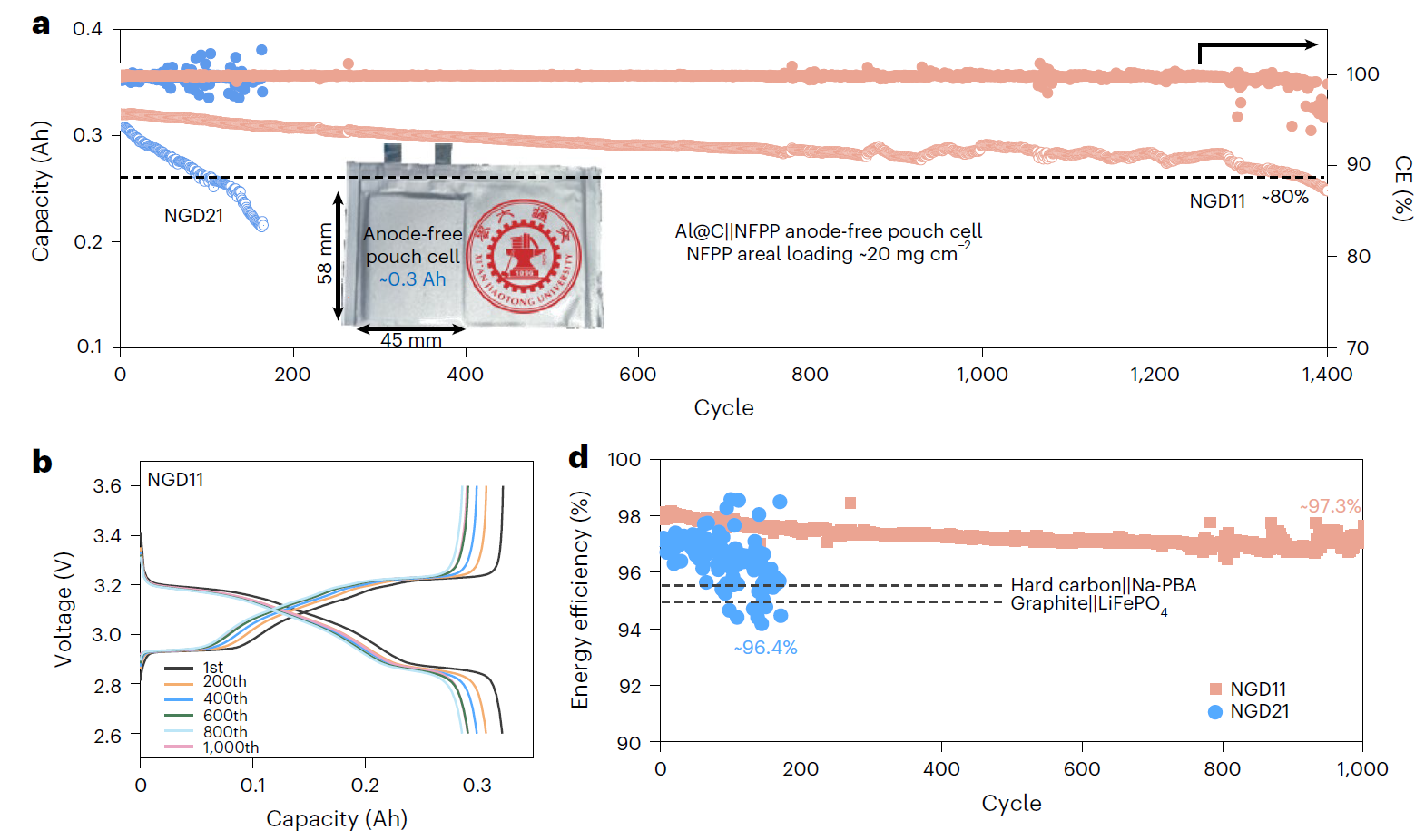
Fig. 2 | Electrochemical performance of anode-free sodium pouch cells enabled by the controlled interfacial polymerization electrolyte.
The study, entitled ‘Stable anode-free sodium batteries enabled by controlled oligomerization’, was published in the prestigious energy research journal Nature Energy. It was also highlighted in a News & Views commentary entitled ‘Directing solvent reactivity’, co-authored by Professor Yong-Mook Kang, a member of the Korean Academy of Science and Technology and a Fellow of the Royal Society of Chemistry. Shuicen Ding, Xijie Chen, and Zhen Yao from Professor Xue’s research group, together with Mengdi Hao from the Institute of Physics, Chinese Academy of Sciences, are co-first authors of the paper. Research Professor Yong-Sheng Hu of the Institute of Physics, Chinese Academy of Sciences, and Professor Weijiang Xue are co-corresponding authors. The research received support from the National Natural Science Foundation of China; the Center for Advancing Materials Performance from the Nanoscale, the Instrumental Analysis Center, and the National Innovation Platform (Center) for Industry-Education Integration of Energy Storage Technology at Xi’an Jiaotong University; the State Key Laboratory of New Ceramic Materials at Tsinghua University; Jingdezhen Ceramic University; the Shanghai Synchrotron Radiation Facility; Shanghai Jiao Tong University; and the Qingdao Institute of Bioenergy and Bioprocess Technology, Chinese Academy of Sciences.
Since joining Xi’an Jiaotong University in 2022, Professor Weijiang Xue has developed a series of innovative molecular-design strategies for electrolytes and applied them in sodium-ion batteries (Adv. Mater., 2025, 37, 12, 2415611; Nat. Commun., 2026, 17, 4378; Adv. Mater., 2025, e19965), high-energy-density lithium-metal batteries (Adv. Mater., 2025, 38, e12236; Angew. Chem. Int. Ed., 2025, 64, e11223), and high-energy-density lithium-ion batteries with silicon–carbon anodes (Adv. Mater., 2025, 38, e15562).
Research article:
https://www.nature.com/articles/s41560-026-02154-y
News & Views commentary:
https://www.nature.com/articles/s41560-026-02150-2
Professor Weijiang Xue’s homepage:
https://gr.xjtu.edu.cn/en/web/xueweijiang


