Research Background
Thermoelectric materials enable direct mutual conversion between thermal energy and electric energy, holding promising application prospects in fields such as industrial waste-heat recovery, deep-space power generation, chip thermal management, optical-communication temperature control, biomedicine and solid-state refrigeration. As a solid-state energy-conversion technology featuring no moving components, high reliability and long service lifetime, thermoelectrics deliver vital solutions for sustainable energy utilization and precise thermal management.
The conversion efficiency of thermoelectric materials is governed by the dimensionless thermoelectric figure-of-merit zT = S²σT/κ, where S denotes the Seebeck coefficient, σ the electrical conductivity, and κ the total thermal conductivity. Ideal thermoelectric materials are expected to possess both a high power factor (PF = S²σ) and low thermal conductivity. Nevertheless, thermoelectric transport parameters exhibit strong mutual coupling: raising carrier concentration generally degrades the Seebeck coefficient; meanwhile, introducing defects to suppress lattice thermal conductivity (κL) frequently amplifies carrier scattering and reduces carrier mobility (μ). Accordingly, how to effectively scatter phonons while preserving or even enhancing electronic transport remains a long-standing core scientific challenge for thermoelectric research.
Over past decades, defect engineering has stood as one of the most powerful strategies to boost thermoelectric performance. Researchers have introduced multi-scale defects including substitutional atoms, vacancies, interstitial atoms, antisite defects, dislocations, nanoprecipitates and grain boundaries to substantially strengthen phonon scattering and lower κL, yielding prominent zT enhancement in multiple benchmark thermoelectric systems. Conventional defect engineering, however, is dominated by the philosophy of “increasing disorder”. Though randomly distributed defects scatter phonons, they concurrently disrupt the periodic lattice potential and aggravate alloy scattering, ionized-impurity scattering and local strain-field scattering, thereby deteriorating carrier mobility. As the lattice thermal conductivity of many higherformance thermoelectrics approaches its theoretical lower bound, performance gains from simply pursuing greater disorder are diminishing, whereas its adverse impact on electronic transport becomes increasingly severe.
Against this backdrop, a critical scientific question arises: must defects in thermoelectric materials exist solely in a random, disordered fashion? Can we tailor the spatial arrangement of defects to transform them from indiscriminate scattering centers into selective functional structural units? If randomly dispersed point defects can be manipulated into ordered or quasi-ordered configurations, it is feasible to achieve targeted scattering of heat-carrying phonons while maintaining relatively continuous electronic transport channels, so as to break the κL-μ coupling bottleneck. This paradigm shift from “disorder fabrication” toward “order design” represents a vital direction for developing next-generation high-performance thermoelectric materials.
Article Brief Introduction
The research team led by Academician Jun Sun, Professor Xiangdong Ding and Professor Haijun Wu from the State Key Laboratory for Mechanical Behavior of Materials and School of Materials Science and Engineering, Xi’an Jiaotong University, has published a review article entitled Point Defect Engineering Thermoelectrics: From Disorder to Order in the international materials journal Advanced Materials. This review systematically traces the development history of point-defect engineering for thermoelectrics, and proposes a design principle: manipulating crystal defects from random distributions toward ordered configurations to circumvent the transport coupling bottleneck in thermoelectrics.
The review highlights that conventional thermoelectric defect engineering mainly enhances phonon scattering by elevating the concentration of random defects, yet such “disorder-centered” design inevitably sacrifices carrier mobility. By contrast, ordered-defect design emphasizes the spatial arrangement of defects. When defects of identical type and comparable concentration evolve from random dispersion into ordered or quasi-ordered architectures, their interactions with phonons and electrons undergo fundamental changes. On one hand, ordered defect structures introduce new periodicity or quasi-periodicity, reconstruct phonon dispersion relations, reduce phonon group velocities, and effectively scatter mid-frequency phonons that are hardly affected by conventional random point defects. On the other hand, ordered configurations partially restore the periodic potential perceived by charge carriers, reviving Bloch-like transport and mitigating the degradation of electron mobility.
Centered on this core concept, the review systematically summarizes ordering pathways for major families of point defects: substitutional atoms, vacancies, interstitial atoms and antisite defects. For substitutional-defect systems, isosize alloying and symmetry enhancement suppress κL with limited damage to μ. For vacancy-containing systems, random vacancies can evolve into vacancy layers and vacancy-induced dislocation networks; alternatively, oriented filling gives rise to lattice planarization, restoring lattice periodicity and improving carrier transport. For interstitial-atom systems, excess small-radius atoms form ordered interstitial chains, clusters and glide dislocations, enabling synergistic modulation of carrier concentration, effective mass and phonon scattering. In antisite-defect systems, antisite atoms serve as structural precursors of extended defects and trigger the formation of stacking faults and dislocation networks.
Furthermore, this review extends the “disorder-toorder” point-defect design philosophy to mechanical-reliability modulation of thermoelectrics. Ordered point-defect architectures not only optimize electrical and thermal transport, but also act as strengthening motifs to improve mechanical strength and service stability. For instance, ordered interstitial atoms at twin boundaries and vacancy-derived dislocation networks can pin dislocations, impede crack propagation and sustain largely continuous carrier-transport pathways, while scattering phonons simultaneously. This signifies that defects are no longer merely thermal-conductivity-reducing scattering centers, but multi-physical functional building blocks bridging electrical, thermal and mechanical properties.
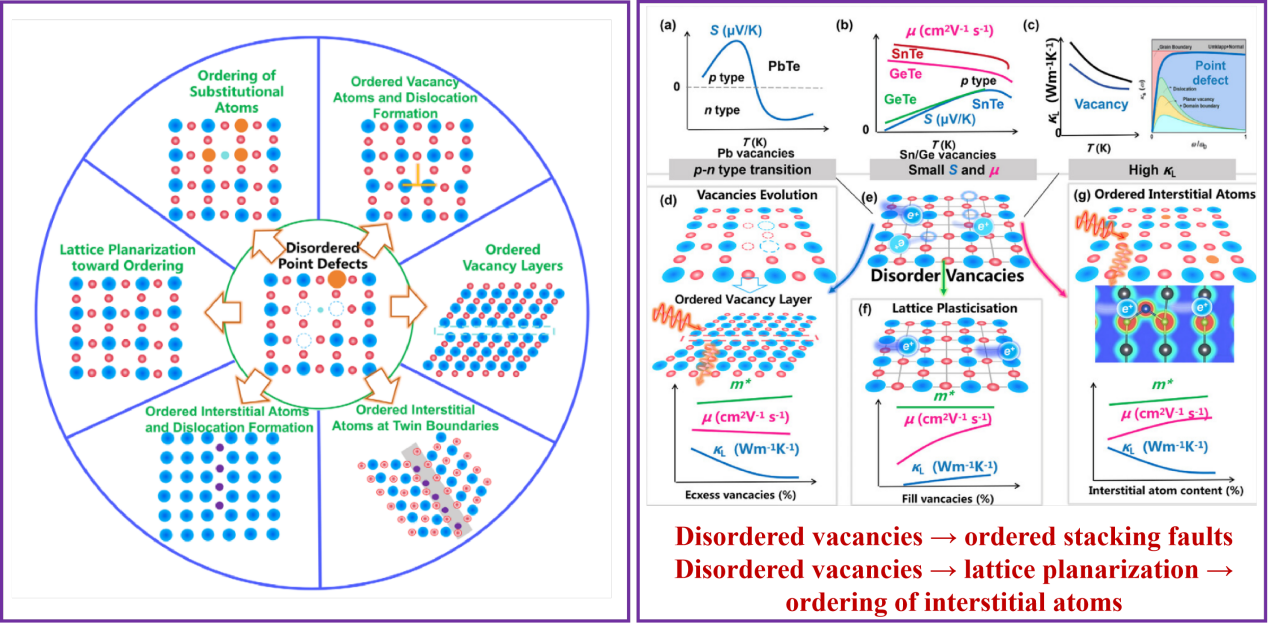
Figure 1 Schematic framework for point-defect engineering from disorder to order. Traditional point-defect engineering relies heavily on random defects for phonon scattering, which tends to impair electronic transport. In comparison, ordered point-defect structures tailor spatial defect distributions, driving substitutional atoms, vacancies, interstitial atoms and antisite defects into ordered or quasi-ordered functional units to realize selective modulation of electron transport, phonon transport and mechanical behaviors.
Key Innovations
1. Proposal of a unified “disorder-to-order” framework for point-defect engineering
This review integrates substitutional atoms, vacancies, interstitial atoms and antisite defects in thermoelectrics within a unified disorder-to-order evolutionary framework. It explicitly states that performance improvement should not rely purely on introducing more defects or amplifying random disorder; instead, modulating the spatial configuration of defects is of primary importance. Conventional point-defect engineering utilizes random defects for phonon scattering, which is commonly accompanied by reduced carrier mobility. By comparison, ordered or quasi-ordered defect architectures scatter heat-dominant phonons more efficiently while preserving relatively continuous electronic transport pathways. This viewpoint redefines point defects from passive “structural perturbations” to designable, tunable and functionalized structural units, offering new physical insights for overcoming the coupling bottleneck between lattice thermal conductivity and carrier mobility.
2. Systematic summary of ordering pathways for diverse point defects and identification of cross-system general mechanisms
Focusing on representative point-defect categories including substitutional, vacancy, interstitial and antisite defects, this review elaborates multiple feasible routes transforming random disorder into ordered structures. In substitutional-defect systems, isosize alloying and symmetry enhancement lower lattice thermal conductivity with mitigated mobility degradation. In vacancy systems, stochastic vacancies can develop into vacancy layers and vacancy-triggered dislocation networks; oriented filling achieves lattice planarization to recover lattice periodicity and boost carrier transport. In interstitial-atom systems, small-radius atoms assemble into ordered interstitial chains, clusters and glide dislocations, realizing coordinated tuning of carrier concentration, effective mass and phonon scattering. For antisite-defect systems, antisite atoms act as precursors for extended defects and stimulate stacking-fault and dislocation-network formation. These examples demonstrate that defect ordering is not restricted to individual material systems but constitutes a universal design rule for thermoelectric materials.
3. Extension of defect engineering from electro-thermal transport optimization toward multi-dimensional electro-thermo-mechanical collaborative design
The review further points out that next-generation thermoelectric materials demand not only high zT and large power output, but also superior mechanical strength, processing stability and service reliability. Ordered point-defect configurations can modulate electron and phonon transport and function as mechanical strengtheners to enhance material strength and durability. For example, ordered interstitial atoms at twin boundaries and vacancy-induced dislocation networks pin dislocations, retard crack extension and maintain fairly continuous carrier-transport paths alongside phonon scattering. Consequently, point-defect engineering is no longer confined as a tool to reduce thermal conductivity; it evolves into a critical structural platform correlating thermoelectric performance and mechanical reliability, opening new avenues for designing high-performance, tough and serviceable thermoelectric materials.
Acknowledgements & Author Information
State Key Laboratory for Mechanical Behavior of Materials, Xi’an Jiaotong University serves as the primary affiliation. Yang Zhang and Yuxuan Yang contributed equally as co-first authors. Professor Haijun Wu and Dr. Yihua Zhang are the co-corresponding authors. The authors appreciate the support from the Instrumental Analysis Center of Xi’an Jiaotong University.
Article DOI: https://doi.org/10.1002/adma.202520643
Group homepage of Prof. Haijun Wu: https://www.x-mol.com/groups/Wu_Haijun


