State Key Laboratory for Mechanical Behavior of Materials, School of Materials Science and Engineering, Xi’an Jiaotong University
Research Background
Practical deployment of high-performance thermoelectric materials relies not only on superior energy-conversion efficiency but also heavily on mechanical reliability during processing, assembly, welding, and thermal-cycling service conditions. For heavy chalcogenide thermoelectrics such as SnTe, PbTe, GeTe and Bi2Te3, hypervalent bonding endows these materials with excellent electronic-transport properties and intrinsic low lattice thermal conductivity. Nevertheless, it also brings about drawbacks including soft lattice, poor shear resistance and pronounced brittleness. Although conventional alloying and nanostructuring strategies can effectively reduce lattice thermal conductivity, they frequently introduce extra random disorder, interfacial defects and localized stress concentration, rendering materials susceptible to cracking or failure during device fabrication and service.
Accordingly, simultaneously enhancing mechanical strength and service stability while preserving outstanding thermoelectric performance constitutes a critical bottleneck that must be resolved for real-world applications of SnTe-based and other hypervalent-bond thermoelectric materials. In recent years, high- and medium-entropy design has offered new opportunities to address this challenge. Configurational entropy stabilizes complex solid-solution phases; differences in atomic size, valence state and solubility among constituent elements can guide the ordered evolution of multi-scale defect structures, which holds the potential to break the conventional trade-off between high performance and low mechanical reliability.Nevertheless, high entropy is not equivalent to simply increasing elemental species or generating random disorder. Rational entropy engineering must answer three core questions: which elements to introduce, in what sequence they are incorporated, and what final defect configurations are formed. Only by combining entropy-stabilization effects with intrinsic chemical features of alloying elements can one realize synchronous modulation of electronic transport, phonon scattering and mechanical-strengthening mechanisms.
Article Brief Introduction
The research team led by Academician Jun Sun, Professor Xiangdong Ding and Professor Haijun Wu from the State Key Laboratory for Mechanical Behavior of Materials and School of Materials Science and Engineering, Xi’an Jiaotong University, has published a research article titled Entropy-Enabled Hierarchical Defect Architecture for Dual Enhancement of Thermoelectric and Mechanical Performance in SnTe Alloys in Advanced Materials. Taking SnTe-based thermoelectrics as a model system, this work proposes an “entropy-driven hierarchical-defect-architecture” design strategy to achieve simultaneous improvement of thermoelectric and mechanical properties.
Rather than blindly pursuing high compositional complexity, this study utilizes configurational entropy as a thermodynamic platform for stabilizing complex single-phase solid solutions. Differences in atomic size, valence state and solubility of GeSe, Sb, Cd and other alloying elements are exploited to drive stepwise evolution of defect structures. First, GeSe alloying introduces intense local lattice distortion and zero-dimensional (0D) substitutional atomic clusters within the SnTe matrix, strengthening high-frequency phonon scattering. Second, despite similar atomic radius and mass to Sn, isovalent-heterovalent substitution by Sb triggers localized stress fields and defect rearrangement, facilitating the formation of one-dimensional (1D) dislocation arrays near grain boundaries. Further Cd addition, limited by its low solid solubility, gives rise to three-dimensional (3D) coherent (Cd,Ge)Se nanoprecipitates upon cooling. Consequently, a hierarchical defect architecture spanning atomic-scale local distortion, substitutional atomic clusters, dislocation arrays and coherent nanoprecipitates is constructed inside the material.
Such hierarchical defect architecture exerts multi-faceted influences on thermal transport, electronic transport and mechanical responses. Zero-dimensional point defects and substitutional clusters predominantly scatter high-frequency phonons; one-dimensional dislocation arrays effectively damp mid-frequency phonons and contribute to strain hardening; three-dimensional coherent nanoprecipitates further suppress phonon transport while pinning dislocations and inhibiting dislocation slip. Meanwhile, coherent interfaces maintain favorable lattice continuity and mitigate severe carrier scattering at interfaces. Benefiting from this multi-scale synergy, the optimized composition Sn0.91Cd0.03Sb0.09Te(GeSe)0.25 achieves an ultra-low lattice thermal conductivity of 0.26 W·m-1·K-1and a peak zT of 1.7 at 873 K.More importantly, mechanical strength is substantially boosted without sacrificing thermoelectric performance. The optimized sample delivers a compressive yield strength of 220 MPa, representing ~83 % enhancement compared with pristine SnTe (120 MPa), while maintaining reasonable ductility. In-situ TEM micropillar-compression experiments further demonstrate superior deformation resistance and pronounced dislocation-precipitate interactions at nanoscale for Cd-doped specimens. The results confirm that coherent nanoprecipitates and dislocation networks collaboratively enable load transfer, dislocation pinning and crack suppression. For device validation, single-leg thermoelectric devices fabricated from the optimized SnTe material attain a conversion efficiency of ~7.2 % and an output power of ~30 mW under a temperature difference ΔT=550 K
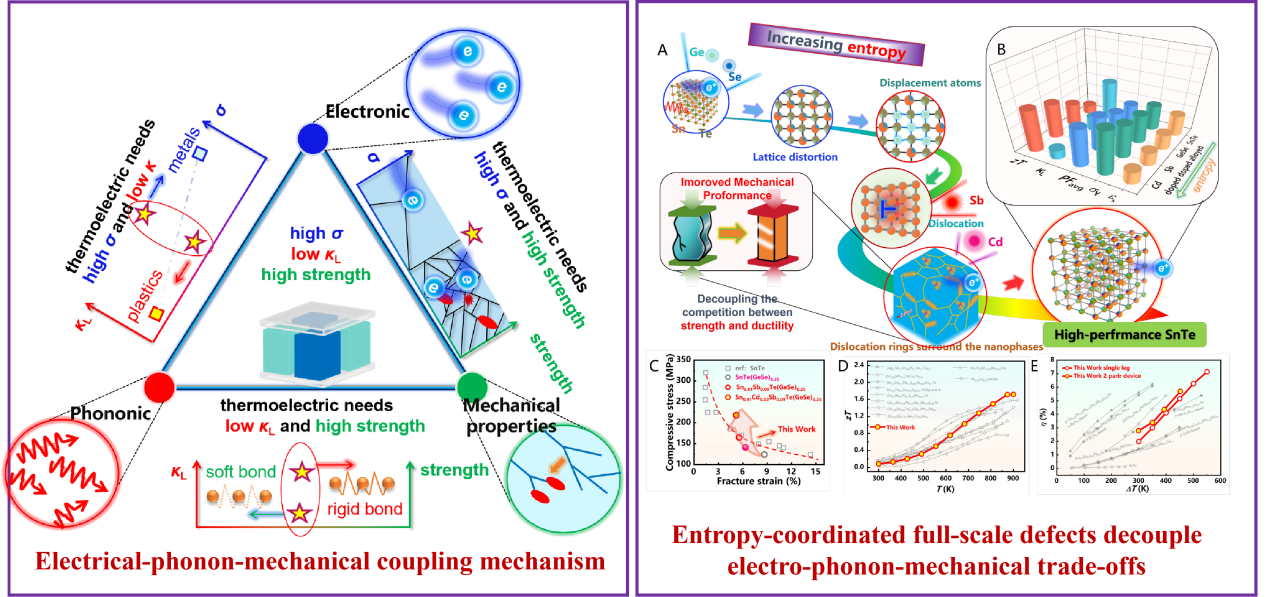
Figure 1. Synergistic improvement of thermoelectric and mechanical performance in SnTe via entropy-driven hierarchical defect architecture. Stepwise incorporation of Ge/Se, Sb and Cd drives sequential evolution of defect motifs within the SnTe matrix: 0D substitutional atomic clusters, 1D dislocation arrays and 3D coherent nanoprecipitates. This hierarchical structure scatters phonons across multiple frequency ranges. Meanwhile, dislocation pinning, load transfer and precipitation strengthening improve mechanical properties. Ultimately, the unified realization of low lattice thermal conductivity, high zT, high device efficiency and elevated yield strength is accomplished.
Key Innovation-
1. Proposal of “entropy-driven hierarchical-defect-architecture” strategy: from random alloying toward targeted defect construction
This work clarifies that the core of entropy engineering does not lie in simply adding more elements or raising compositional complexity. Instead, configurational entropy serves as a thermodynamic foundation to stabilize complex single-phase solid solutions. Differences in size effect, valence mismatch and solubility limits among alloying elements are harnessed to guide stepwise formation of designated defect structures. The authors construct a hierarchical defect assembly composed of 0D substitutional atomic clusters, 1D dislocation arrays and 3D coherent nanoprecipitates in SnTe, accomplishing the paradigm shift from “random disordered alloying” to “rational targeted defect-architecture design”. This strategy provides clearer physical insights for high-entropy thermoelectric design: high entropy is not the end goal, but a tool for stabilizing complex matrices and steering defect evolution.
2. Establishment of multi-scale synergistic mechanisms linking electronic transport, phonon scattering and mechanical strengthening
Conventional thermoelectric optimization mainly focuses on reducing lattice thermal conductivity, yet insufficient attention is paid to preserving carrier mobility and mechanical reliability. The hierarchical-defect architecture realizes multi-functional synergy: substitutional atomic clusters amplify local stress fluctuations and scatter high-frequency phonons; dislocation arrays suppress mid-frequency phonons and produce strain hardening; coherent (Cd,Ge)Se nanoprecipitates further attenuate phonon transport and enhance mechanical strength through dislocation pinning and load transfer. Critically, coherent interfaces preserve lattice continuity and avoid severe carrier scattering, enabling a favorable balance among low lattice thermal conductivity, high power factor and superior mechanical strength. This mechanism overcomes the long-standing limitation in traditional defect engineering, wherein intensified phonon scattering is usually accompanied by degraded electronic transport and poor mechanical robustness.
3. Simultaneous achievement of high thermoelectric performance, high device efficiency and large mechanical strength for SnTe�based materials
The optimized Sn0.91Cd0.03Sb0.09Te(GeSe)0.25 exhibits an ultra-low lattice thermal conductivity of 0.26 W·m-1·K-1, a peak zT of 1.7 and an average zT of 0.73. Its compressive yield strength reaches 220 MPa (~83 % improvement relative to pristine SnTe). At the device level, single-leg and multi-leg devices achieve conversion efficiencies of ~7.2 % and ~5.7 %, respectively. These results demonstrate that thermoelectric material optimization should not be limited to the single metric of zT; thermoelectric conversion capability, mechanical robustness and device stability must be considered simultaneously for practical applications. This work offers a transferable route for synergistically optimizing strength�toughness and energy-conversion performance for hypervalent-bond thermoelectrics as well as other brittle functional materials.
Author Information & Acknowledgements
State Key Laboratory for Mechanical Behavior of Materials, Xi’an Jiaotong University is the primary affiliation. Yihua Zhang, Guyang Peng and Yang Zhang are co-first authors. Professor Haijun Wu, Academician Jun Sun and Professor Xiangdong Ding act as co-corresponding authors. The authors acknowledge the support from the Instrumental Analysis Center of Xi’an Jiaotong University.
Article DOI: https://doi.org/10.1002/adma.73653
Group homepage of Prof. Haijun Wu: https://www.x-mol.com/groups/Wu_Haijun


