Overview
Combining a large response amplitude with high-frequency operation is a central requirement for piezoelectric materials used in ultrasonic transduction, precision actuation, microelectromechanical systems (MEMS), and related applications. Achieving both simultaneously, however, has remained a long-standing scientific challenge. Recently, Professor Haijun Wu’s group, part of the research team led by Academician Jun Sun and Professor Xiangdong Ding at the State Key Laboratory for Mechanical Behavior of Materials and the School of Materials Science and Engineering, Xi’an Jiaotong University, collaborated with Professor Jing-Feng Li’s team at Tsinghua University on a study published in *Science* entitled “Ultrahigh piezoelectricity by polaron-defect complexes.”In silver-niobate-based AKN thin films, the collaborative team engineered a dynamically reconfigurable point-defect architecture built from polaron-defect (PD) complexes, establishing the PD-AKN material system. Under DC-bias activation, PD-AKN achieved a field-induced effective piezoelectric coefficient of 7170 pm V⁻¹ and a maximum field-induced strain of 6.2% at 1 kHz. Even when the frequency was increased to 10 kHz, the field-induced effective piezoelectric coefficient remained 1090 pm V⁻¹, demonstrating an outstanding kilohertz-rate electromechanical response.
A Central Challenge: Reconciling Piezoelectric Response Magnitude and Speed
Piezoelectric response depends not only on how much polarization and lattice deformation an electric field can induce, but also on whether these changes can keep pace with the applied field. Intrinsic electric dipoles exhibit fast response dynamics, but under moderate electric fields, the amplitudes of reversible polarization modulation and lattice displacement are typically limited. Ionic defects can redistribute over multiple unit cells to generate large defect polarization and lattice deformation, but their relatively high migration barriers cause the response to decay markedly as the operating frequency increases. These two mechanisms therefore create a pronounced trade-off between response magnitude and operating frequency: “fast but small” versus “large but slow.”
The central design principle of PD-AKN is to use rapidly hopping small electron polarons—localized electronic states coupled to local lattice distortions—to drive changes in defect polarization. This combines large defect polarization with fast electronic dynamics, producing a large-amplitude, high-speed field-induced electromechanical response. Unlike the long-range migration of ionic defects, this electronically mediated local reconfiguration offers faster dynamics while retaining a strong ability to modulate the lattice, providing a new design paradigm for reconciling response magnitude with operating frequency.
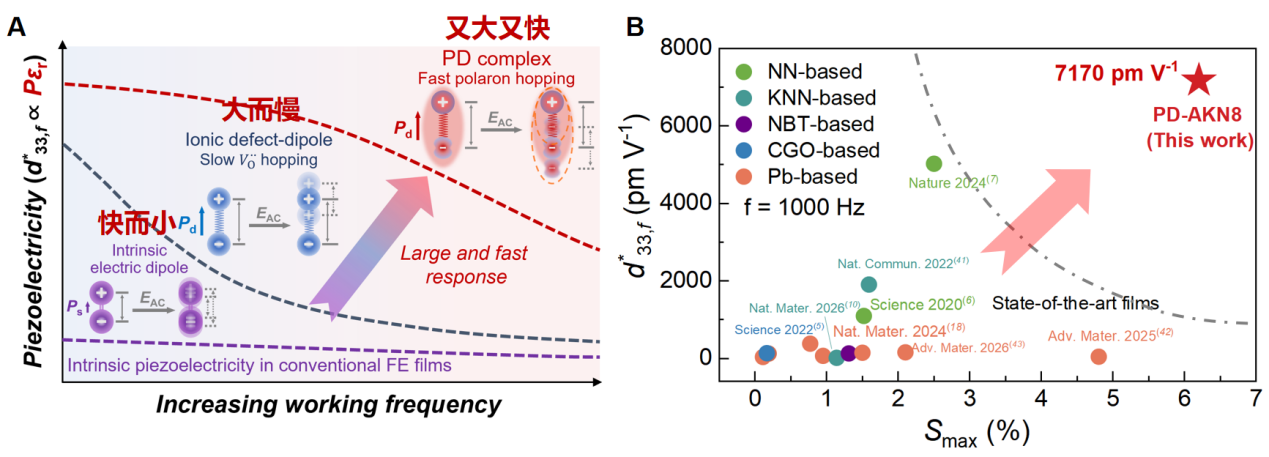
Figure 1 | Design concept and kilohertz-rate performance of PD-AKN. Intrinsic electric dipoles respond rapidly but offer limited tunable deformation, whereas ionic defect dipoles can generate large polarization and deformation but are constrained by slow migration. Rapid hopping of small electron polarons drives PD-complex reconfiguration, enabling PD-AKN to combine a pronounced field-induced response with kilohertz-rate operation.
Atomic-Scale Structural Basis of Polaron-Defect Complexes
Atomic-resolution scanning transmission electron microscopy revealed a high density of Nb-antisite defect units in PD-AKN, with local compositional fluctuations accompanying the formation and clustering of these defects. Multi-angle imaging and defocus-series observations further showed that spatially extended defect units form a dense, interconnected three-dimensional network throughout the film, providing a structural host for a high density of PD complexes.
Local strain analysis revealed pronounced lattice expansion and contraction around the antisite defects. Atomic-resolution electron energy-loss spectroscopy further revealed a reduction in the Nb valence state near the defects, consistent with the formation of small electron polarons. The electronic-state perturbation and lattice distortion decayed over comparable nanoscale distances. Together with spectroscopic characterization and theoretical calculations, these observations revealed coupled electrostatic and elastic interactions among the relatively immobile antisite defects, small electron polarons, and their accompanying lattice distortions.
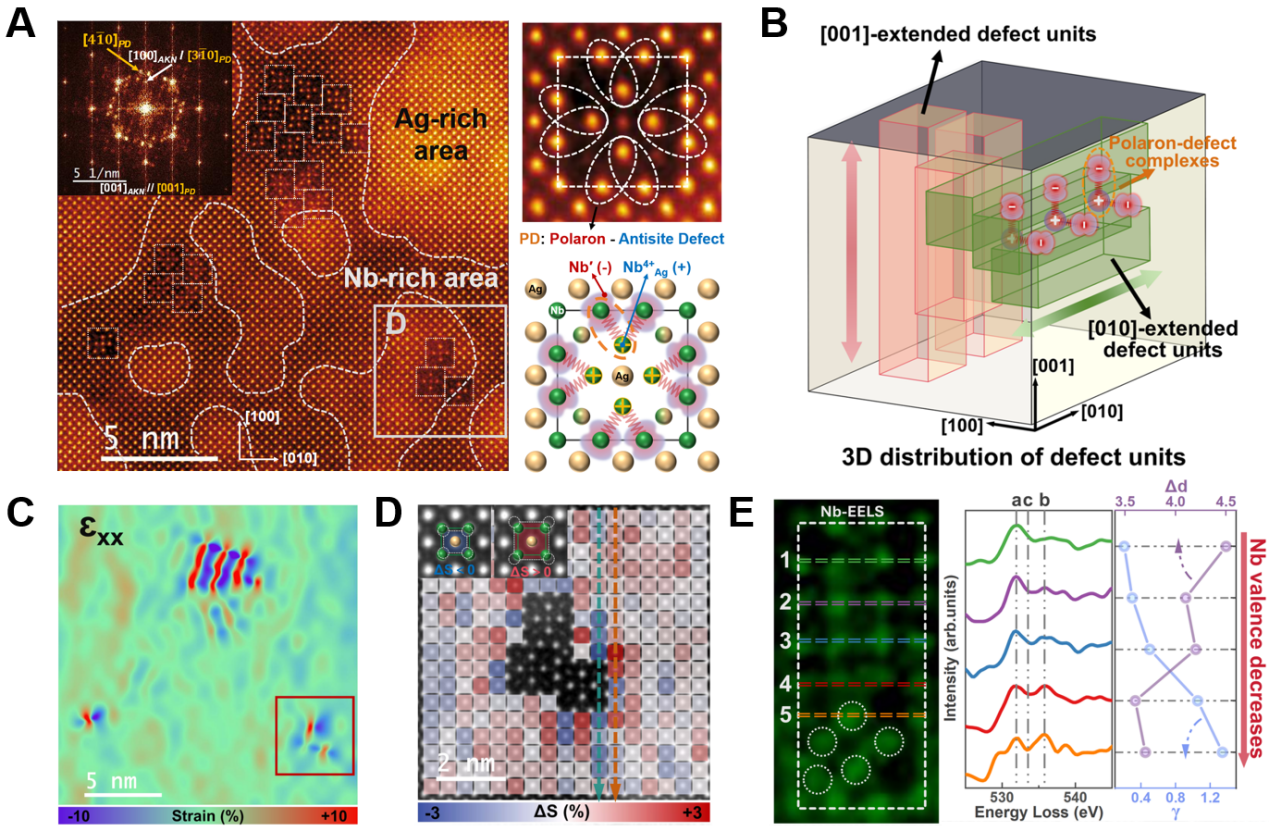
Figure 2 | Atomic-scale structural evidence for polaron-defect complexes in PD-AKN. Atomic-scale imaging reveals Nb-antisite defect units and their clustered morphologies. Multi-angle and defocus-series imaging captures their spatial extension and interconnected three-dimensional network, while local lattice distortions and changes in Nb valence near the defects further reveal coupling between charge localization and lattice distortion.
Electric-Field-Driven Reconfiguration of Polaron-Defect Complexes
In the absence of an applied field, the PD complexes are nearly randomly oriented, and their local polarizations largely cancel at the macroscopic scale. When a DC electric field is applied, polarons undergo directed hopping between neighboring lattice sites, reconfiguring the PD complexes. This process generates large defect polarization and enhances the anisotropy of local distortions near the defects. When an AC field is superimposed, the polarons rapidly hop back and forth, allowing a large polarization modulation to persist at frequencies of several kilohertz. Electrostrictive coupling then converts this polarization modulation into macroscopic strain.
As the DC bias increased, both the background and localized hotspots in the second-harmonic generation (SHG) signal intensified. Polarization-resolved SHG analysis showed that the PD complexes underwent a two-stage evolution consisting of alignment followed by extension. Operando 4D-STEM directly recorded progressively enhanced out-of-plane lattice expansion in defect-rich regions. SHG and operando 4D-STEM thus tracked the electric-field-induced evolution of the PD complexes at the levels of mesoscale polarization states and nanoscale lattice structure, respectively. Their ability to respond at kilohertz frequencies is governed by the hopping kinetics of small electron polarons.
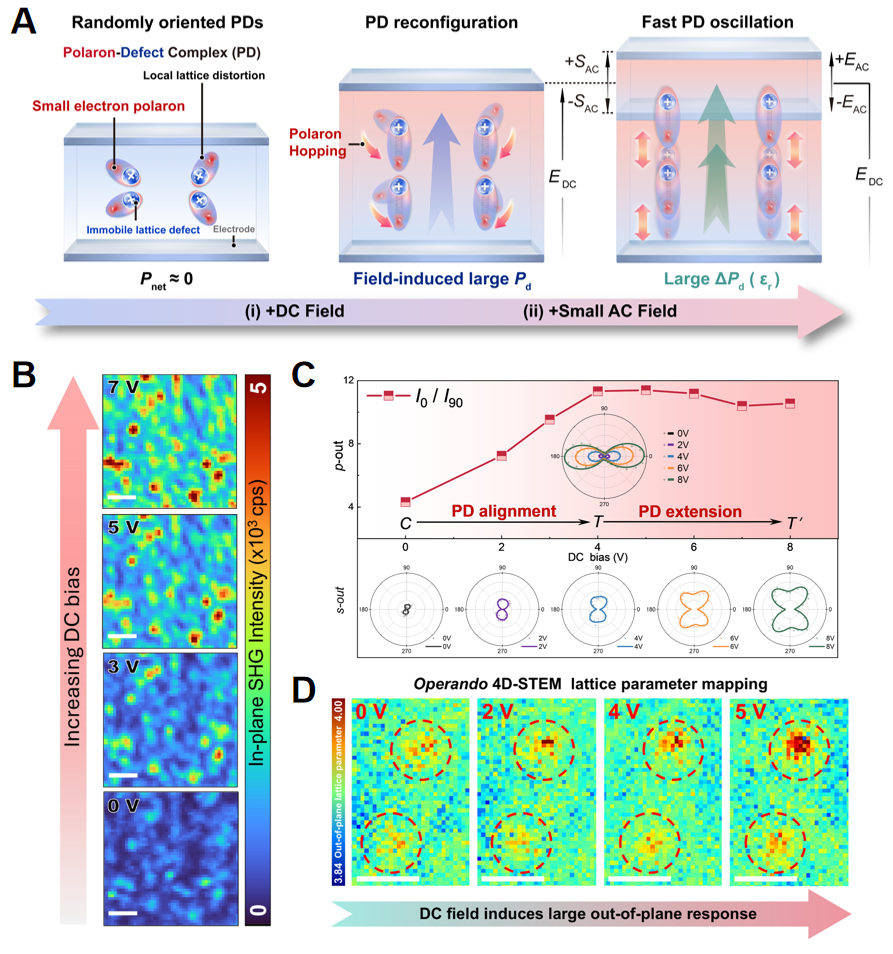
Figure 3 | Electric-field-driven dynamic reconfiguration of PD complexes. A DC bias drives the PD complexes from a random state through alignment and then extension. When a small AC field is superimposed, small polarons hop back and forth near the defect centers. SHG and operando 4D-STEM respectively track the evolution of polarization-related states and the out-of-plane lattice expansion of defect-rich regions.
Small Electron Polaron Dynamics Underpin the Ultrahigh Kilohertz Response
Electrical transport measurements, broadband dielectric spectroscopy, and frequency-dependent relaxation analysis yielded an effective activation energy of approximately 0.41 eV and a room-temperature relaxation time of 0.4–0.8 ms. These values fall within the characteristic range of small electron polaron hopping. Compared with typical oxygen-vacancy migration processes, the lower effective barrier and shorter relaxation time provide the kinetic basis for the kilohertz response of PD-AKN.
Building on this kinetic foundation, PD-AKN achieved a field-induced effective piezoelectric coefficient of 7170 pm V⁻¹ and a maximum field-induced strain of 6.2% at 1 kHz. At 5 and 10 kHz, the field-induced effective piezoelectric coefficient remained 2080 and 1090 pm V⁻¹, respectively. Cycling tests further showed that, after more than 40 million cycles at 10 kHz, PD-AKN exhibited no discernible time-dependent drift.
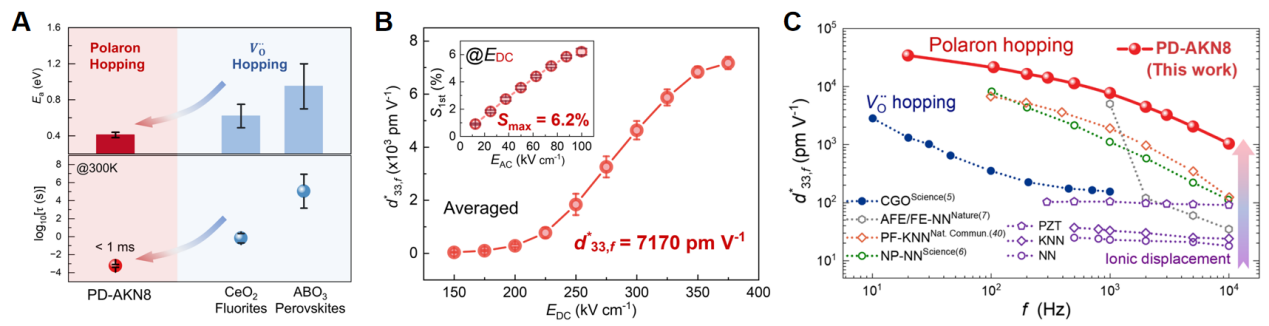
Figure 4 | Small electron polaron dynamics and the kilohertz electromechanical response of PD-AKN. An effective activation energy of approximately 0.41 eV and a submillisecond relaxation time reflect the kinetic advantage of small electron polarons. At 1 kHz, PD-AKN achieves a field-induced effective piezoelectric coefficient of 7170 pm V⁻¹ and a maximum field-induced strain of 6.2%; at 10 kHz, the coefficient remains 1090 pm V⁻¹.
Broader Applicability and Significance
The research team also obtained a similar kilohertz electromechanical response in centrosymmetric, non-perovskite Nb-doped TiO2-x thin films. This result shows that the PD-complex design can operate across different host lattices and does not rely on conventional ferroelectric spontaneous polarization. It further broadens the design space for high-performance electromechanical materials through cooperative interactions among localized polarons, defects, and the lattice, while offering a new avenue for exploring bulk and ceramic material forms.
The ultrahigh kilohertz response of PD-AKN demonstrates that electronic states, lattice distortions, and response dynamics can be co-designed within a single material. Charged defects spatially anchor small electron polarons, while an external field controls their dynamic reconfiguration; lattice coupling then converts local charge redistribution into macroscopic strain. This polaron-driven, charge-lattice-coupled response provides a new physical basis and materials-design pathway for creating electromechanical materials that combine large deformation with fast dynamics beyond conventional ferroelectric mechanisms.
Authors
The State Key Laboratory for Mechanical Behavior of Materials at Xi’an Jiaotong University is the primary corresponding institution for the paper. Dr. Liang Shu of Tsinghua University and doctoral student Guyang Peng of Xi’an Jiaotong University are co-first authors. Professor Haijun Wu of Xi’an Jiaotong University, Associate Professor Qian Li of Tsinghua University, Professor Kun Xu of the University of Science and Technology Beijing, and Professor Jing-Feng Li of Tsinghua University are co-corresponding authors. Academician Jun Sun and Professor Xiangdong Ding of Xi’an Jiaotong University are coauthors. The authors acknowledge support from the Instrumental Analysis Center of Xi’an Jiaotong University.
Paper link:
https://www.science.org/doi/10.1126/science.aeg4972
Professor Haijun Wu’s group website:
https://www.x-mol.com/groups/Wu_Haijun


