Event vision is highly effective at detecting changes in dynamic scenes, yet it remains challenging to simultaneously encode the magnitude of those changes. Researchers at the State Key Laboratory for Mechanical Behavior of Materials at Xi’an Jiaotong University have addressed this limitation by introducing information-weighting capability directly into the intrinsic photoresponse of organic mixed ionic–electronic conductor (OMIEC) materials through molecular and device design.
The team developed an amplitude-programmable event-driven organic photosensor that integrates event detection, amplitude modulation, and information weighting within a single active layer. This design enables the photosensitive material to evolve from a passive carrier of sensing signals into an active functional unit for information processing, providing a new materials-based route toward efficient and adaptive neuromorphic vision systems. The work has been published in Nature Materials.
The paper, entitled “Amplitude-controllable event-driven organic photosensors based on ionic-mediated inhibition,” was co-first-authored by Chao Zhao and Xudong Su from the State Key Laboratory for Mechanical Behavior of Materials at Xi’an Jiaotong University and Xi Chen from Southern University of Science and Technology. Wei Ma, Qunping Fan, and Zhongrui Wang are the co-corresponding authors. Xi’an Jiaotong University is the primary affiliation of the first authors and the affiliation of the first corresponding author. Researchers from Northwestern Polytechnical University and Xi’an Jiaotong University Health Science Center also contributed to the study. The work was supported by the National Natural Science Foundation of China, the National Key Research and Development Program of China, the Shaanxi Province Youth Talent Support Program, the 111 Project, and other funding programs.
Paper link: https://www.nature.com/articles/s41563-026-02747-8
The rapid development of artificial intelligence, robotics, and intelligent vision technologies has created growing demand for efficient information processing in complex and dynamic environments. Conventional frame-based image sensors capture complete images at fixed time intervals. Even when most regions of a scene remain unchanged, they continue to generate and transmit large volumes of redundant data.
Event cameras reduce this redundancy by generating signals only when changes in illumination occur. However, conventional event cameras generally encode these changes as binary “ON/OFF” events, meaning that the amplitude of an individual event does not directly represent the magnitude of the illumination change. When spike-frequency coding is used instead, signal intensity must be represented by the number of spikes generated within a given time window, introducing additional energy costs associated with event generation, transmission, and processing. Moreover, intelligent visual systems often need to dynamically adjust the response weights of different spatial regions according to task requirements, enhancing task-relevant information while suppressing irrelevant stimuli.
At present, implementing these functions typically requires complex pixel architectures and peripheral circuitry. A fundamental limitation is that conventional semiconductor photosensitive materials rely primarily on electronic transport and generally lack intrinsic feedback mechanisms capable of autonomously generating and regulating event spikes. Consequently, multi-transistor pixel structures or additional analog circuits are often required to achieve event generation and amplitude modulation simultaneously.
Although some ion-modulated devices can adapt to changes in illumination, their responses are largely governed by prior illumination history and are difficult to program actively according to task-specific requirements. Therefore, simultaneously achieving low-redundancy event sensing, preserving information about the magnitude of illumination changes, enabling programmable weighting, and simplifying device architecture remains a key challenge in the development of efficient neuromorphic vision systems.
To address this challenge, the team led by Professor Wei Ma at Xi’an Jiaotong University proposed an event-driven organic photosensing mechanism based on ionic-mediated inhibition and developed an ionic–electronic event-driven sensor (IEES). The researchers synthesized the organic mixed ionic–electronic conductor PgBDT-T and blended it with the non-fullerene acceptor Y6 to form a bulk-heterojunction photoactive layer. This design couples electronic transport and ionic motion, which occur on distinct timescales, within the same active material.
When illumination changes, photogenerated electrons in Y6 are rapidly extracted, producing transient excitatory photocurrent spikes. Meanwhile, the comparatively slower hole transport in PgBDT-T leads to gradual hole accumulation, which is compensated by the migration of anions into the material. This ionic redistribution progressively weakens the local carrier-extraction field and facilitates charge recombination, thereby exerting an inhibitory effect on subsequent photocurrent responses. Through the direct coupling of ionic and electronic transport processes within the photoactive layer, the device can directly convert changes in light intensity into event spikes. Importantly, the amplitude of these event spikes can be continuously tuned by applying an external bias voltage to regulate the strength of the ionic feedback.
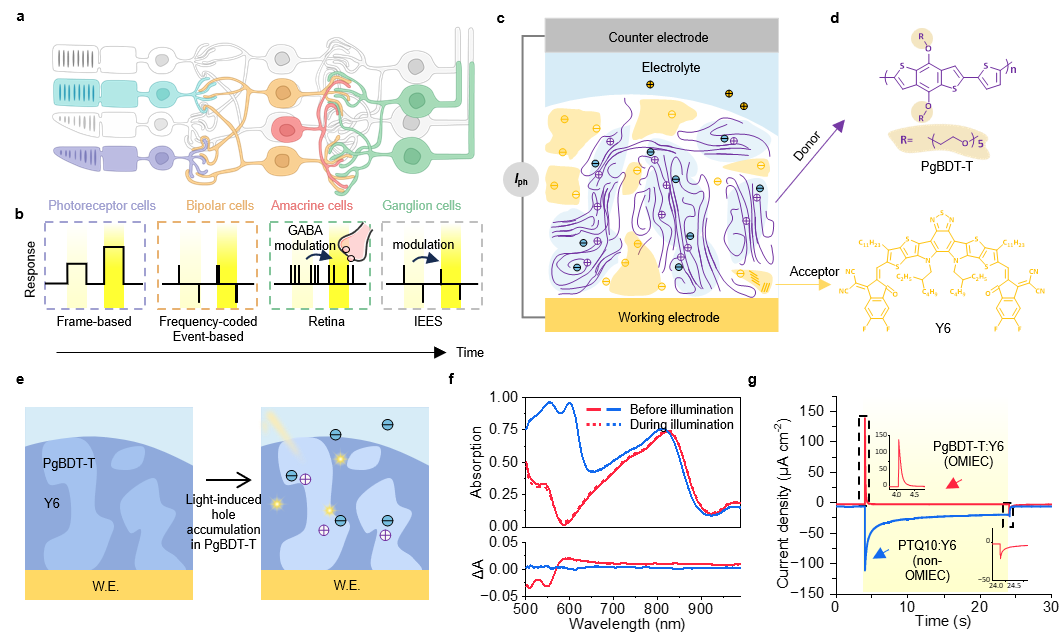
Figure 1 | Design concept and device structure of the amplitude-programmable event-driven organic photosensor. (a–b) Signal processing in the biological retina and comparison of different visual sensing approaches. (c–d) Device structure and photoactive materials of the IEES. (e–g) Schematic illustration of ionic–electronic coupling, spectral characterization and transient photocurrent responses of different material systems.
Upon an increase in illumination, photogenerated electrons in Y6 are rapidly extracted, producing transient excitatory photocurrent spikes. In contrast, the slower hole transport in PgBDT-T leads to gradual accumulation of positive charges, which drives anions from the electrolyte into the material to maintain charge compensation. The resulting ionic redistribution weakens the local carrier-extraction field and facilitates charge recombination, thereby suppressing the subsequent photocurrent response and causing the signal to decay after the initial spike.
When the illumination is switched off, the accumulated charges are released, giving rise to a transient response of opposite polarity. Through the coupled processes of rapid electron extraction and slower ionic compensation, the device can directly sense changes in illumination while encoding their magnitude in the spike amplitude. In situ spectroscopic measurements, electrical characterization, and carrier-transport simulations collectively elucidate this excitation–inhibition feedback mechanism (Fig. 2).
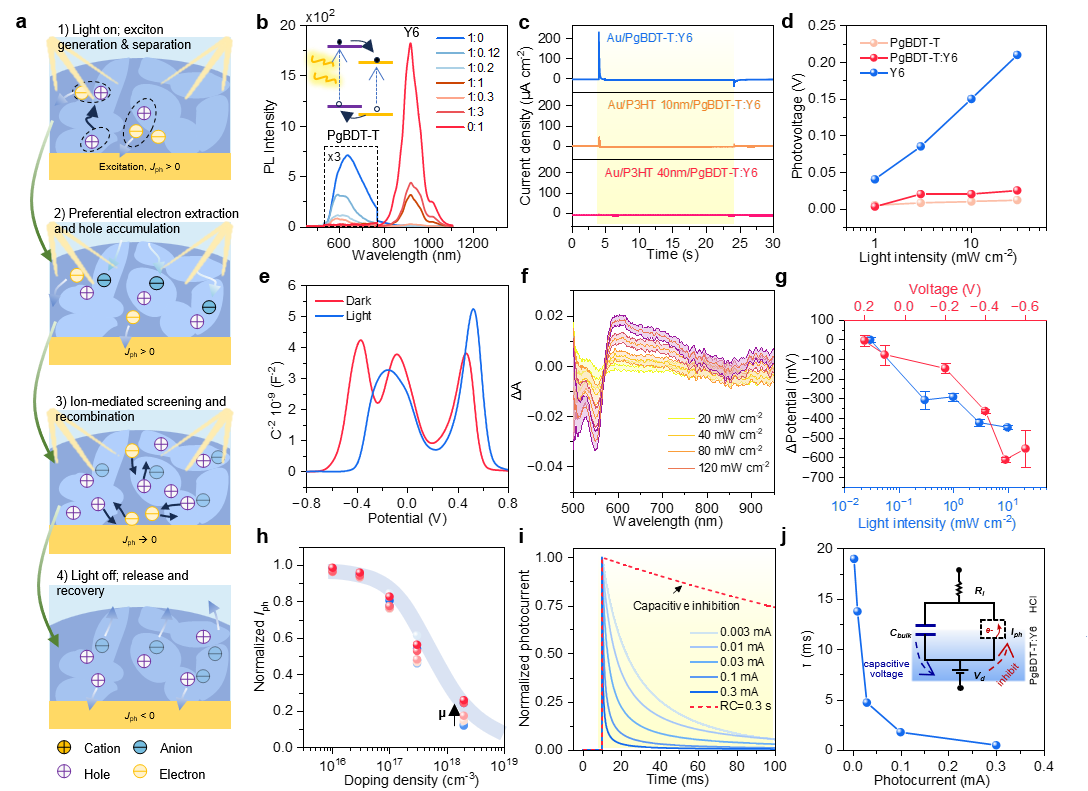
Figure 2 | Working mechanism of event spike generation through ionic–electronic coupling. (a) Device operating mechanism, including photogenerated charge generation, electron extraction and hole accumulation, ionic-mediated inhibition and charge release. (b–g) Spectroscopic and electrical measurements characterizing the separation, extraction and accumulation of photogenerated charges. (h–j) Photocurrent simulations and spike-decay analyses revealing the inhibitory effect of ionic feedback on subsequent photocurrent responses.
The device combines event-driven response with voltage-programmable control capability. Under a fixed bias voltage, the amplitude of event spikes varies with the magnitude of illumination changes, achieving a dynamic range exceeding 75 dB. During cyclic illumination tests over 20,000 s, the response deviation remained below 5%.
By further applying bias voltages from 0 to 0.24 V, the strength of ionic compensation and its inhibitory effect can be adjusted, enabling continuous tuning of event-spike amplitude (Fig. 3). Therefore, the same photosensitive unit can both preserve information about the intensity of visual changes and receive externally programmed response weights through voltage control.
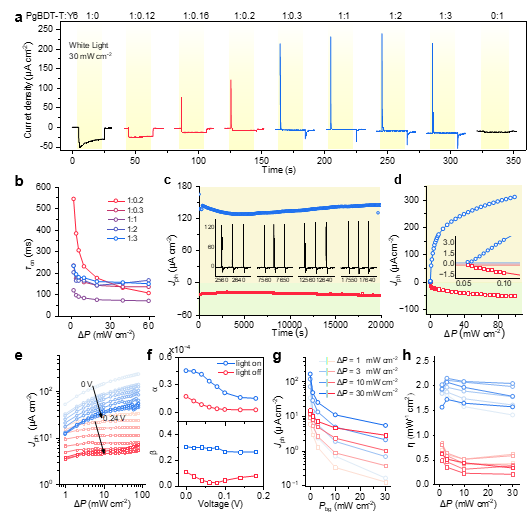
Figure 3 | Photoresponse characteristics and voltage-programmable amplitude modulation of the IEES. (a–b) Effects of blend ratio on transient responses and response dynamics. (c) Operational stability under cyclic illumination. (d) Relationship between event-spike amplitude and illumination-change magnitude. (e–f) Bias-voltage regulation of event amplitude. (g–h) Effects of background illumination on event responses.
Leveraging this capability, the research team further developed a pixel-level attention modulation mechanism. In dynamic letter-pattern projection experiments, independently controlled bias voltages were applied to individual pixels to regulate their event responses, enabling signals generated under different illumination conditions to be normalized to comparable amplitudes.
In simulations of multi-person action scenarios based on experimentally measured device-response models, predefined spatial bias distributions were employed to selectively enhance target regions while suppressing non-target regions. As a result, the event count in the target region increased to nearly ten times that obtained under uniform-bias conditions (Fig. 4). These results demonstrate that the visual front end can actively redistribute response weights according to task-specific requirements.
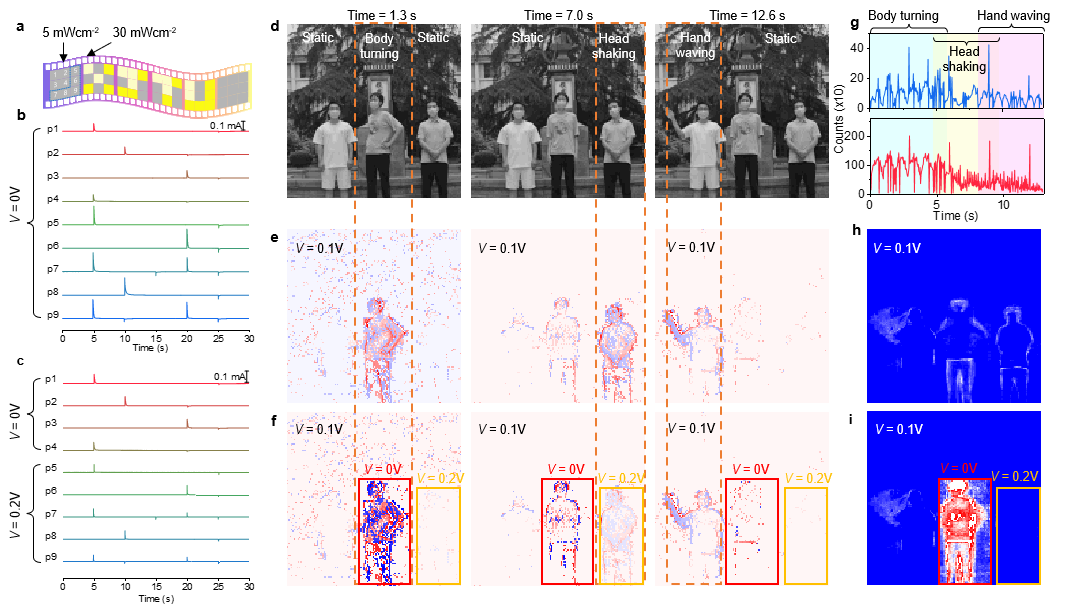
Figure 4 | Pixel-level event-response modulation. (a–c) Array experiments using dynamic letter-pattern projection, demonstrating response normalization under different illumination conditions through pixel-level bias adjustment. (d–i) Dynamic-scene simulations based on experimentally measured device-response models, showing target-region enhancement, non-target-region suppression and changes in event counts.
Building on this capability, the research team further developed a hybrid amplitude–temporal coded neural network (IEES–HATC NN) that combines sparse event-driven temporal sampling with analog amplitude encoding. Unlike conventional approaches that represent signal intensity through the number or frequency of binary spikes, HATC directly encodes the magnitude of illumination changes in the amplitudes of event spikes. Meanwhile, the spatial weights of the convolutional kernels are mapped onto pixel bias voltages, enabling each illumination change to be analog-weighted during event generation.
The resulting weighted events are temporally accumulated within a fixed time window to form convolutional feature maps, which are subsequently fed into a lightweight long short-term memory (LSTM) network for action classification. By integrating event detection, amplitude encoding, and programmable weighting directly into the visual front end, this architecture reduces the need for repeated generation, transmission, and processing of binary spike sequences (Fig. 5a).
Neural network simulations incorporating experimentally measured device responses demonstrate that HATC effectively suppresses static background information while preserving relatively complete representations of moving human-body structures, thereby enhancing the separability of action-related features.
For the four-class human action recognition task on the Weizmann dataset, the proposed approach achieved a testing accuracy of 100%, compared with 94.2% for the frame-based imaging approach and 75.8% for the binary event-camera approach (Fig. 5b–e). Under consistent benchmarking conditions, the estimated front-end energy consumption for processing the complete 149-video evaluation set was 0.064 mJ, corresponding to approximately one ten-thousandth of that estimated for the conventional event-camera neural-network reference system (Fig. 5f).
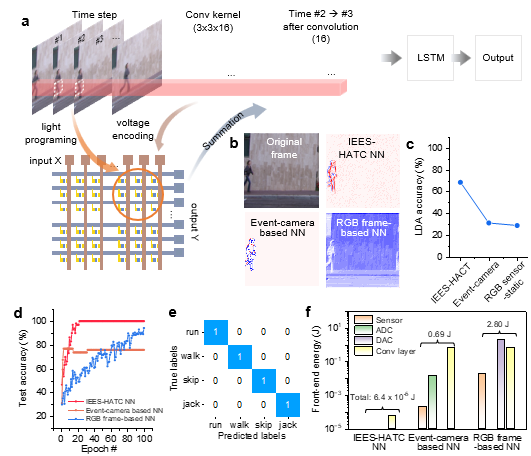
Figure 5 | Hybrid amplitude–temporal coded neural network. (a) Convolutional weights are mapped onto pixel bias voltages, and amplitude-coded events are analog-weighted and temporally accumulated to form feature maps. (b–c) Comparison of feature maps and feature separability among different front-end approaches. (d–e) Testing accuracy and confusion matrices for four-class human action recognition. (f) Comparison of front-end energy consumption under unified benchmark conditions.
This study leverages the ionic–electronic coupling enabled by organic mixed ionic–electronic transport to integrate photoevent sensing and spike-amplitude modulation within a single device. This device-level functionality provides a materials-based solution that reduces the reliance on complex multi-transistor architectures and external analog circuitry typically required to implement these functions.
Building on this capability, HATC further exploits tunable spike amplitudes for information encoding, enabling each event to simultaneously convey the magnitude of illumination changes and the weighting information determined by the pixel bias voltage. Through temporal accumulation, these weighted events are progressively integrated into feature representations for subsequent recognition.
Consequently, the photosensitive unit is no longer limited to optical signal detection, but actively participates in visual information encoding and front-end weighting. By combining the low-redundancy characteristics of event-driven sensing with the enhanced information-carrying capability of analog amplitude encoding, this approach preserves motion-relevant information while reducing downstream processing overhead. These features provide a promising pathway toward low-power, adaptive neuromorphic vision systems.


