Research Background
With the rapid development of renewable energy, electric vehicles, and portable electronic devices, efficient and fast charge/discharge energy storage devices have become one of the key technological bottlenecks. Dielectric capacitors, with their ultra-fast response speed (~μs) and long cycle life, are ideal for high power density storage systems. However, current high-performance capacitors still rely heavily on lead-based materials (e.g., PLZT), which are toxic, environmentally harmful, and limited in supply, severely hindering sustainable development.
In recent years, lead-free perovskite materials (such as sodium niobate, NaNbO3) have been regarded as ideal alternatives. However, previous studies often depended on complex doping and precious metal additives, which are costly, process-complex, and still difficult to match the performance of lead-based materials. Achieving high performance while ensuring green, low-cost fabrication has become a core challenge in the field.
Article Overview
Recently, a joint team from Xi’an Jiaotong University (XJTU), The Hong Kong Polytechnic University (PolyU), and Beijing Institute of Technology (BIT) published a research paper in the prestigious journal Advanced Materials titled “Multi-Polar Order Engineering Enables Near-Ideal Efficiency in Lead-Free Energy Storage Perovskite”. This research successfully developed a new lead-free perovskite material system, NN-xBCS, using a multi-polar order engineering strategy. The team achieved a record-breaking efficiency (η ≈ 95%) and energy density (12 J cm-3) that surpassed commercial lead-based materials like PLZT, while also exhibiting excellent temperature stability and ultrafast discharge response (<32 ns).
This study not only achieved performance breakthroughs but also, for the first time, revealed the critical role of sub-angstrom electronic polarization in energy storage dielectric materials. Through synchrotron X-ray absorption spectroscopy (XAS) and atomic-resolution transmission electron microscopy (HAADF-STEM), the team directly visualized how electronic cloud deformation regulates ionicity and bonding states, significantly enhancing polarization switching speed and energy storage efficiency.
The first author of this work is Yongbo Fan, a postdoctoral researcher at The Hong Kong Polytechnic University (soon to join the School of Materials Science and Engineering, XJTU). Professor Haijun Wu from the School of Materials Science and Engineering, XJTU, is the co-corresponding author. This research was also supported by the XJTU Analytical & Testing Center in terms of electron microscopy microstructure characterization.

Figure 1. Multi-polar order engineering strategy for high-efficiency dielectric energy storage. a) Phase-field simulation guided hierarchical optimization spanning domain structure (polar nano region), atomic configurations (B-site displacement vectors), electronic polarization (sub-angstrom electron cloud displacement) and crystal structure (modulated distortion). b) Electrical microstructure reconfiguration through chemical tuning (relaxation time unification). c) Achieved high volumetric efficiency and fast response rate for next-generation electric vehicle power electronics.
Key Highlights of the Paper
1. Multiscale Synergetic Design
The research team designed highly reversible polar nanoregions (HRPNR) through phase-field simulations, effectively delaying polarization saturation and enhancing breakdown electric field strength. At the atomic level, a multi-cation strategy (Ba/Ca/Sr/Zr/Ti) was used to control structural distortion and electronic states, improving material stability and insulating properties.
2. First-Time Revelation of the Role of “Electronic Cloud Polarization”
Using synchrotron XAS and HAADF-STEM, the team observed sub-angstrom electronic cloud displacements in dielectric materials and demonstrated how these displacements, by enhancing Nb–O bond ionicity and homogenizing bond length distribution, significantly improved polarization switching speed and storage efficiency.
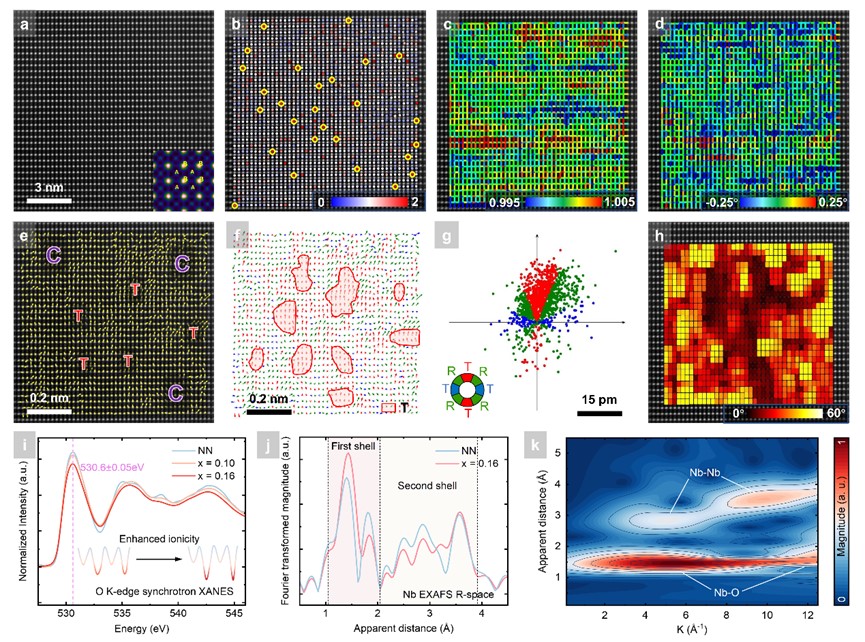
Figure 2. Atomic-level polarization features and electronic structure of NN-xBCS with x = 0.16.
3. Reconstruction of Electrical Microstructure for Unified Relaxation Time
In-situ impedance spectroscopy and relaxation time distribution analysis revealed that the optimized material exhibited a unified response across its resistive-capacitive network, greatly enhancing overall breakdown strength and charge/discharge efficiency.
4. Industrial-Scalable, Low-Cost Fabrication
The NN-xBCS material is prepared using industrial-grade precursors, eliminating the need for rare-earth or precious metal additives. This significantly lowers material costs and allows for compatibility with traditional ceramic sintering processes, making it suitable for large-scale production.
5. Exceptional Thermal Stability and Ultrafast Discharge Capability
Within a temperature range of 25–150°C, the material’s discharge energy density fluctuated by less than 9.3%, and peak current fluctuated by less than 4%, showcasing remarkable environmental adaptability. Under a 200 Ω load, 90% of the energy was discharged within 31.3 ns, making it suitable for high-power applications such as electric vehicle power systems.
Link to the paper: https://doi.org/10.1002/adma.202518270
Author Biography:

Yongbo Fan: Postdoctoral researcher at The Hong Kong Polytechnic University, with a PhD from the University of Sheffield, under Professor Ian Reaney’s group. He has published numerous papers in journals such as Nature Communications, Advanced Materials, Energy & Environmental Science, Advanced Functional Materials, and Applied Physics Letters. He has 6 highly cited papers in ESI, 3 authorized patents, and has received several prestigious awards, including the Henry Royce Scholarship and Hong Kong Innovation and Technology Postdoctoral Fellowship. He also serves as a young editor for Nano-Micro Letters and Journal of Advanced Dielectrics.

Haijun Wu: Professor and doctoral supervisor at Xi’an Jiaotong University, affiliated with the State Key Laboratory for Mechanical Behavior of Materials. He received his bachelor’s and master’s degrees from Xi’an Jiaotong University and his PhD from the National University of Singapore. He has been recognized in the National Youth Talent Program and Shaanxi Province’s “Sanqin Talents” program. As the principal investigator, he leads the Smart Sensors project funded by the National R&D Program and has hosted two NSFC general projects. He has received the Charles Hatchett Award and the Xiaomi Young Scholar Award. He is a board member of the Chinese Materials Research Society and serves as a young editor for several leading journals, including Journal of Advanced Dielectrics, Science China Materials, SusMat, and InfoMat. He has published over 100 papers, including in Science, Nature Communications (14 papers), Advanced Materials (20 papers), and Journal of the American Chemical Society (9 papers), with a total citation count of ~16,400 and an H-index of 69.


