Flexible electronics hold great promise for applications such as implantable medical devices and human-machine interfaces. However, their practical reliability is often limited by the fatigue failure of metal thin-film conductors. Under repeated bending or stretching, conventional nanocrystalline metal films are prone to abnormal grain growth and strain localization, which accelerate crack initiation and propagation. Although alloying and multilayering strategies can improve high-cycle fatigue performance, they often do so at the expense of electrical ductility and low-cycle fatigue life. This long-standing trade-off continues to constrain the operational lifetime of flexible electronic devices.
To address this challenge, the team led by Prof. Jun Sun (CAS Academician) at the State Key Laboratory for Mechanical Behavior of Materials, Xi’an Jiaotong University, has proposed an innovative design strategy termed “coherent gradient nanolayered (CGNL) architectures.” By engineering Ag/Al nanolayered films that integrate atomically coherent interfaces with a layer-by-layer thickness gradient (Figure 1), the strategy enables coordinated control over both crack nucleation and crack propagation, offering a new solution for long-term reliable flexible conductors.
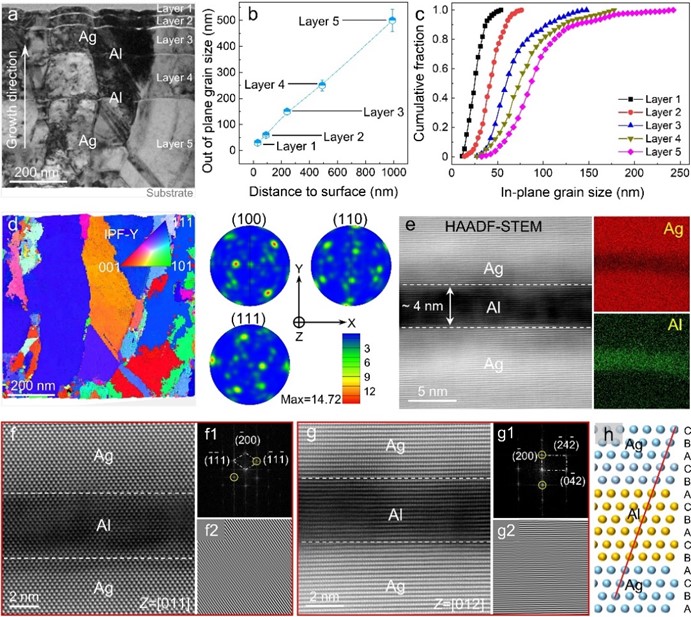
Figure 1. Microstructure of the Ag/Al CGNL film. (a) Cross-sectional TEM image. (b–c) Out-of-plane and in-plane grain-size distributions of the Ag layers. (d) Crystal orientation map and corresponding pole figures. (e) High-resolution STEM image of the Ag/Al interface and the elemental maps. (f–g) Atomic-scale interfacial images along the <011> and <012> zone axes, showing a cube-on-cube orientation relationship at the Ag/Al interface. (h) Schematic of the coherent interfacial structure.
Using magnetron sputtering, the researchers fabricated coherent gradient nanolayered films consisting of alternating silver (Ag) and aluminum (Al) layers. The architecture features several key innovations: (i) atomically coherent Ag/Al interfaces that facilitate dislocation transmission across interfaces, effectively mitigating interfacial stress concentrations and delaying interfacial crack initiation; (ii) a mechanically stable nanocrystalline Ag surface layer that suppresses surface crack formation; (iii) the synergistic effect of mechanically stable coherent interfaces and a thickness-gradient design, which induces hetero-deformation strengthening and guides beneficial lateral grain coarsening (parallel to the interfaces) under cyclic loading, preventing through-thickness microstructural instability and further delaying fatigue-crack initiation; and (iv) the combination of moderate interfacial adhesion and a multiaxial stress state induced by the gradient architecture, which promotes interfacial delamination and crack deflection, effectively suppressing fatigue-crack advancement (Figure 2). Fatigue tests show that the Ag/Al coherent gradient nanolayered film maintains high conductivity of ~ 107 S/m after more than 107 cycles over a wide strain range of 0.7%–2.0%; even under severe fatigue at 5% strain range, it still exhibits conductivity above 106 S/m after 105 cycles. Its overall fatigue resistance markedly exceeds that of previously reported metal thin films, achieving a rare simultaneous enhancement of both high-cycle and low-cycle fatigue performance (Figure 3).
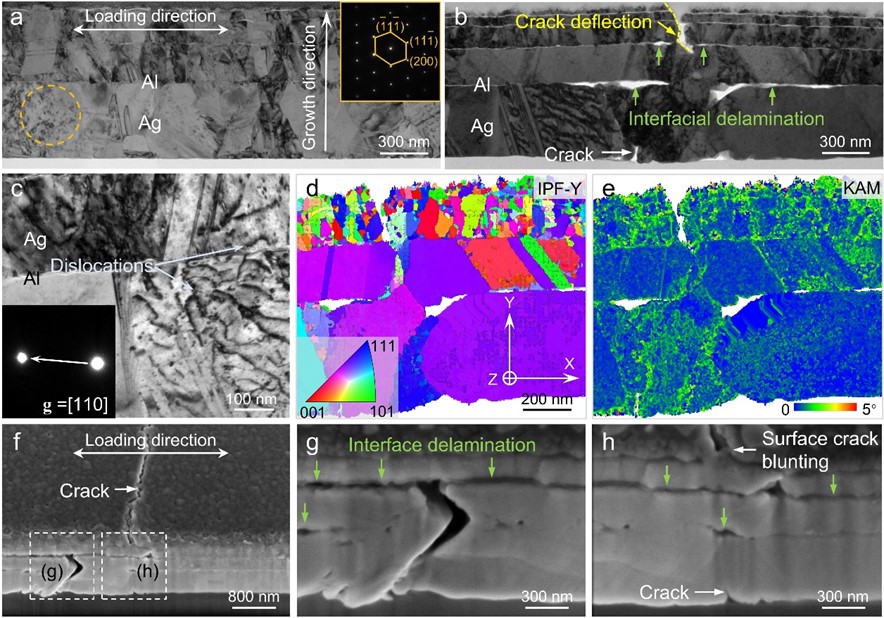
Figure 2. Fatigue damage behaviors of the Ag/Al CGNL film. (a) TEM image prior to crack initiation. (b) TEM image after crack propagation. (c) Magnified view of the Ag/Al interfacial structure. (d) Crystal orientation map of the damaged region in (b). (e) Corresponding local misorientation map of (d); (f–h) Cross-sectional SEM images after crack propagation, showing pronounced crack blunting, interfacial delamination, and crack deflection.
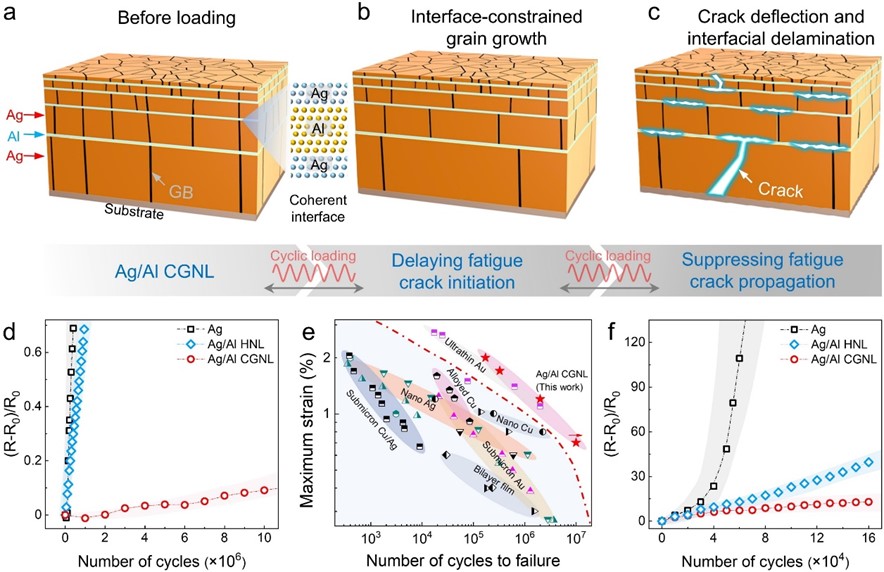
Figure 3. Fatigue performance of the Ag/Al CGNL film. (a–c) Schematic illustration of microstructural evolution and the crack initiation/propagation process. (d) Relative resistance change versus fatigue cycles at 0.7% strain range for pure Ag films, Ag/Al homogeneous nanolayered films, and Ag/Al CGNL films. R0 is the initial resistance and R is the real-time resistance during cycling. (e) Comparison of fatigue performance between the Ag/Al CGNL film and other reported metal films. (f) Relative resistance change versus fatigue cycles at 5% strain range for pure Ag films, Ag/Al homogeneous nanolayered films, and Ag/Al CGNL films.
Importantly, while imparting exceptional fatigue resistance, the coherent gradient nanolayered architecture preserves electrical conductivity and ductility comparable to those of pure silver thin films. The design concept is broadly applicable and can be extended to other metal systems such as Au, Cu, and Al. It is also highly compatible with existing microfabrication technologies, highlighting strong potential for industrial translation.
To further validate practical applicability, the research team fabricated three prototype devices based on the Ag/Al CGNL film conductors: implantable bioelectrodes, flexible light-emitting displays, and flexible interconnect circuits (Figure 4). These results provide a practical pathway to overcoming the long-standing reliability bottleneck in flexible electronics and may accelerate broader adoption in healthcare, human-machine interaction, and intelligent sensing.
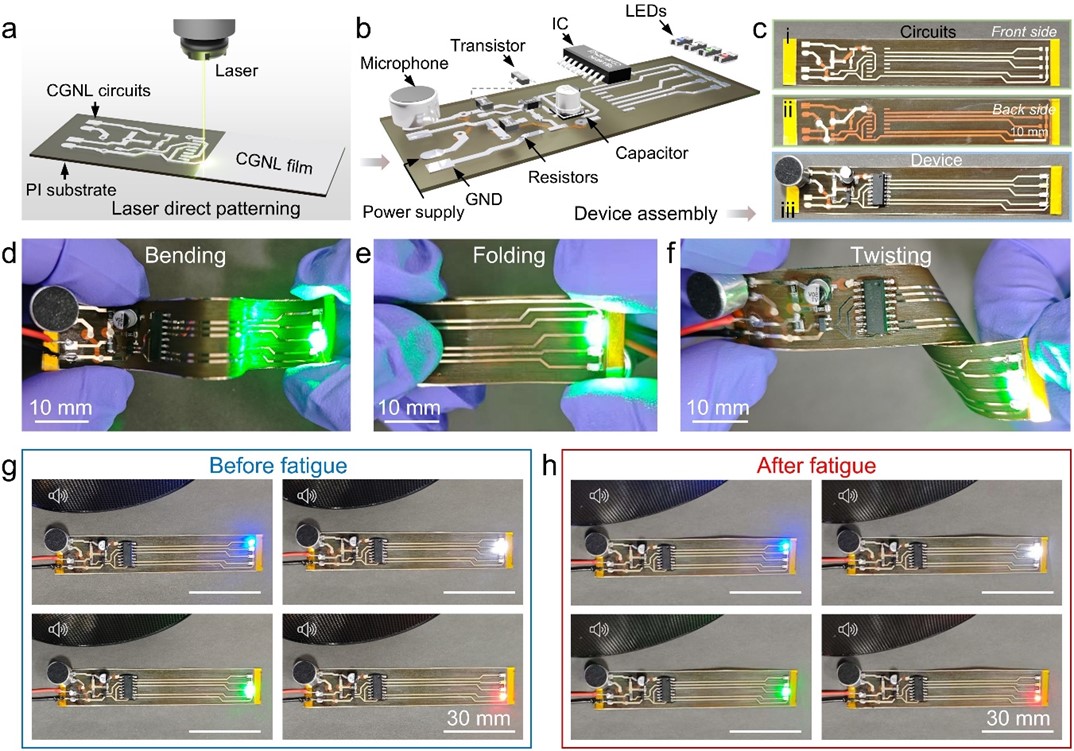
Figure 4. Flexible functional circuits based on the Ag/Al CGNL film. (a) Schematic of the fabrication process. (b) Structural design of a four-color flashing circuit. (c) Photographs of the circuit (front side, back side, and assembled state). (d–f) Circuit performance under bending, folding, and twisting. (g–h) Visual display of the LED flash circuit based on Ag/Al CGNL electrodes before and after fatigue testing.
The study, titled “Fatigue-resistant metal-film-based flexible conductors with a coherent gradient nanolayered architecture”, was published online in Nature Electronics. The first author is Yun Xia, a Ph.D. student at the School of Materials Science and Engineering, Xi’an Jiaotong University. Corresponding authors are Prof. Kai Wu and Prof. Jun Sun (CAS Academician). Co-authors include Prof. Gang Liu, Prof. Jinyu Zhang, Prof. Bo Li, Prof. Yaqiang Wang, Dr. Bing Chen, Dr. Ting Zhu, and Dr. Kai Chen from Xi’an Jiaotong University, as well as Prof. Yizhuang Li and Dr. Qianduo Zhuang from Northeastern University. This research was supported by the National Natural Science Foundation of China, the National Key R&D Program, and the Shaanxi Provincial Science and Technology Innovation Team program. Characterization and testing were supported by the Instrument Analysis Center of Xi’an Jiaotong University.
Paper link: https://www.nature.com/articles/s41928-025-01503-1


