Materials informatics leverages advances in computer science and information technology to enhance the understanding, utilization, selection, and design of materials. The field encompasses a wide range of machine-learning approaches, including (but not limited to) machine-learning interatomic potentials and large language models (LLMs).
Recently, a research team from the School of Materials Science and Engineering at Xi’an Jiaotong University published a review article in Advanced Materials entitled “Materials Informatics: Emergence to Autonomous Discovery in the Age of AI.”
They provide a perspective on the evolution of materials informatics, tracing its conceptual roots to foundational ideas in physics and information theory and its maturation through the integration of machine learning and artificial intelligence (AI). Early contributions from Chelikowsky, Phillips, and Bhadeshia laid the groundwork for what has become a transformative approach to materials discovery. The U.S. Materials Genome Initiative catalyzed a surge in activity, and the period from 2014–2016 marked the first impactful applications of machine learning to materials problems. Since then, the field has seen rapid advances, particularly with the advent of deep learning and transformer-based large language models (LLMs), which now underpin tools for property prediction, synthesis planning, and inverse design.
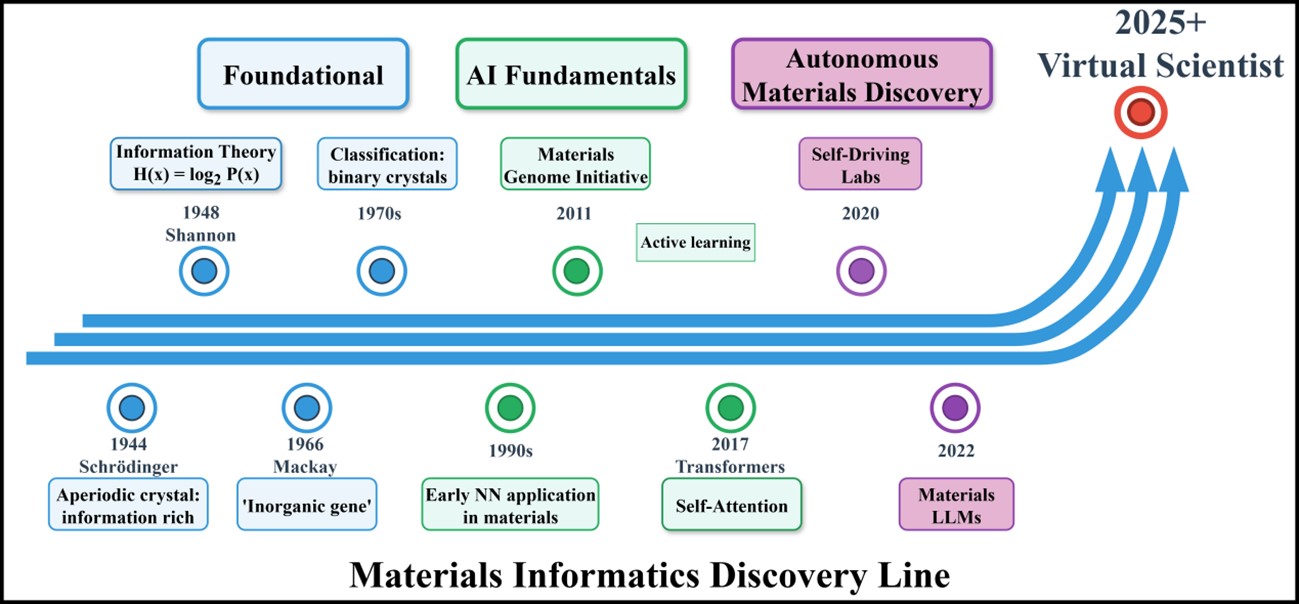
The authors are affiliated with the State Key Laboratory for Mechanical Behavior of Materials and State Key Laboratory of Porous Metal Materials. The work was jointly supervised by Academician Sun Jun and Professor Ding Xiangdong at Xi’an Jiaotong University. Ph.D. student Liu Yujie participated in the study. Professor Lookman and Associate Professor Gao Zhibin served as corresponding authors. Paper link: https://doi.org/10.1002/adma.202515941
In addition, Professor Ding Xiangdong’s group is recruiting long-term postdoctoral researchers, Ph.D./master’s students, and research assistants, with research directions focused on alloy design and synthesis enabled by machine learning and artificial intelligence. For details, applications, or inquiries, please contact: zhibin.gao@xjtu.edu.cn


