Research Background
With the rapid growth of electric vehicles, fast-charging all-solid-state lithium batteries (ASSLBs) are widely regarded as a key candidate for next-generation energy-storage technologies. Compared with conventional liquid-electrolyte batteries, all-solid-state batteries offer substantially improved safety and hold great promise for higher power density, enabling much shorter charging times and effectively alleviating consumers’ “charging anxiety.”
However, realizing practically viable fast charging in ASSLBs remains a major challenge. Fast-charging operation requires batteries to sustain stable performance under high current densities. In practical applications, thick electrodes—essential for achieving high energy density—often suffer from sluggish ionic and electronic transport at high rates. In addition, severe volume changes during cycling can disrupt electron and ionic conducting percolation networks, leading to rapid capacity degradation. As a result, simultaneously achieving high energy density, high power capability, and long cycle life remains one of the central bottlenecks preventing the large-scale deployment of all-solid-state lithium batteries.
Article Overview
Recently, a multi-institutional research team led by the School of Materials Science and Engineering at Xi’an Jiaotong University, in collaboration with the Qingdao Institute of Bioenergy and Bioprocess Technology of the Chinese Academy of Sciences and the Laoshan Laboratory, reported a breakthrough in the high-impact journal, Nature Communications, entitled “architected continuum alloy negative electrode for fast charging all-solid-state lithium batteries,” introduces a new design paradigm for alloy-based negative electrodes tailored for fast-charging ASSLBs.
In this work, the authors propose a phase-evolution-guided and architected continuum alloy strategy, and successfully develop a ternary In0.38Sn0.33Bi0.29 alloy negative electrode. This design enables the simultaneous realization of efficient ionic–electronic coupled transport and robust structural stability under fast-charging conditions.
An industrially relevant, high-loading full cell composed of In0.38Sn0.33Bi0.29||LiCoO2 delivers remarkable performance: after 1,300 cycles at 4.0 C (15-minute charging), the capacity retention remains as high as 87.5%. Under even faster charging at 5.0 C (12-minute charging), the cell achieves a cell-level gravimetric energy density of 203.1 Wh kg−1 and a volumetric energy density of 670.6 Wh L−1. Importantly, these fast-charging capabilities are further validated in large-format pouch cells. Beyond offering a scalable, high-performance negative-electrode solution for fast-charging all-solid-state lithium batteries, this work establishes a general design framework for structural optimization and mechanistic understanding of alloy anodes in solid-state battery systems.
The first author of the study is Dr. Tao Liu from Shandong Normal University. Professor Weijiang Xue (School of Materials Science and Engineering, Xi’an Jiaotong University), Chinese Academician Bo Tang (Laoshan Laboratory), and Dr. Shanmu Dong and Dr. Guanglei Cui (Qingdao Institute of Bioenergy and Bioprocess Technology, CAS) serve as corresponding authors. The authors also acknowledge the support of Xiaohua Cheng, an engineer at the Analytical and Testing Center and Micro-Nano Fabrication Center of Xi’an Jiaotong University, for assistance with microstructural characterization.
Key Findings
1. Concept of an architected continuum alloy negative electrode
This study is the first to propose the concept of an architected continuum alloy negative electrode. Unlike conventional approaches based on single-phase or multiphase alloy anodes, the researchers precisely tailor the elemental ratios of three metals to construct a structurally continuous intermetallic alloy. This design synergistically integrates the advantages of particle-stacked anodes (PSA) and planar metal-foil anodes (PMFA). The resulting alloy features:
(i) a mechanically compliant soft phase to accommodate stress,
(ii) a bicontinuous mixed ionic–electronic conducting network, and
(iii) strong resistance to lithium dendrite formation under high current densities.
To meet these multifunctional requirements, the alloy is rationally designed using elements with low eutectic melting points.

Figure 1. Conceptual design of the architected continuum alloy negative electrode. Conventional negative-electrode architectures—particle-stacked anodes (PSA) and planar metal-foil anodes (PMFA)—and their respective advantages and limitations. (b) Schematic of the architected continuum alloy combining the merits of PSA and PMFA, featuring bicontinuous mixed ionic-electronic conduction and soft-soft interfacial contacts that buffer mechanical stress and suppress crack-induced degradation. (c) Deformation-mechanism map of various materials at 25 °C. (d) Lithiation process of the InSnBi negative electrode.
2. Stepwise phase evolution for stress mitigation and structural integrity
During lithiation, the In0.38Sn0.33Bi0.29 electrode undergoes stepwise formation of multiple flexible intermediate phases. This process effectively alleviates stress concentration induced by volume changes and suppresses crack initiation and propagation. As a result, the percolating mixed ionic–electronic conduction network remains stable over long-term cycling. The alloy electrode delivers a high specific capacity of 724 mAh g−1 and exhibits an exceptional critical current density of 150 mA cm−2 at an areal capacity of 5.0 mAh cm−2.
3. Outstanding fast-charging performance of full solid-state cells
Using Li6PS5Cl (LiPSCl) as the solid electrolyte, the InSnBi || LiCoO2 full cell achieves a high energy density of 278.4 Wh kg−1 (919.5 Wh L−1) at 0.2 C. Even at high rates of 5.0 C and 6.0 C, the cell retains 73.6% and 72.0% of its energy density, respectively. The full cell delivers a maximum specific power of 1,545.3 W kg−1 (5,103.8 W L−1), approaching the performance range of supercapacitors. Long-term cycling at 4.0 C for 1,300 cycles maintains 87.5% capacity retention, and the fast-charging capability is further confirmed in large-format pouch cells.
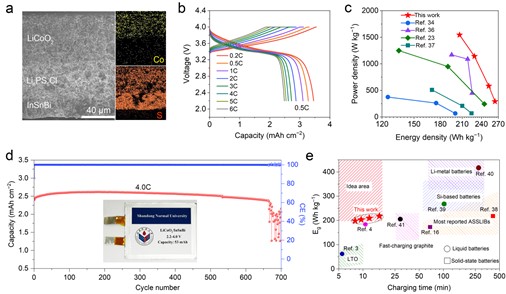
Figure 2. Electrochemical performance of the full cell. (a) Cross-sectional SEM image of the InSnBi || LiPSCl || LiCoO2 cell. (b) Charge–discharge profiles from 0.2 C to 6 C. (c) Comparison of specific power with reported all-solid-state lithium batteries. (d) Cycling performance of the pouch cell at 4.0 C. (e) Comparison of fast-charging performance with representative literature.
Paper link:
Architected continuum mixed ionic and electronic conducting alloy negative electrode for fast-charging all-solid-state lithium batteries. Nature Communications,
https://www.nature.com/articles/s41467-025-67352-w
Professor Weijiang Xue – Biography
Weijiang Xue is a Professor and PhD Supervisor at Xi’an Jiaotong University. His research focuses on the molecular design of advanced electrolytes for lithium- and sodium-based batteries, as well as the development of high-performance metal negative electrodes. As a first or corresponding author, he has published extensively in leading international journals, including Nature Energy (two papers), Nature Communications (2025), Advanced Materials (four papers, 2025), Angewandte Chemie (2025), and Energy & Environmental Science (two papers).
Professor Xue has been consecutively recognized as one of the World’s Top 2% Scientists by the Stanford–Elsevier ranking. He has led multiple research projects supported by the National Natural Science Foundation of China and has directed several major industry–academia collaborative R&D programs. In addition, he serves as the principal investigator for a Young Scientists Project under China’s National Key R&D Program, representing the collaborating institution.
Professor Xue is an active reviewer and adjudicating reviewer for more than 30 prestigious journals in the fields of chemistry, energy, and materials science, including Nature, Nature Sustainability, Nature Communications, Advanced Materials, Journal of the American Chemical Society, Angewandte Chemie, and Energy & Environmental Science.
Personal webpage: https://gr.xjtu.edu.cn/en/web/xueweijiang


