Since the catastrophic accident at the Fukushima Daiichi Nuclear Power Plant in 2011, the development of accident tolerant fuels (ATFs) has emerged as a central direction for next-generation advanced nuclear materials. Among the various ATF concepts, chromium (Cr) coatings have attracted particular attention owing to their excellent corrosion resistance, strong tolerance to neutron irradiation, and robust interfacial bonding with zirconium-based substrates. Importantly, Cr coatings can be integrated into existing nuclear fuel cladding designs without altering the current assembly architecture or fabrication routes, making them one of the most economically viable and practically feasible coating solutions for accident tolerant fuel systems.
Previous studies have largely focused on oxidation products of Cr coatings and coating failure mechanisms following the formation of ZrO2. In contrast, the microstructural evolution within Cr coatings during oxidation—and its direct role in governing oxidation kinetics—has received far less attention. In particular, the formation and evolution of pores within Cr coatings during oxidation remain poorly understood.
A research team led by Academician Jun Sun at the State Key Laboratory for Mechanical Behavior of Materials, Xi’an Jiaotong University, has now addressed this knowledge gap through a systematic investigation combining in situ thermogravimetric analysis, multiscale microstructural characterization, and phase-field simulations. Their study reveals a previously unrecognized mechanism by which micropores dominate the transition in high-temperature oxidation kinetics of Cr coatings, offering new insights into the assessment of coating integrity and protective performance under loss-of-coolant accident (LOCA) conditions.
The study demonstrates that the oxidation weight gain of Cr-coated Zr alloys in high-temperature steam follows a clear three-stage kinetic behavior (Fig. 1). In the first stage (0–20 min), oxidation follows parabolic kinetics, with the rapid formation of a dense Cr2O3 layer on the surface; the oxidation rate is controlled by ionic diffusion. In the second stage (20–160 min), the kinetics deviate from the parabolic law as cation vacancies aggregate within the Cr2O3 layer to form micropores, which accelerate inward oxygen diffusion. Consequently, the oxidation mode transitions from “external growth” to “internal growth.” In the third stage (≥240 min), oxidation transits to an accelerated and linear kinetics. During this stage, outward diffusion of Zr leads to redox reactions with Cr2O3, while the Kirkendall effect induces pore formation at the Cr/Zr interface (Fig. 2). Coating delamination ensues, resulting in a sharp increase in the oxidation rate.
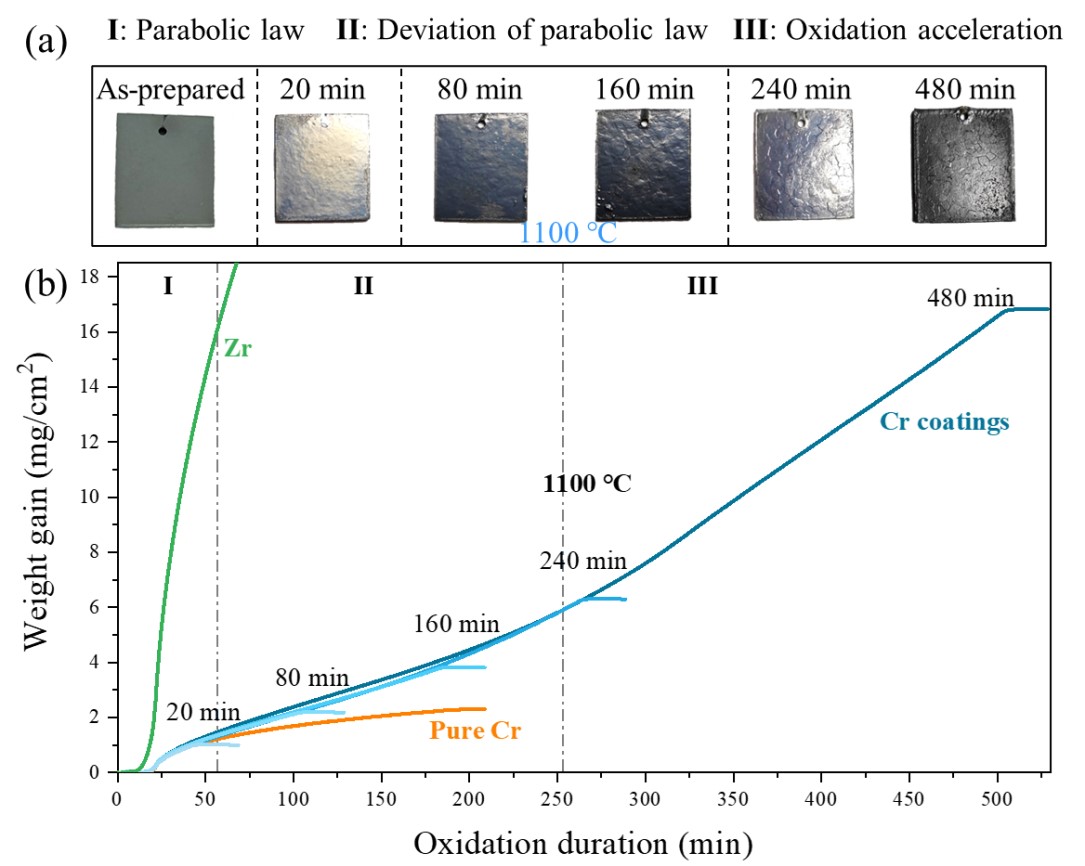
Figure 1. Morphology and oxidation weight-gain behavior of samples oxidized in steam at 1100 °C: (a) macroscopic morphology of Cr-coated Zr–1Nb alloy; (b) oxidation weight gain curves of Zr–1Nb alloy, Cr-coated Zr–1Nb alloy, and pure Cr metal.
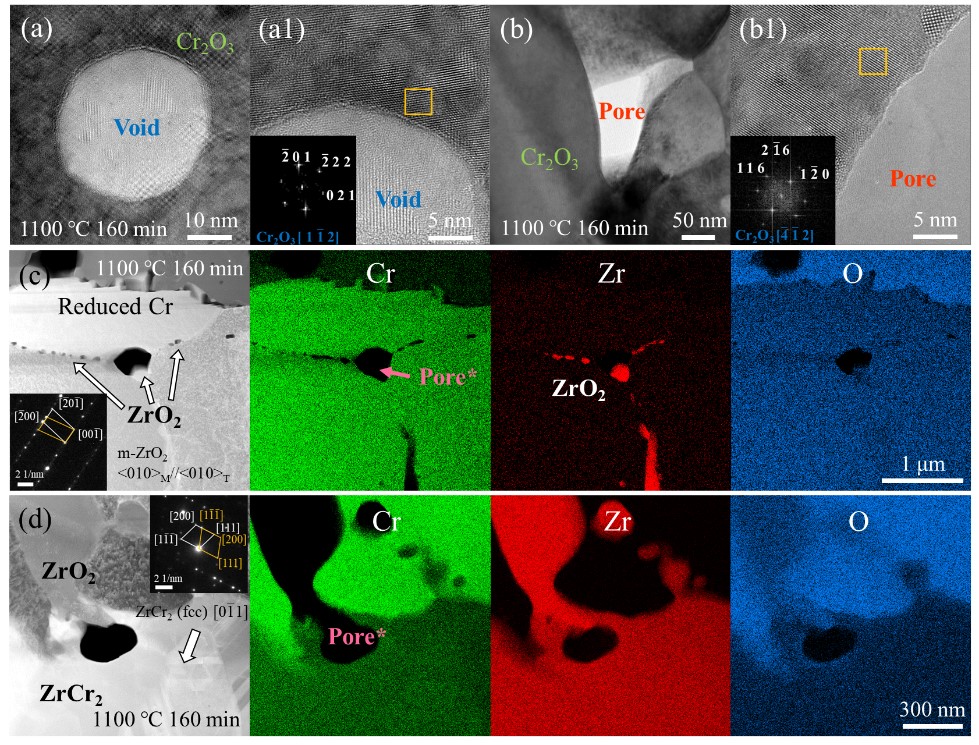
Figure 2. Characteristics of pore structures in Cr2O3 and Cr coatings after oxidation at 1100 °C for 160 min: (a), (a1), (b), (b1) nanoscale and microscale pores; (c) pore formation along grain boundaries in Cr coatings induced by Cr2O3–Zr redox reactions; (d) interfacial pores formed at the Cr coating/Cr–Zr diffusion layer due to the Kirkendall effect.
The underlying mechanism of this distinctive kinetic transition is attributed to a cascade process of vacancy accumulation–micropore coalescence–structural degradation. The small characteristic length scales of Cr coatings—namely, micrometer-scale coating thickness and grain size—lead to elevated back stresses that suppress interfacial dislocation motion and reduce vacancy annihilation efficiency, thereby promoting micropore formation within the Cr2O3 layer (Fig. 3). These micropores not only hinder outward diffusion of Cr cations but also provide fast diffusion pathways for oxygen ions, triggering the oxidation-mode transition. Subsequent Zr diffusion-driven redox reactions and interfacial pore coarsening further compromise coating integrity, ultimately resulting in accelerated oxidation.
Phase-field simulations were employed to directly visualize the coupled evolution of micropores and oxidation kinetics, providing strong validation of the dominant role of micropores in regulating the oxidation behavior of Cr coatings (Fig. 4).
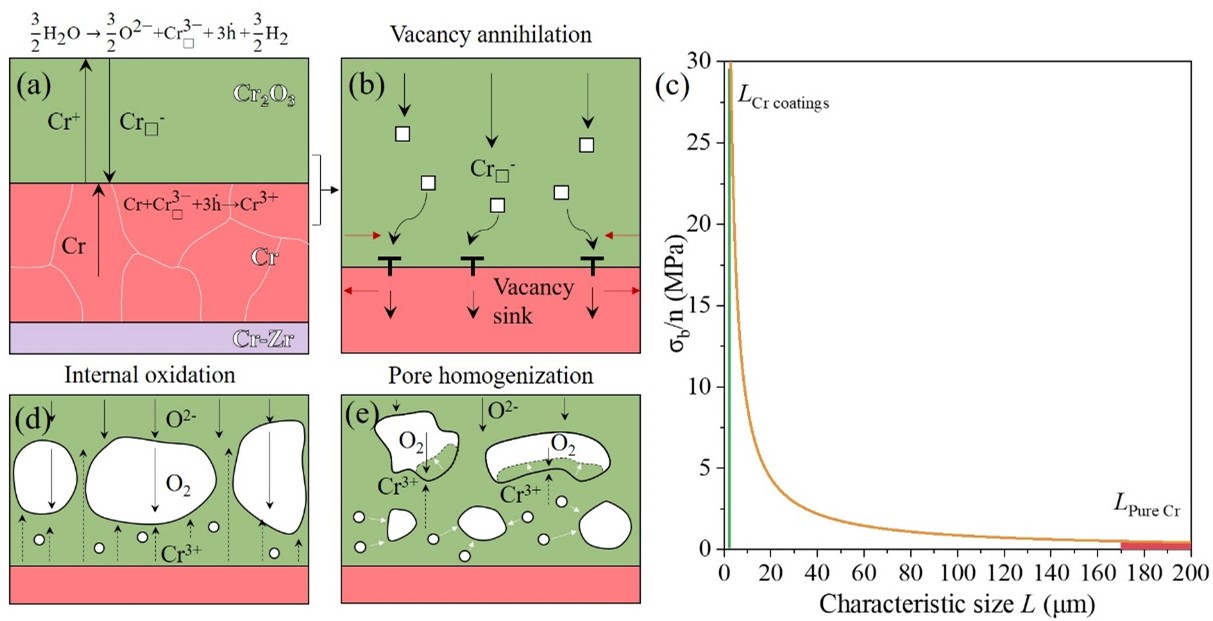
Figure 3. Mechanism of Cr2O3 pore formation in steam environments: (a) cation vacancy concentration; (b–c) reduced vacancy annihilation efficiency at the Cr/ Cr2O3 interface due to high back stress in Cr coatings; (d) inhibition of outward metal cation diffusion by pores; (e) pore homogenization process.
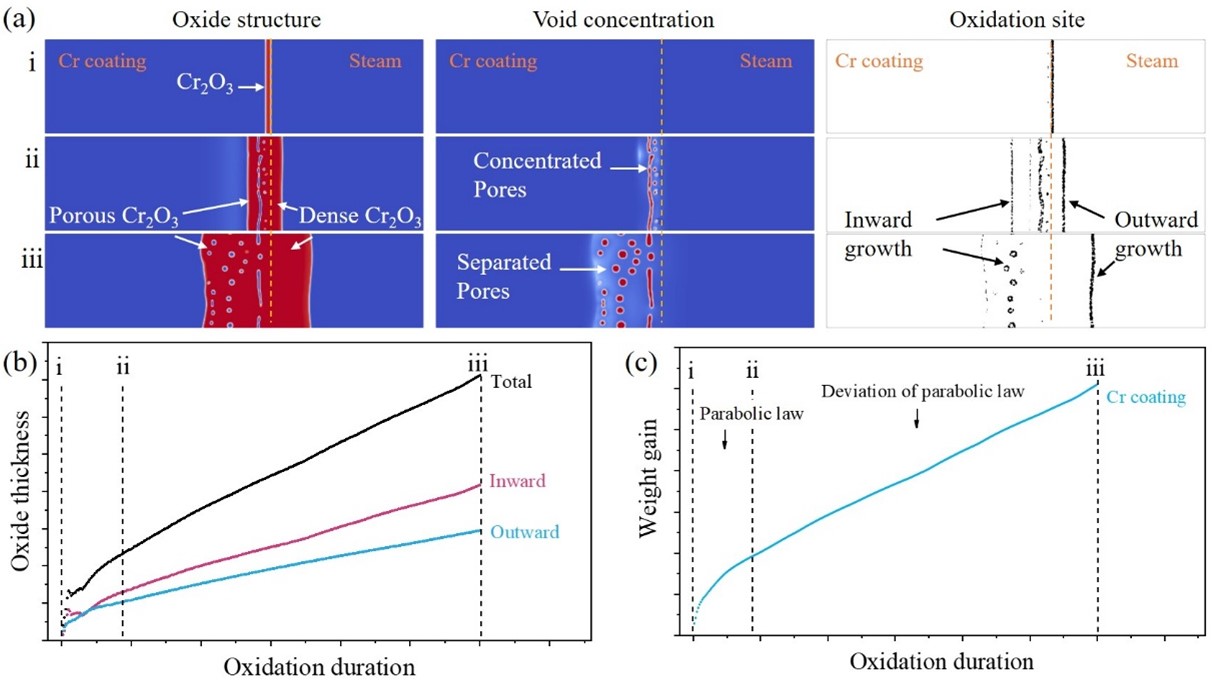
Figure 4. Phase-field simulations of Cr2O3 pore evolution during the transition from parabolic to linear oxidation kinetics: (a) coupled evolution of oxide morphology, vacancy concentration, and oxidation sites (simulation snapshots); (b) time evolution of oxide thickness for external and internal growth modes; (c) simulated oxidation weight-gain curve showing the parabolic-to-linear transition.
This work provides the first clear evidence that micropores are a key factor governing the high-temperature oxidation kinetic transition of Cr coatings. The findings offer critical guidance for coating design and lifetime assessment of ATF cladding materials in nuclear reactors. Moreover, the integrated experimental–phase-field modeling framework established in this study provides a new paradigm for elucidating oxidation mechanisms in protective coatings.
The results have been published in Acta Materialia under the title “Micropores governed high-temperature oxidation behavior of Cr coatings: kinetics analysis and phase-field modeling.” Ph.D student Jianxi Deng and Associate Professor Jiadong Zuo from Xi’an Jiaotong University are co–first authors. The corresponding authors are Associate Professor Jiadong Zuo, Postdoctoral Fellow Chuanxin Liang, and Professor Qiaoyan Sun, with Academician Jun Sun and Professor Zhongxiao Song serving as principal advisors. The State Key Laboratory for Mechanical Behavior of Materials at Xi’an Jiaotong University is the sole corresponding institution. This work was supported by the National Natural Science Foundation of China (U21B2057, 52301168, 52394163), with experimental support from the Analytical and Testing Center and the Experimental Technology Center of the School of Materials Science and Engineering at Xi’an Jiaotong University.
Paper link: https://doi.org/10.1016/j.actamat.2026.121931


