Metal additive manufacturing (AM), commonly known as metal 3D printing, has attracted increasing attention in recent years. Its advantages extend beyond the direct fabrication of components with complex geometries to the generation of unique microstructural features. Among these, a particularly striking characteristic is the emergence of cellular sub-grain structures with a honeycomb-like morphology, which are fundamentally different from the sub-grain structures produced by conventional thermomechanical processing. These solidification cells and dislocation cells exist at the sub-micrometer scale with very small crystallographic misorientations, yet they exert a pronounced influence on the mechanical behavior of materials. Although such unconventional sub-grain structures have been frequently observed in additively manufactured metals, their formation mechanisms have remained poorly understood. Previous studies on metal additive manufacturing have largely focused on process optimization and mechanical performance, while a clear physical picture explaining how these “cellular structures” form, why they are stable, and how they efficiently alter dislocation motion has been lacking.
Recently, Assistant Professor Guanghui Yang and Professor En Ma from the Center for Materials Innovation Design (CAID), School of Materials Science and Engineering, conducted a systematic investigation into this fundamental materials science problem. By combining thermodynamic and kinetic analyses with a comprehensive synthesis of experimental characterizations and numerical simulations, the authors elucidated the evolutionary pathways of cellular structures in additively manufactured metals and proposed a mechanistic framework for the formation of dislocation cells. Their findings were published in a review article entitled “Unconventional sub-grain structures formed in additively manufactured metals” in the leading materials science journal Materials Today (Impact Factor = 22). Assistant Professor Guanghui Yang is the first author of the paper and, together with Professor En Ma, serves as a corresponding author.
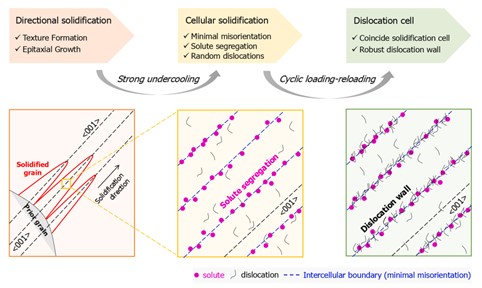
Figure 1. Schematic illustration of the formation of solidification cells and dislocation cells during the metal additive manufacturing process.
The study reveals that the formation of the characteristic cellular structures in additively manufactured metals arises from three interrelated key processes (Fig. 1): directional solidification, the development of solidification cells, and the subsequent formation of dislocation cells. Under conditions of rapid solidification and steep thermal gradients, metals first undergo directional solidification. This is followed by the formation of solidification cells driven by solute rejection and constitutional undercooling, leading to pronounced solute segregation. Superimposed on this microstructural template, the repeated thermal cycling inherent to additive manufacturing generates substantial internal stresses, which promote prolific dislocation generation. Guided by the “template” of solidification cells, these dislocations reorganize and self-assemble, ultimately forming a regular network of dislocation cells (Fig. 2).
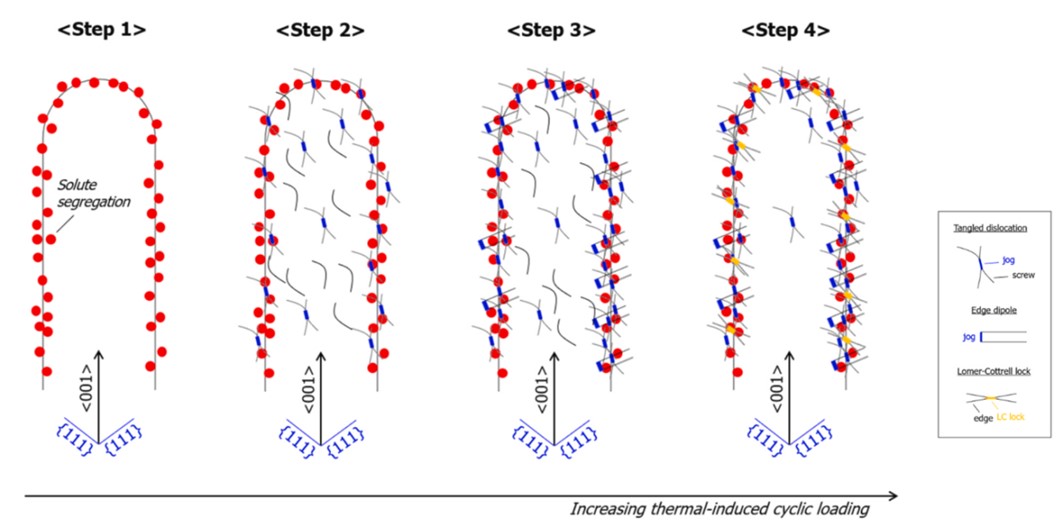
Figure 2. Schematic illustration of the formation and evolution of dislocation cells in additively manufactured metals.
Furthermore, the paper systematically addresses five questions of broad interest to the community:
1. How are dislocation cells constructed?
2. Why are dislocation cells so fine and nearly crystallographically aligned?
3. How do such sub-grain structures simultaneously enhance strength and strain hardening?
4. Why cannot conventional thermomechanical processing generate these unconventional structures?
5. How do different materials and processing conditions affect the controllability of dislocation cells?
Through an in-depth discussion spanning over ten thousand words, the authors analyze the underlying physical mechanisms behind these questions and provide their perspectives and outlook on future research directions.
Paper link: https://doi.org/10.1016/j.mattod.2026.01.007


