The human brain, composed of hundreds of billions of neurons and synapses, represents the most efficient computing platform in nature. It exhibits exceptional capabilities in learning, memory, and parallel information processing, while operating with extremely low energy consumption. Inspired by these features, neuromorphic computing has emerged as a key paradigm for overcoming the fundamental limitations of the conventional von Neumann architecture. Among various candidates, resistive switching devices based on complex oxides are considered as promising neuromorphic devices due to their simple structure, excellent scalability, and low power consumption. In particular, complex oxide materials, characterized by rich metastable states and strongly correlated electronic behavior, can exhibit diverse resistive switching phenomena under external electric fields. These features provide a unique materials platform for emulating neuronal spiking behavior and the nonlinear dynamical properties of biological synapses, such as plasticity and adaptability.
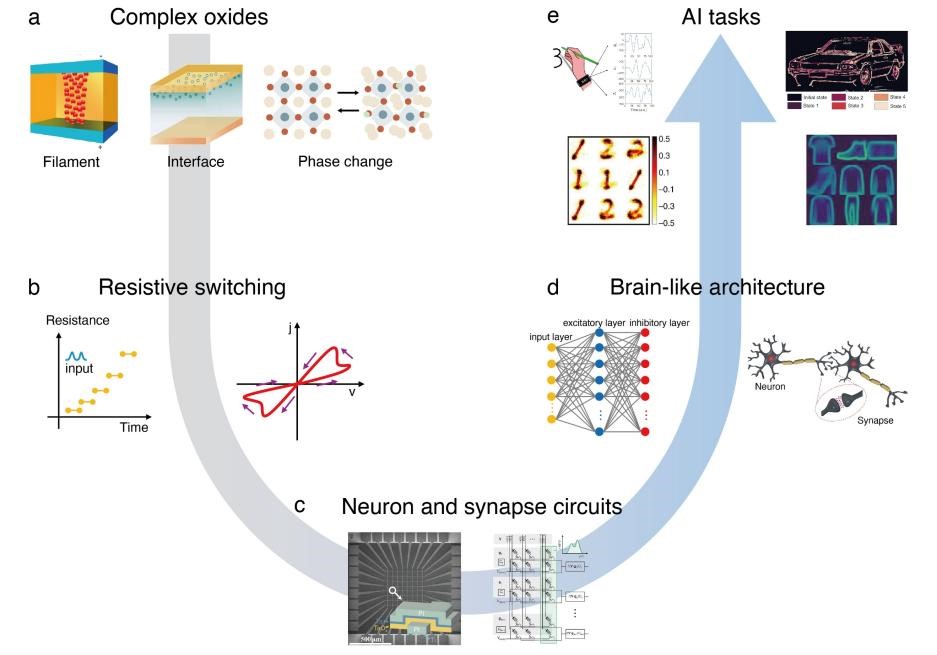
Figure 1. Schematic roadmap for the development of complex-oxide-based chips for neuromorphic computing.(a) Illustration of resistive switching mechanisms in complex oxides, including oxygen vacancy migration, interface barrier modulation, and metal–insulator transitions; (b) Typical resistive switching behaviors of complex oxide devices, from current–voltage characteristics to pulse responses; (c) Representative crossbar array architectures constructed from resistive switching devices; (d) Schematic of complex oxides in neuromorphic hardware architectures, highlighting the evolution from single devices to arrays and from functional units to system-level integration; (e) Representative tasks efficiently enabled by neuromorphic computing, such as pattern recognition, temporal learning, and low-power edge intelligence.
Recently, a research team from the State Key Laboratory for Mechanical Behavior of Materials published an online review article in Advanced Materials, entitled “Resistive Switching Oxides: Mechanism, Performance, and Device-Algorithm Co-design for Artificial Intelligence”. From an integrated perspective spanning materials mechanisms, device performance, and algorithmic co-design, the review systematically summarizes recent advances in complex-oxide-based resistive switching devices for neuromorphic computing. The authors elucidate the multiscale microscopic origins and dynamical characteristics of resistive switching behaviors, including conductive filament migration, interfacial effects, and metal–insulator transitions. Key performance metrics of various complex oxide resistive switching devices, such as switching ratio, endurance, retention, and energy consumption, are comparatively analyzed, clarifying pathways for performance optimization.
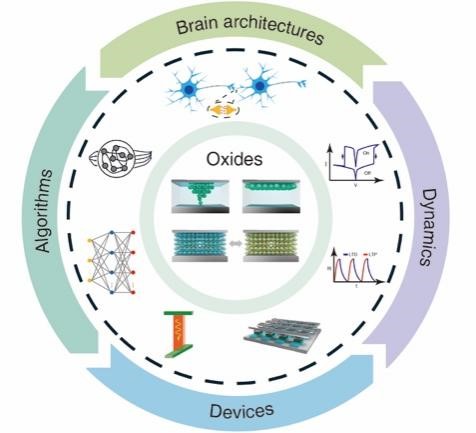
Beyond demonstrating the capability of individual devices to emulate biological neural functions, the review further discusses task-driven device–algorithm co-design strategies under device integration scenarios, providing practical guidance toward real-world applications. Finally, the article offers an objective assessment of the remaining challenges facing complex oxide resistive switching devices, including device-to-device variability, operational stability, and large-scale integration, and presents an outlook on future directions for neuromorphic chips from the perspectives of materials, devices, and algorithms.
Graduate students Xurong Qiao, Ziyu Liu, and Jiahui Sun from the School of Materials Science and Engineering, Xi’an Jiaotong University, are co–first authors of the paper. Master students Xi Yan, Xin Jia, Xianwei Liu, and Jingkai Jiao contributed to the manuscript preparation. Professors Yan Ni and Zhen Zhang served as co-corresponding authors. The work was conducted under the joint supervision of Professor Jun Sun and Professor Xiangdong Ding, and was carried out at the State Key Laboratory for Mechanical Behavior of Materials. Financial support was provided by the National Natural Science Foundation of China (Grant Nos. 62475211 and 52071258), the Fundamental Research Funds for the Central Universities (xzd012022022 and xtr072024009), and the Xiaomi Young Scholars Program.
Paper link: https://doi.org/10.1002/adma.202517373
Research group homepage: https://gr.xjtu.edu.cn/zh/web/mzhangz


