Nickel-based superalloys play an indispensable role in aerospace and energy industries, where extreme temperatures and stresses demand materials with exceptional mechanical reliability. Their outstanding performance originates from precisely tailored compositions and hierarchical microstructures. However, conventional manufacturing routes based on casting and machining are often time-consuming, costly, and inefficient, while in-service degradation such as thermal erosion and cyclic loading inevitably leads to damage and failure of critical components. Metal additive manufacturing (AM), commonly known as 3D printing, has emerged as a disruptive technology for the fabrication and repair of complex superalloy components. By enabling layerwise deposition and localized melting, AM offers unprecedented design freedom, high material efficiency, and rapid production capability. Despite these advantages, the practical implementation of AM for Ni-based superalloys is still constrained by several intrinsic challenges, including severe hot cracking, limited control over grain structures, and unclear correlations between as-built microstructures and mechanical performance - especially for nonweldable, crack-sensitive superalloys.
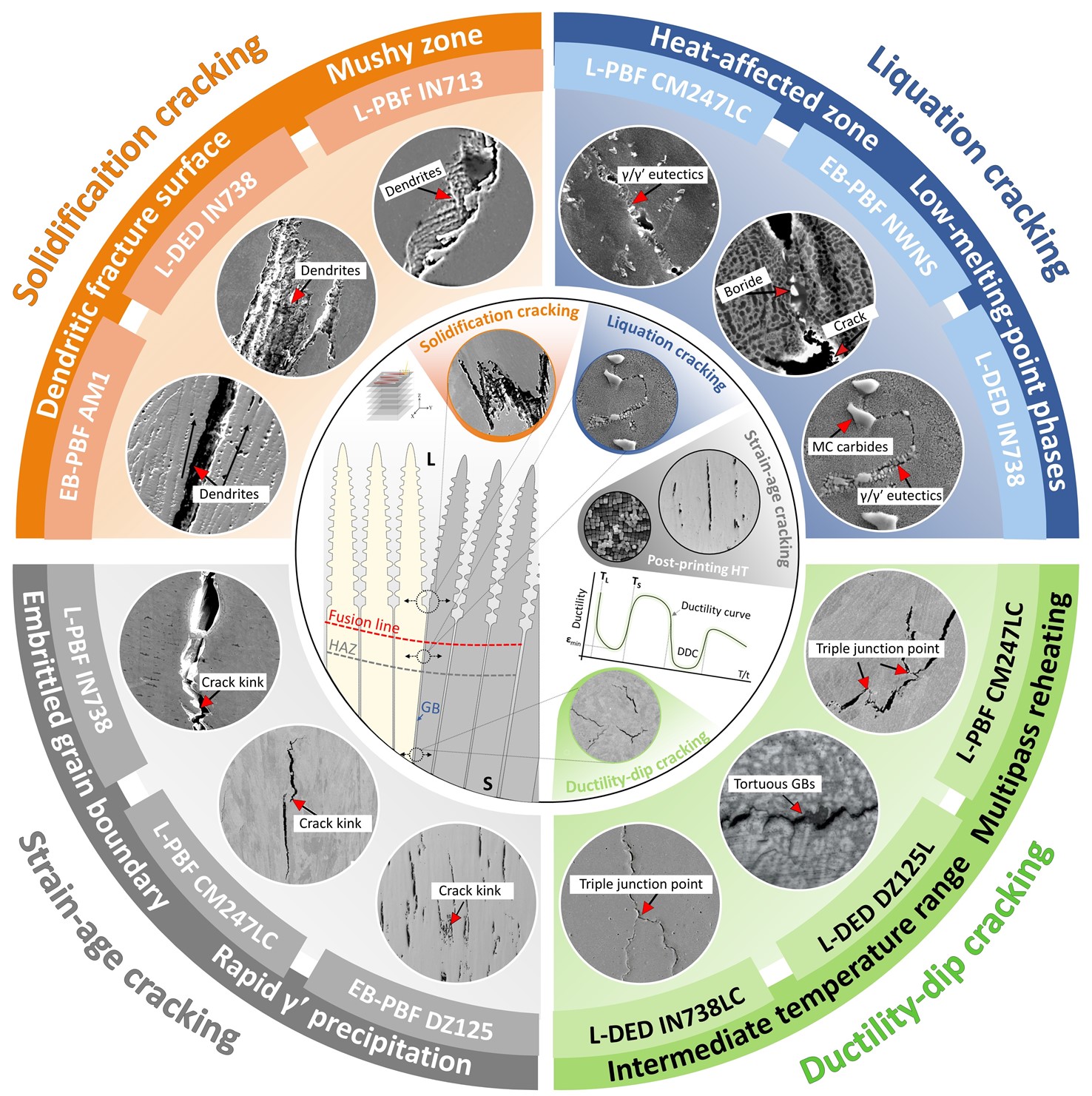
Figure 1. Four classical cracking types in additively manufactured Ni-based superalloys
To address these issues, a research team from Xi’an Jiaotong University has recently published a state-of-the-art review in Advanced Materials, entitled “Turn Nonweldable Ni-Superalloys Printable and Microstructurally Controllable”. This review provides a systematic overview of recent advances in laser- and electron-beam-based AM of high crack-sensitive superalloys, emphasizing how elemental segregation, melt pool geometry, micro-defects, and residual stresses collectively govern hot cracking behavior, microstructure evolution, and mechanical performance. The authors summarize hot cracking mechanisms and mitigation strategies from three key dimensions: alloy chemistry, parameter optimization, and tailored heat treatments. They further compare three representative AM technologies (L-PBF, L-DED, and EB-PBF) revealing their respective capabilities and limitations in controlling melt pool geometry, grain morphology, dendritic structures, elemental distributions, and dislocation configurations. By benchmarking tensile and creep properties against conventional cast and forged superalloys, the review highlights the unique performance potential and optimization pathways of AM superalloys.
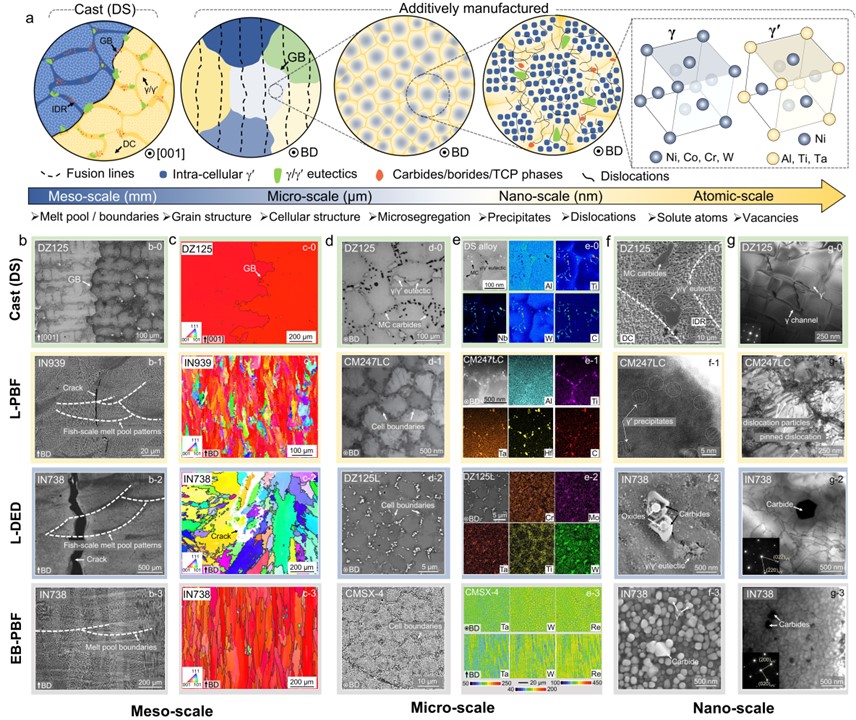
Figure 2. Microstructural comparison between conventionally cast directionally solidified superalloys and additively manufactured Ni-based superalloys
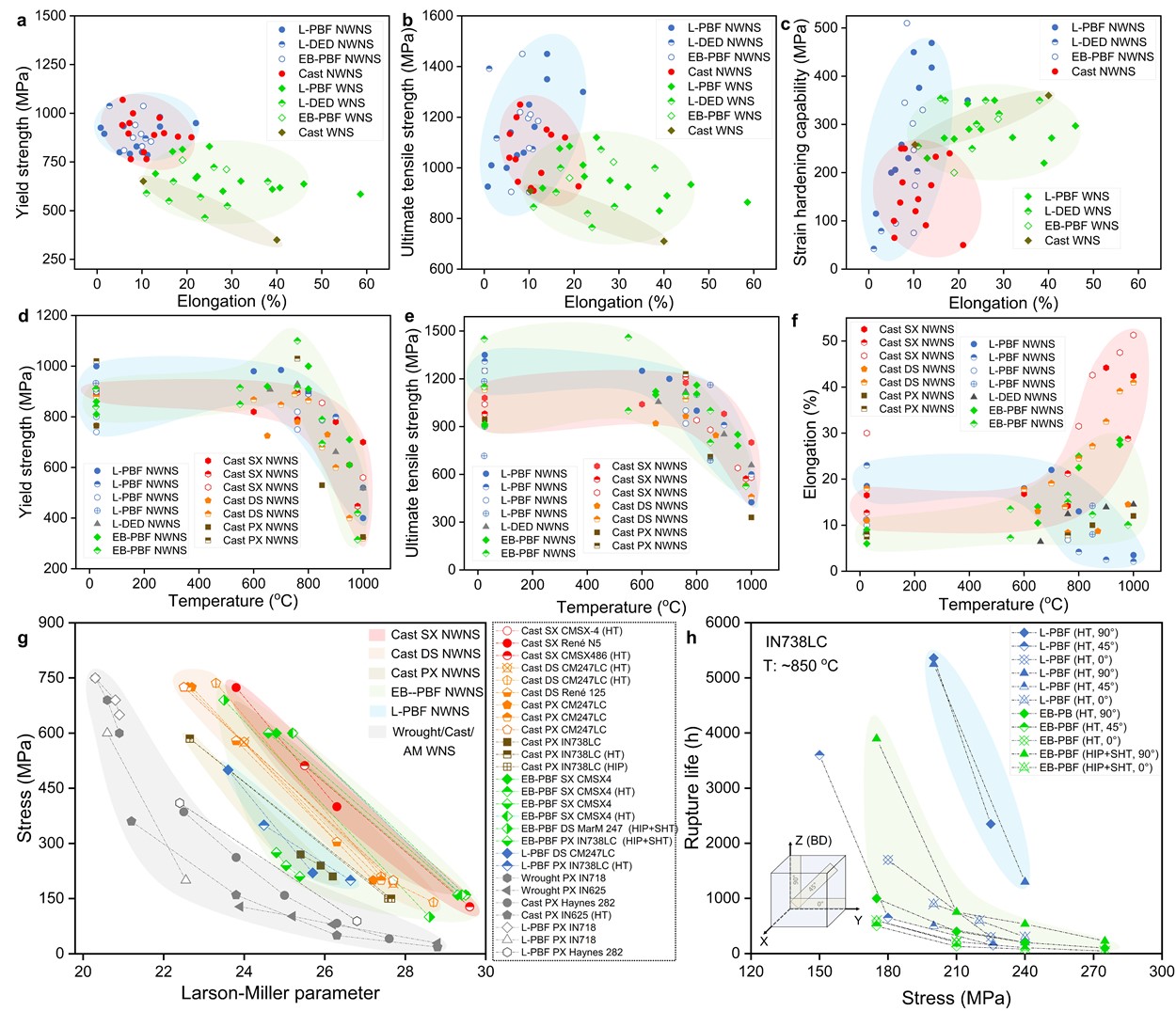
Figure 3. Comparison of tensile and creep properties between additively manufactured and cast/forged Ni-based superalloys
Using turbine blades a representative application scenario, this study outlines research directions toward next-generation additive manufacturing of superalloys, including AI-assisted alloy design, high-throughput in-situ monitoring of cracking and defects, spatially programmed grain structures, and an integrated design paradigm linking composition, microstructure, processing, and heat treatment. Together, these strategies are expected to transform nonweldable Ni-based superalloys from difficult-to-print materials into fully controllable, high-performance structural materials for extreme service environments.
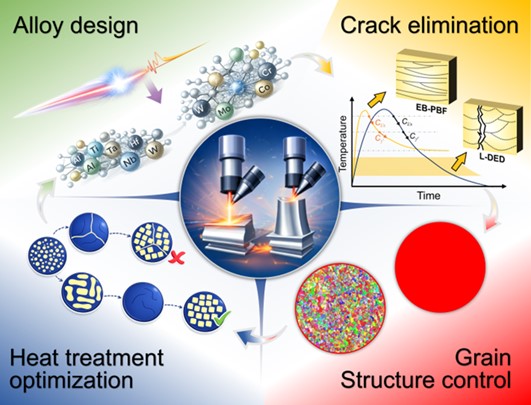
Figure 4. Outlook on future development of additively manufactured Ni-based superalloys.
The first author of the paper is Zhaowei Wang, a PhD candidate at the School of Materials Science and Engineering, Xi’an Jiaotong University (XJTU). The corresponding authors are Prof. Kai Chen (XJTU) and Dr. Qiang Li (Nanyang Technological University, Singapore). Prof. Fei Liu (Guizhou University) and Dr. Shubo Gao (A*STAR, Singapore) also contributed to data compilation and manuscript preparation. This work was supported by the National Key Research and Development Program of China (No. 2023YFB12002) and the National Natural Science Foundation of China (Nos. W2411048 and 52271042).
Paper link:https://doi.org/10.1002/adma.202517003
Professor Kai Chen′s Group Website:https://gr.xjtu.edu.cn/en/web/kc_xjtu/home


