Research Background
Sodium-ion batteries (SIBs) stand out as a highly promising post-lithium-ion battery (LIB) technology due to abundant sodium resources and low cost. Yet, their practical deployment is constrained by relatively low energy density. Enhancing energy density requires high-voltage, high-capacity electrodes, which demand electrolytes with robust oxidative stability, tolerance to large volume changes, and effective suppression of side reactions. Thus, designing matched liquid organic electrolytes for specific electrode systems is critical to realizing the full potential and commercialization of SIBs.
Article Overview
A collaborative research team led by Prof. Weijiang Xue from the Center for Advancing Materials Performance from the Nanoscale (CAMP-Nano) of the State Key Laboratory for Mechanical Behavior of Materials at Xi’an Jiaotong University, has published a comprehensive review article titled “Fundamentals, Status, and Prospects of Liquid Organic Electrolytes for High-Energy Sodium-Ion Batteries” in the renowned international journal Advanced Materials. This review is based on the latest research outcomes from the National Key R&D Program of China, led by the Institute of Physics, Chinese Academy of Sciences, and jointly conducted by the Dalian Institute of Chemical Physics and Xi’an Jiaotong University. The article systematically compares the fundamental principles of electrolyte design in SIBs and LIBs, and summarizes the key challenges and guiding principles for SIB electrolyte development. Focusing on liquid organic electrolytes that are closest to practical commercialization, the review summarizes recent advances in electrolyte design strategies tailored to different types of high-energy cathodes, including layered oxides, polyanionic compounds, and Prussian blue analogues. It also discusses electrolyte approaches suitable for high-capacity anodes. Furthermore, the article addresses electrolyte design considerations for real-world operating conditions such as fast charging, wide-temperature performance, and safety, while providing an outlook on future directions from the perspectives of full-cell performance, cost, and industrialization feasibility. The first authors of the paper are Ph.D. student Xinke Cui and research assistant Shuicen Ding from the School of Materials Science and Engineering at Xi’an Jiaotong University.
Highlights of the Review
Moving beyond a solvent-centric narrative, this review establishes an application driven framework in which electrolyte selection aligns with electrode chemistry and practical deployment constraints. This study integrates novel solvent/electrolyte molecular design with emerging high-energy electrode trends and evolving market applications, bridging laboratory innovation and industrial electrolyte engineering to guide the development and commercialization of next-generation high-energy SIBs.
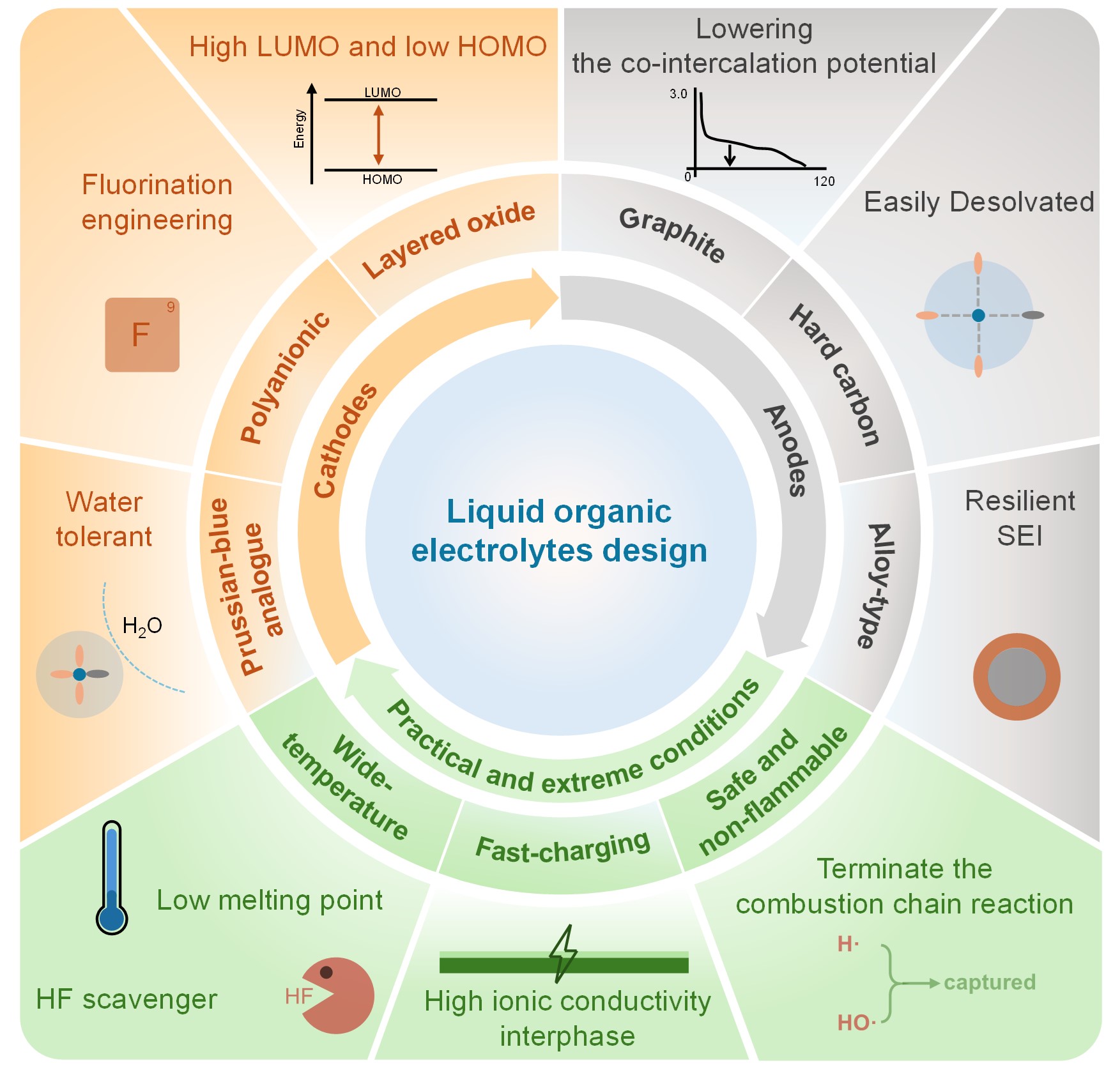
Figure 1. Overview of the electrolyte design for SIBs: matching different electrodes and operational needs.
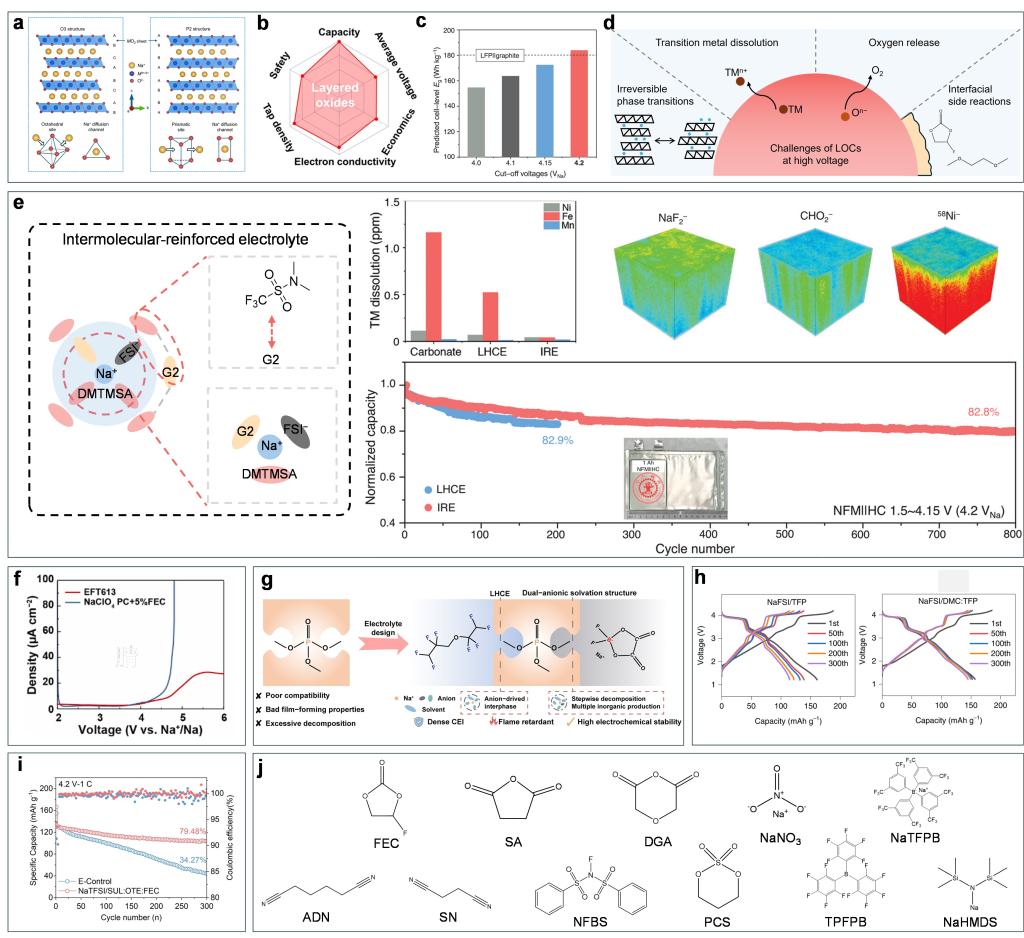
Figure 2. Challenges and electrolyte modification strategies for layered oxide cathodes (LOCs). (a) Typical crystal structure of LOCs; (b) Radar chart comparing key performance metrics of LOCs (specific capacity, average voltage, economic feasibility, electronic conductivity, tap density, and safety); (c) Relationship between cut-off voltage and full-cell energy density (Eg); (d) Schematic illustration of major challenges in high-voltage LOCs; (e) Solvation structure of sulfonamide-based electrolytes and their suppression of transition metal dissolution and stable long-term cycling performance in 1 Ah NFM333||HC pouch cells; (f) Ester-based localized high-concentration electrolytes (LHCEs) for LOCs; (g) Phosphate-based LHCEs for LOCs; (h) Voltage-capacity profiles and rate performance of NaNMC||HC full cells using NaFSI-DMC/TFP electrolyte; (i) Sulfone-based LHCEs for LOCs; (j) Molecular structures of functional additives for LOCs.
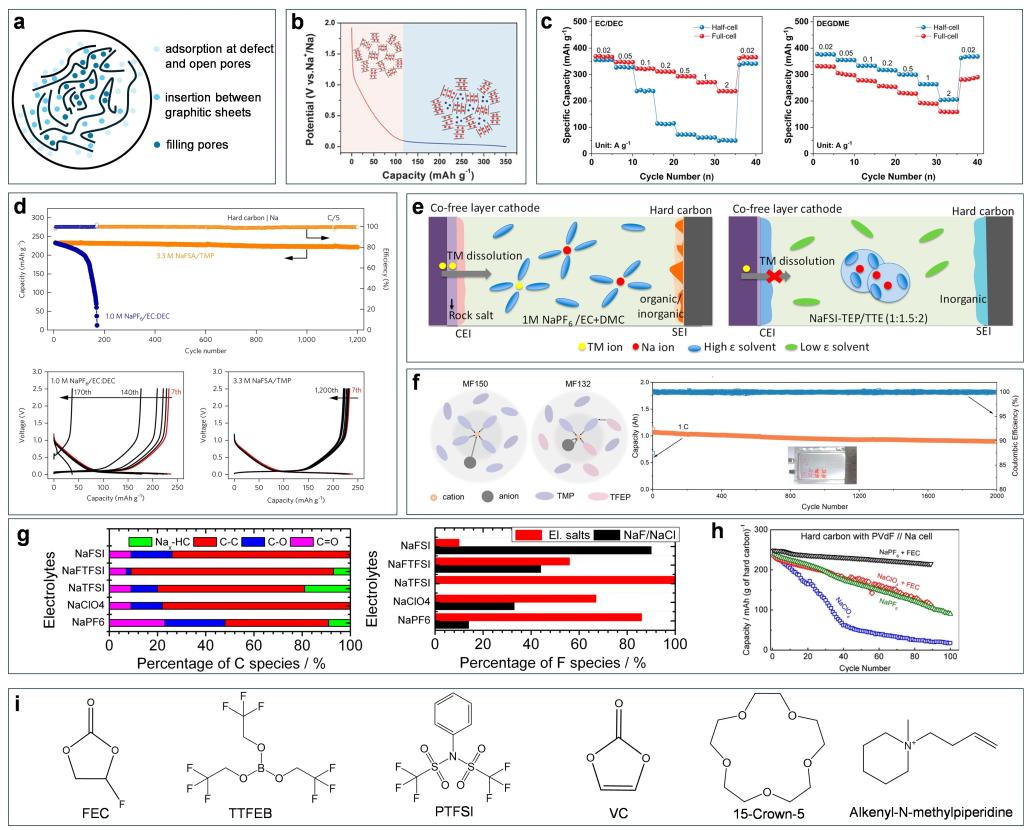
Figure 3. Electrolyte design for hard carbon (HC) anodes. (a) Schematic structure of HC; (b) Illustration of Na+ storage mechanisms in HC; (c) Rate capability of NFM333||HC full cells and HC||Na half cells using EC/DEC and G2 electrolytes; (d) Cycling performance and Coulombic efficiency of HC||Na half cells with concentrated 3.3 M NaFSA-TMP electrolyte versus conventional electrolyte; (e) Schematic comparison of reaction pathways at cathode and anode in different electrolytes; (f) Solvation structures and cycling performance of NFPP||HC pouch cells; (g, h) Impact of various salts on the electrochemical performance of HC anodes; (i) Molecular structures of functional additives designed for HC anodes.
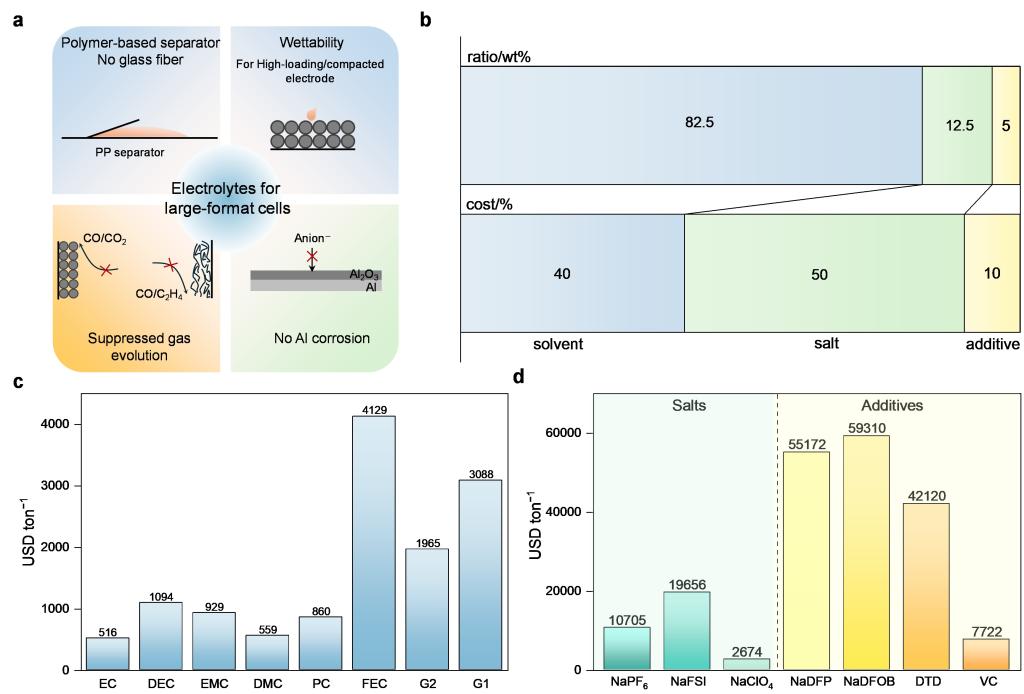
Figure 4. Electrolyte design guidelines and cost analysis for large-format cells. (a) Design guidelines for electrolytes in large-format batteries: excellent wettability (for wetting polymer separators and high-loading electrodes), suppressed gas evolution, and no aluminum corrosion; (b) Weight and cost percentage of each electrolyte component; (c) Price comparison of common carbonate and ether solvents; (d) Price comparison of common sodium salts and additives.
Outlook:
Although rapid iteration of existing solvent–salt–additive formulations remains the most efficient pathway toward near-term commercialization, the discovery and design of new electrolyte molecules are crucial for achieving long-term breakthroughs in the SIB field. While the eventual practical deployment of such novel molecules will require careful evaluation of manufacturing cost, environmental impact, and supply-chain feasibility when approaching commercialization (considerations that are primarily industry-driven), from an academic perspective, advancing molecular innovation and deepening mechanistic understanding already constitutes a meaningful and necessary contribution to the field. To accelerate progress, high-throughput experimentation, computational screening, and artificial intelligence (AI) are becoming increasingly powerful tools. Modeling efforts that predict physicochemical properties and electrochemical behavior—such as molecular-universe-style computational frameworks—enable rapid identification of promising candidates before synthesis. Concurrently, automated electrolyte formulation platforms and high-throughput battery testing systems significantly shorten the iteration cycle for electrolyte optimization. Looking forward, fully integrating molecular design, synthesis, electrolyte formulation, cell fabrication, and electrochemical testing within a unified high-throughput and AI-assisted workflow represents a highly promising direction for accelerating discovery and enabling the next generation of advanced sodium-ion battery electrolytes.
Paper Link:
Fundamentals, Status, and Prospects of Liquid Organic Electrolytes for High-Energy Sodium-Ion Batteries. Adv. Mater. 2025, e19965
https://doi.org/10.1002/adma.202519965
Professor Weijiang Xue
Weijiang Xue is a Professor and Doctoral Supervisor at Xi’an Jiaotong University. He is a recipient of the National High-Level Young Talent Program, recognized as one of the Stanford–Elsevier Top 2% Most Cited Scientists Worldwide, and a Xiaomi Young Scholar. From 2016 to 2021, he conducted postdoctoral research in Prof. Ju Li’s group at the Massachusetts Institute of Technology (MIT). He has long been engaged in research on lithium/sodium secondary batteries, accumulating extensive experience in the design and optimization of all battery components (cathodes, anodes, electrolytes, separators, etc.) and practical devices. He has achieved a series of domestically and internationally advanced research results in the molecular structure design of novel high-voltage-resistant electrolytes and high-specific-energy lithium/sodium batteries. He has published 78 papers in renowned international academic journals, many of which were published as first author or corresponding author in top-tier journals in materials and energy fields, including Nature Energy (2 papers), Nature Communications (2 papers, 2025/2026), Advanced Materials (2025, 4 papers), Angewandte Chemie International Edition (2025), Energy & Environmental Science, Matter, ACS Nano, and Advanced Functional Materials. He is the principal investigator of projects funded by the National Natural Science Foundation of China (General Program), multiple key industry collaborative R&D projects, and serves as the collaborating institution leader for the National Key R&D Program for Young Scientists. He serves as a reviewer and adjudicator for nearly 30 prestigious journals in chemistry, energy, and materials science, including Nature, Nature Sustainability, Nature Communications, Advanced Materials, and Journal of the American Chemical Society.
Personal link: https://gr.xjtu.edu.cn/en/web/xueweijiang


