Researchers from the State Key Laboratory for Mechanical Behavior of Materials at Xi'an Jiaotong University have published an important review article titled “Multicomponent alloys: coherent vs noncoherent precipitate strengthening” in the prominent journal Progress in Materials Science (I.F = 40). Under the guidance of academician Jun Sun, this work was led by Dr. Yasir Sohail and Professor Jinyu Zhang. The publication provides a comprehensive overview of precipitation strengthening mechanisms in multicomponent alloys and offers new insights into overcoming the long-standing strength–ductility trade-off in structural materials.
Precipitation strengthening has long been recognized as one of the most effective strategies for improving the mechanical performance of metallic materials. The phenomenon was first identified in 1906 by Alfred Wilm, who discovered that aluminum alloys could gradually become harder after heat treatment. Since then, precipitation hardening has played a pivotal role in the development of high-performance alloys used in aerospace, transportation, and energy industries. However, conventional precipitation-strengthened alloys are typically based on dilute alloy systems dominated by a single principal element, and their strengthening phases often introduce stress concentrations that may reduce ductility.
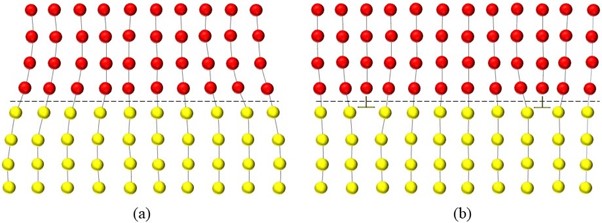
Fig. 1. Schematic representation of interface structures. (a) A coherent boundary with misfit strain and (b) a semi-coherent boundary with misfit dislocations.
Fig. 1 shows that imperfect lattice matching can be accommodated by elastic strain to maintain coherency (Fig. 1a), while larger lattice misfit favors the formation of semi-coherent interfaces with misfit dislocations (Fig. 1b). In recent years, concentrated multicomponent alloys (MCAs), including high-entropy and medium-entropy alloys, have emerged as a promising class of advanced structural materials. Unlike conventional alloys, MCAs contain several principal elements in high concentrations, resulting in unique characteristics such as high configurational entropy, severe lattice distortion, and complex chemical interactions. These features create new opportunities for designing alloys that can simultaneously achieve high strength, excellent ductility, and outstanding damage tolerance.
The review focuses on the fundamental role of precipitate–matrix interface structures, particularly the distinction between coherent and noncoherent precipitates. Coherent precipitates maintain crystallographic continuity with the surrounding matrix, allowing dislocations to shear through them during deformation. This interaction enables coherent precipitates to function both as dislocation barriers and as dislocation sources, promoting sustained work hardening and enabling alloys to achieve an exceptional synergy between strength and ductility. In multicomponent alloy systems, nanoscale coherent precipitates—such as L12-type intermetallic phases—have demonstrated remarkable mechanical performance, enabling strengths exceeding 1–2 GPa while retaining considerable ductility.
In contrast, noncoherent precipitates exhibit substantial lattice mismatch with the matrix, thereby disrupting lattice continuity at the interface. These precipitates strengthen alloys primarily by forcing dislocations to bypass them through mechanisms such as Orowan looping. While this process can provide strong strengthening effects, it may also generate severe stress concentrations at the precipitate–matrix interface, potentially leading to localized deformation and reduced ductility. Interestingly, the review highlights recent discoveries indicating that chemically complex noncoherent precipitates in multicomponent alloys can exhibit unexpected deformability. Certain B2-type intermetallic phases, for example, can accommodate dislocation activity or undergo stress-induced phase transformations, thereby mitigating brittleness and improving overall mechanical performance.
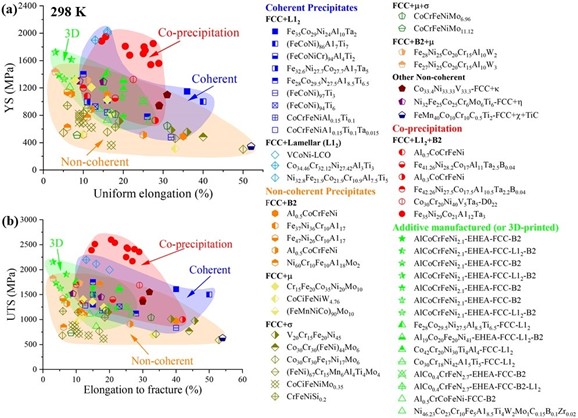
Fig. 2. Mechanical properties of precipitate strengthened FCC MCA at 298K testing.
Fig. 2 summarizes the mechanical properties—YS vs. UE and UTS vs. El—of precipitate-strengthened MCAs at 298 K. These alloys are strengthened through coherent, noncoherent, and co-precipitation mechanisms, including 3D-printed precipitate-strengthened MCAs tested at ambient temperature. A clear strength–ductility trade-off is observed in single-phase precipitate-strengthened systems, regardless of whether the precipitates are coherent or noncoherent.
Beyond reviewing the current state of knowledge, the article also discusses emerging strategies for designing next-generation MCAs. These strategies include hierarchical microstructure design across multiple length scales, the integration of machine learning and artificial intelligence to accelerate alloy discovery, and the application of advanced manufacturing technologies such as additive manufacturing to engineer complex microstructures. Such approaches are expected to significantly expand the design space for high-performance structural materials.
Overall, the publication provides a comprehensive framework for understanding precipitation strengthening in MCAs and offers valuable guidance for the rational design of future structural materials. The insights presented in the study are expected to contribute to the development of advanced alloys for demanding applications, including aerospace systems, cryogenic engineering, energy infrastructure, and next-generation transportation technologies.
The research was supported by the National Natural Science Foundation of China, the 111 Project of China, the Shaanxi Province Innovation Team Project, and the Fundamental Research Funds for the Central Universities.
Publication information
Title: Multicomponent alloys: coherent vs noncoherent precipitate strengthening
Journal: Progress in Materials Science
First Author: Dr. Yasir Sohail
Corresponding Author: Prof. Jinyu Zhang
Other contributors: Academician Jun Sun, Prof. Gang Liu
State Key Laboratory for Mechanical Behavior of Materials, Xi'an Jiaotong University
DOI:https://doi.org/10.1016/j.pmatsci.2026.101701


