Hydrogen peroxide (H₂O₂) is an important green oxidant with broad applications in wastewater treatment, bleaching, and disinfection. However, its large-scale industrial production still relies heavily on the anthraquinone process, which is energy-intensive, environmentally burdensome, and dependent on organic solvents as well as multistep reaction pathways. In this context, the photocatalytic synthesis of H₂O₂ from water or oxygen under visible light has emerged as a highly promising sustainable alternative. Its practical development, however, has long been hindered by several fundamental challenges, particularly inefficient charge separation in photocatalysts and mass-transfer limitations in conventional solid-state framework materials.
To address these issues, Professor Mingming Zhang’s group at Xi’an Jiaotong University proposed a supramolecular photocatalytic strategy based on discrete metallacages. The team developed a template-directed orthogonal coordination self-assembly approach and successfully constructed two structurally precise porphyrin-based metal–organic cages featuring well-defined double-cavity architectures. These metallacages integrate photoactive zinc porphyrin units with electron-accepting triazine components, forming an intrinsic donor–acceptor configuration at the molecular level. This design enables efficient photoinduced electron transfer and charge separation under visible-light irradiation.
Building on the unique double-cavity structure, the researchers further encapsulated electron-rich planar aromatic guest molecules, including triphenylene and benzotrithiophene, to construct a series of host–guest complexes. Their study demonstrates that guest inclusion can effectively stabilize the photoinduced charge-separated states and markedly prolong carrier lifetimes, thereby substantially enhancing the visible-light photocatalytic production of H₂O₂. Under optimized conditions, the system achieved an H₂O₂ production rate of 4037 µmol g⁻¹ h⁻¹, placing it among the leading supramolecular photocatalysts reported for visible-light-driven H₂O₂ generation.
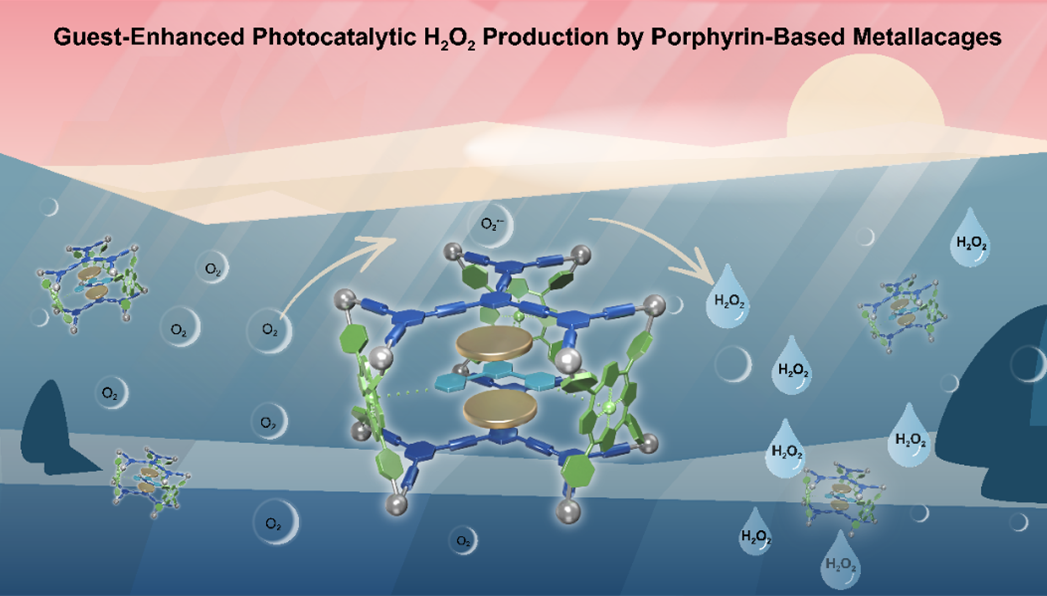
Figure 1. Schematic illustration of porphyrin-based double-cavity metallacages for visible-light-driven H₂O₂ production.
This work was recently published in Angewandte Chemie International Edition under the title “Guest-Enhanced Charge Separation in Porphyrin-Based Double-Cavity Metallacages for Visible-Light-Driven H₂O₂ Production.” Huang Yujuan, a PhD candidate at the School of Materials Science and Engineering, Xi’an Jiaotong University, is the first author of the paper. Professor Mingming Zhang and Associate Professor Zhikai Li of Xi’an Jiaotong University, together with Professor Haonan Peng of the School of Chemistry and Chemical Engineering, Shaanxi Normal University, are the corresponding authors. The State Key Laboratory of Metal Porous Materials at Xi’an Jiaotong University is the first corresponding institution.
This research was supported by the Open Fund of the State Key Laboratory of Metal Porous Materials, the National Natural Science Foundation of China, and the Open Fund of the State Key Laboratory of Chemistry and Biological Engineering for Advanced Materials Creation. Characterization and testing were supported by the Analytical and Testing Center of Xi’an Jiaotong University.
Paper link:
https://onlinelibrary.wiley.com/doi/10.1002/anie.9964829
Research group website:
https://gr.xjtu.edu.cn/en/web/mingming.zhang


