Research Background
With the rapid development of energy storage and power battery technologies, sodium-ion batteries (SIBs) have emerged as an important complementary system to lithium-ion batteries due to their abundant resources and cost advantages. However, SIBs still face significant challenges under high-voltage (≥4.2 V) and extreme temperature conditions (e.g., −60 °C and below). At high voltages, electrolytes are prone to oxidative decomposition, leading to unstable electrode–electrolyte interfaces. At low temperatures, restricted solvent molecular reorientation and strengthened ion–dipole interactions severely hinder ion transport kinetics. These issues become even more pronounced in high-loading pouch cells, greatly limiting their practical application and large-scale deployment.
Research Highlights
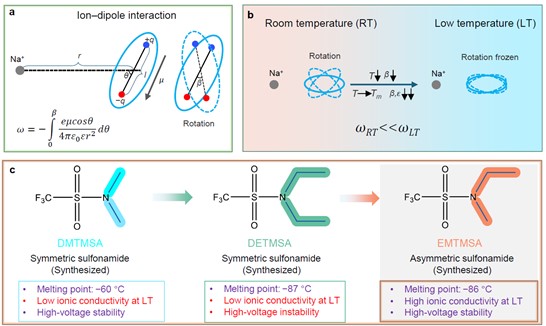
To address these critical challenges, the research group led by Prof. Weijiang Xue from the School of Materials Science and Engineering at Xi’an Jiaotong University proposed a novel sulfonamide-based electrolyte molecule based on an “asymmetric molecular structure design” strategy—namely, N-ethyl-N-methyl-trifluoromethanesulfonamide (EMTMSA).
By introducing asymmetric alkyl substituents into the sulfonamide molecule, the regular crystal packing during solidification is effectively disrupted, leading to a significantly reduced melting point of −86 °C. This enables the synergistic optimization of low-temperature fluidity and high-voltage stability at the molecular level. Meanwhile, the molecule retains salt-like structural characteristics, inducing solvation structures dominated by contact ion pairs (CIPs) and aggregates (AGGs), which facilitate the formation of inorganic-rich, low-impedance, and stable interphases during electrochemical reactions.
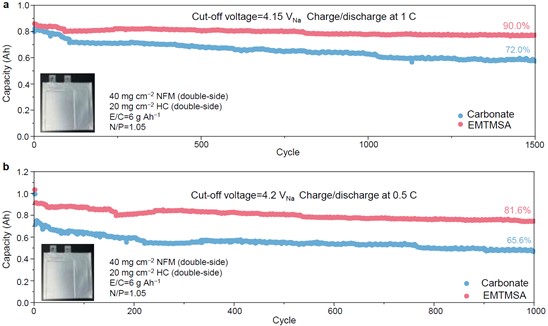
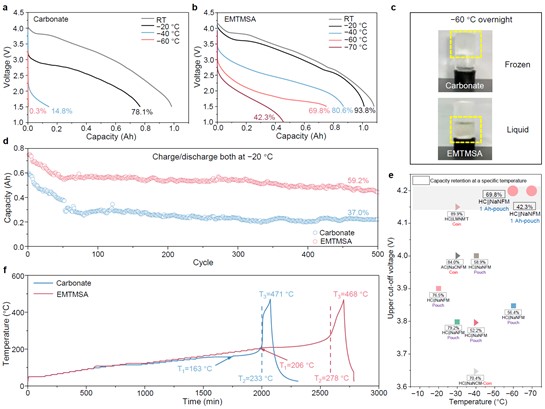
The electrolyte based on this molecule demonstrates outstanding performance in Ah-level pouch cells. Specifically, it achieves a capacity retention of 81.6% after 1000 cycles at a high cut-off voltage of 4.2 VNa, and 90.0% retention after 1500 cycles at 4.15 VNa. Remarkably, it maintains excellent discharge capability under extreme low temperatures, retaining 69.8% and 42.3% of room-temperature capacity at −60 °C and −70 °C, respectively. In addition, the electrolyte significantly enhances high-temperature stability and thermal safety by delaying the onset of thermal runaway, enabling stable operation over a wide temperature range from −70 °C to 60 °C.
Notably, Prof. Weijiang Xue first proposed and developed fluorosulfonamide electrolyte molecules in 2020 (Energy & Environmental Science, 2020, 13, 212–220), and has since extended this molecular design strategy to various battery systems, including lithium metal batteries (Nature Energy, 2021, 6, 495–505;Energy & Environmental Science, 2021, 14, 6030–6040;Advanced Materials, 2025, 38, e12236;ACS Nano, 2024, 18, 47, 32723;ACS Energy Letters, 2025, 10, 3610;Angewandte Chemie International Edition, 2025, 64, e11223), silicon-based lithium-ion batteries (Advanced Materials, 2025, 38, e15562), and sodium-ion batteries (Advanced Materials, 2025, 37, 12, 2415611). This work represents the tenth publication in the fluorosulfonamide electrolyte family.
This study reveals the fundamental mechanism of achieving compatibility between high-voltage stability and low-temperature kinetics through the regulation of ion–dipole interactions and solvation structures. It systematically demonstrates a complete research pathway from molecular design and solvation chemistry to pouch-cell validation, providing important guidance for the practical application of sodium-ion batteries in extreme environments and high-energy-density scenarios.
Publication Information
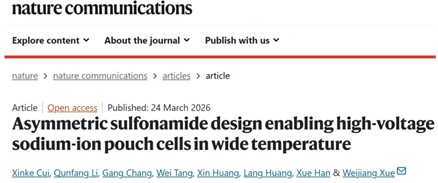
The above work was published in Nature Communications under the title:
“Asymmetric sulfonamide design enabling high-voltage sodium-ion pouch cells in wide temperature.”
Xi’an Jiaotong University’s State Key Laboratory for Mechanical Behavior of Materials is the primary corresponding institution. Mr. Xinke Cui, a fourth-year Ph.D. student from the School of Materials Science and Engineering, is the first author, and Prof. Weijiang Xue is the corresponding author.
This work was supported by the National Key R&D Program of China, as well as the Micro/Nano Center and Analytical & Testing Center of the School of Materials Science and Engineering at Xi’an Jiaotong University.
Paper link:
https://www.nature.com/articles/s41467-026-70592-z
Prof. Weijiang Xue’s homepage:
https://gr.xjtu.edu.cn/en/web/xueweijiang


