A molecular snap-fit strategy integrates three distinct organic ligands into box-shaped heteroleptic cages and enables deliberate control over intramolecular electronic communication
Release date: June 23, 2026
Institution: Xi'an Jiaotong University
Journal: Journal of the American Chemical Society
XI'AN, China - Researchers at Xi'an Jiaotong University have demonstrated a snap-fit-inspired self-assembly strategy for constructing heteroleptic platinum(II) cages containing three types of organic ligands. The strategy produces box-shaped metallacages with reduced constitutional symmetry and integrates electronically disparate components within a single discrete architecture.
The rational design of heteroleptic metallacages from multiple ligands remains a significant challenge in supramolecular chemistry because increasing the number of components raises the likelihood of thermodynamic mixtures and poorly defined assemblies. This selectivity problem has limited the structural complexity and functional integration achievable in artificial multicomponent systems.
To address the challenge, the team led by Professor Mingming Zhang and Associate Professor Zhikai Li translated the engineering principle of snap-fit assembly into coordination chemistry. An asymmetric tetracarboxylate ligand acts as a multifaceted connector, guiding two distinct tetrapyridyl panels to snap into place around Pt(II) vertices. Self-assembly with a tetrapyridyl perylene diimide panel, one of three tetrapyridyl p-terphenyl panels and cis-Pt(II) nodes yielded heteroleptic metallacages 5a-5c as four-component assemblies.
Within each cage, the spatial combination of electron-rich anthracene or dimethoxybenzene donors with electron-deficient perylene diimide acceptors facilitates efficient through-space photoinduced electron transfer and charge separation. Spectroscopic and computational analyses support the close donor-acceptor electronic communication, enhanced charge separation and increased production of reactive oxygen species.
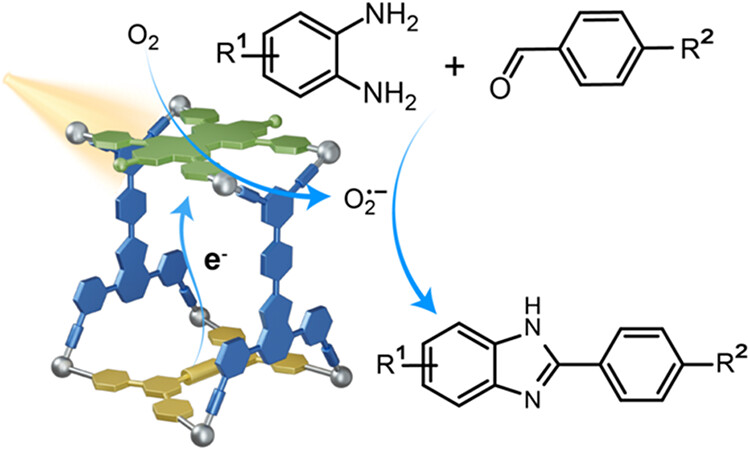
Figure 1. Multicomponent Pt(II) metallacage-mediated benzimidazole formation through a visible-light-driven condensation-oxidative cyclization sequence.
The metallacages promote the generation of superoxide radical anions and enable photocatalytic benzimidazole formation from o-phenylenediamines and aromatic aldehydes through a condensation-oxidative cyclization sequence. Under air and 525 nm irradiation for two hours, anthracene-containing metallacage 5b delivered the best performance, achieving nearly complete conversion and a 98% yield. It retained more than 90% of its initial yield after five consecutive catalytic runs, indicating good operational durability and minimal structural degradation during turnover.
The proposed photocatalytic pathway efficiently harnesses molecular oxygen as a mild and sustainable oxidant. More broadly, the snap-fit design principle expands the synthetic toolbox for building functionally integrated metallacages. It offers a modular and programmable approach to multicomponent assembly, a versatile platform for engineering intramolecular electronic communication and a route toward more complex functional systems in supramolecular photocatalysis.
Publication and authorship
The study, titled "Snap-Fit Assembly of Multicomponent Pt(II) Metallacages Enabling Through-Space Electron Transfer and Enhanced Photocatalysis," was published in the Journal of the American Chemical Society. The article was authored by Jikun Li, Shijin Jian, Zilin Zhou, Zeyuan Zhang, Chaoqun Mu, Yali Hou, Zhikai Li and Mingming Zhang. Jikun Li, Shijin Jian and Zilin Zhou contributed equally to the work. Yali Hou, Zhikai Li and Mingming Zhang are corresponding authors. The State Key Laboratory for Porous Metal Materials at Xi'an Jiaotong University is the primary corresponding institution.
The work was supported by the State Key Laboratory for Porous Metal Materials (PMMSKL-ZZYJ-2025-10), the National Natural Science Foundation of China (22301238 and 22571246) and the Open Project of the State Key Laboratory of Synergistic Chem-Bio Synthesis (sklscbs202511). The authors also acknowledged support from the Instrument Analysis Center and the Experimental Chemistry Center of Xi'an Jiaotong University for NMR and fluorescence measurements, together with external crystallographic and mass-spectrometric characterization support.
Further information
Paper: Read the paper in JACS
Research group: Visit Professor Mingming Zhang's research group


