Research Background
Aluminum-ion batteries (AIBs) are considered promising for large-scale energy storage because aluminum is abundant and inexpensive and offers exceptionally high theoretical volumetric (8046 mAh cm−3) and gravimetric (2981 mAh g−1) capacities. However, pure aluminum negative electrodes face severe challenges. On the one hand, defects in the native passivation layer lead to nonuniform local charge distributions, resulting in uneven ion flux and severe dendrite growth. On the other hand, the electronic percolation network formed among deposited aluminum particles is highly fragile and lacks strong mechanical bonding with the substrate. Consequently, the electrode is prone to structural collapse and delamination during cycling, generating substantial amounts of “dead aluminum” and severely compromising the long-term cycling stability of AIBs.
Article Overview
Recently, Weijiang Xue of the Micro/Nano Center, State Key Laboratory for Mechanical Behavior of Materials, School of Materials Science and Engineering, Xi'an Jiaotong University, together with Yao Li, Xue Han, and Zhanqiu Tan from Academician Di Zhang's team at the State Key Laboratory of Metal Matrix Composites and the School of Materials Science and Engineering, Shanghai Jiao Tong University, published a research article entitled “A Bioinspired CNTs-Enhanced Anode for Ultra-Stable Aluminum-Ion Batteries” in the internationally renowned energy materials journal Advanced Energy Materials.
Inspired by the architecture of the diffuse nerve network in sea-anemone tentacles, the research team designed a composite negative electrode based on micro-/nanoscale aluminum flakes and carboxylated carbon nanotubes (CNTs). By introducing a three-dimensional continuous CNT electronic percolation network with both high electrical conductivity and exceptional mechanical strength into the aluminum matrix, the electrode overcomes mass-transport barriers imposed by the native aluminum oxide passivation layer and reduces the nucleation overpotential by 50%. Notably, during aluminum stripping, CNTs deeply embedded within the matrix become exposed in situ, creating a self-adaptive, dynamically CNT-regulated interphase that guides subsequent aluminum-ion deposition toward uniform, dendrite-free growth. In addition, the robust mechanical interlocking and internal anchoring provided by the CNT network suppress electrode pulverization and collapse during prolonged cycling, thereby mitigating the accumulation of “dead aluminum.” The Al@CNT composite electrode delivers outstanding electrochemical performance. Under demanding conditions of 3 mA cm−2 current density and 3 mAh cm−2 areal capacity, the Al@CNT symmetric cell operates stably for more than 1800 h with low polarization, whereas the control pure-Al symmetric cell short-circuits within only 170 h. Furthermore, when paired with an artificial graphite (AG) positive electrode in a full cell, the system retains more than 80% of its capacity after as many as 45,000 cycles at a high rate of 5 A g−1. Through bioinspired structural design, this work addresses the long-standing difficulty of simultaneously achieving electrochemical and mechanical stability at aluminum-metal electrode interfaces and introduces a new strategy for the “self-adaptive” regulation of electrode interfaces using a 3D CNT network.
The first author of the paper is doctoral student Yongsheng Hu. The corresponding authors are Yao Li, Xue Han, Zhanqiu Tan, and Weijiang Xue. This work received characterization support from the National Innovation Platform (Center) for Industry-Education Integration in Energy Storage Technology at Xi'an Jiaotong University.
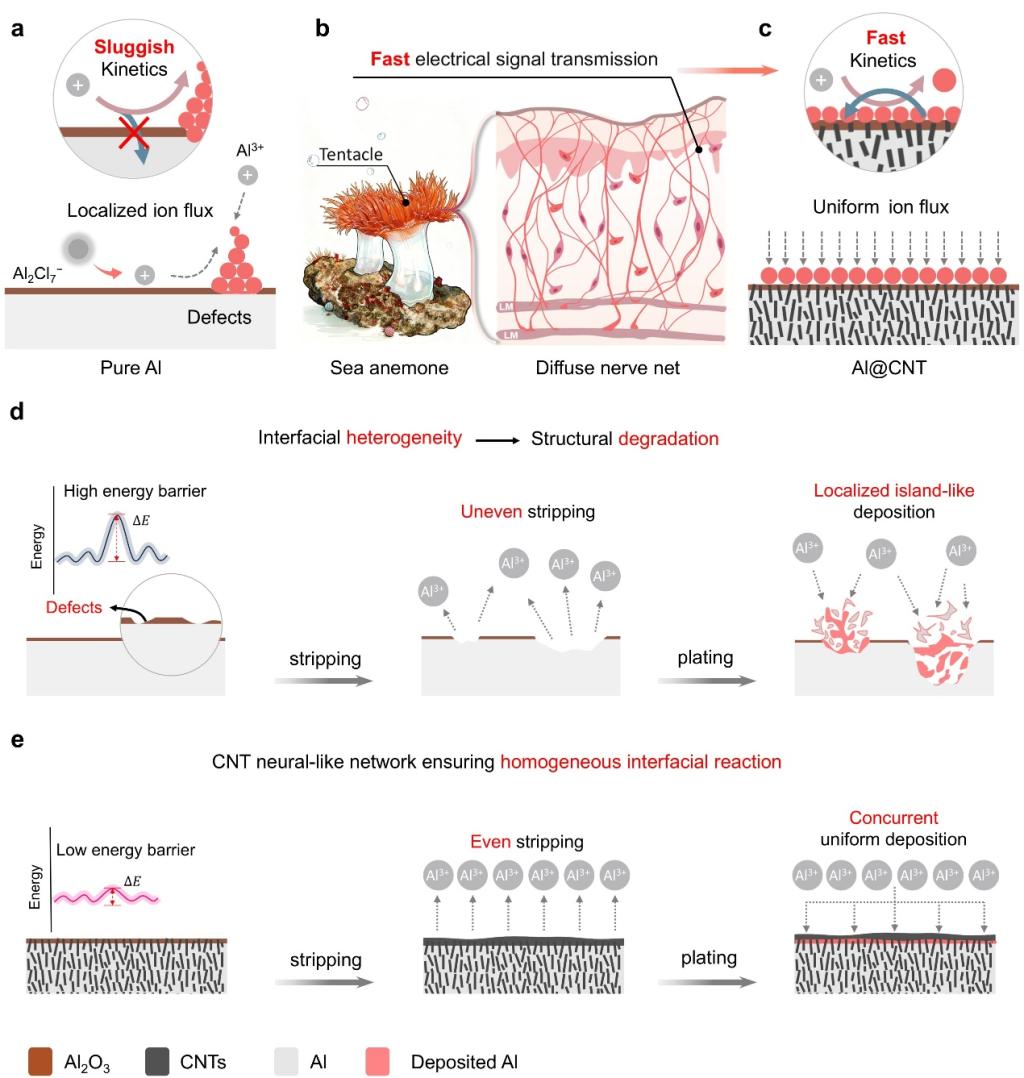
Figure 1. Bioinspired design of the Al@CNT negative electrode, inspired by the diffuse nerve network of sea-anemone tentacles
Paper Information:
YongSheng Hu, Xue Han*, Yijun Chen, Cong Zeng, Yao Li*, ZhanQiu Tan*, Weijiang Xue*, Di Zhang. A bioinspired CNTs-enhanced anode for ultra-stable Aluminum-ion batteries. Advanced Energy Materials, 2026, e71213.
Paper Link: https://advanced.onlinelibrary.wiley.com/doi/full/10.1002/aenm.71213
Profile of Professor Weijiang Xue, School of Materials Science and Engineering, Xi'an Jiaotong University:
Weijiang Xue is a professor and doctoral supervisor at Xi'an Jiaotong University. His research focuses on the molecular design of advanced electrolytes and metal negative electrodes. As a first and/or corresponding author, he has published papers in internationally renowned journals including Nature Energy (2 papers), Nature Communications (2 papers), Advanced Materials (4 papers), Angewandte Chemie, Energy & Environmental Science (2 papers), and Advanced Energy Materials. He has been consecutively included in the Stanford–Elsevier World's Top 2% Scientists list. He has led a General Program project of the National Natural Science Foundation of China and multiple major industry-sponsored R&D projects, and serves as the principal investigator for a collaborating institution in a Young Scientist Project of the National Key R&D Program of China. He has served as a reviewer and adjudicative reviewer for more than 40 leading journals in chemistry, energy, and materials science, including Nature, Nature Sustainability, Nature Communications, Advanced Materials, Journal of the American Chemical Society, Angewandte Chemie, and Energy & Environmental Science.
Professor Weijiang Xue's Personal Homepage
https://gr.xjtu.edu.cn/xueweijiang/zh_CN/zhym/985230/list/index.htm


