Professor Weijiang Xue’s Group at the School of Materials Science and Engineering, Xi’an Jiaotong University Reports Advances in High-Voltage Sodium-Ion Batteries
Research Background
Sodium-ion batteries offer advantages including abundant resources and low cost, and have considerable potential for large-scale energy storage and medium-range electric transportation. Increasing battery energy density requires the development of high-voltage cathode materials. However, conventional carbonate electrolytes are prone to continuous oxidative decomposition at 4.3 V, forming a thick and porous cathode interphase and causing transition-metal dissolution, interfacial impedance growth, and rapid capacity decay. Existing fluorinated solvents and high-voltage additives generally struggle to simultaneously deliver high-voltage stability, high ionic conductivity, and performance over a wide temperature range. A new electrolyte design strategy based on regulating the solvation structure is therefore urgently needed.
Article Summary
Recently, Professor Weijiang Xue’s group at the Center for Advancing Materials Performance from the Nanoscale and the State Key Laboratory for Mechanical Behavior of Materials, School of Materials Science and Engineering, Xi’an Jiaotong University, published a research article entitled “Confined Solvation Electrolyte for 4.3-V-Class High-Voltage Sodium-Ion Pouch Cells” in ACS Nano. The team proposed a confined solvation electrolyte (CSE) design strategy that reconstructs the local coordination environment of Na+ by introducing the polar inducing solvent N,N-dimethyltrifluoromethanesulfonamide (Me2TFMSA).
Through dipole interactions, this strategy confines the carbonate solvents propylene carbonate (PC) and ethyl methyl carbonate (EMC) within the first solvation shell of Na⁺, promotes the participation of FSI− in coordination, and creates an aggregate-dominated solvation structure. While maintaining an ionic conductivity of 3.5 mS cm−1, it substantially reduces the content and oxidative activity of free carbonate molecules. During cycling, the CSE forms a compact, inorganic-rich cathode–electrolyte interphase less than 8 nm thick and a stable NaF-rich interphase on the hard-carbon anode, thereby suppressing continuous electrolyte decomposition, transition-metal dissolution, cathode-particle cracking, and interfacial impedance growth.
Ah-scale hard-carbon||P2-type layered-oxide pouch cells using this electrolyte exhibited stable long-term cycling at an operating voltage of 4.3 V: capacity retention reached 74.8% after 800 cycles at 0.5 C and remained 66.2% after 1,000 cycles at 1 C. The cells retained 74.1% of their capacity after 300 cycles at 45 °C. Under deep desodiation conditions at −30 °C, the CSE also effectively prevented the low-temperature sodium plating observed with conventional electrolytes. This study provides a new molecular design strategy for simultaneously achieving high-voltage stability, low-temperature kinetics, and practical pouch-cell performance in sodium-ion batteries.
Chenxi Liu, a master’s student who entered the School of Materials Science and Engineering in 2023, is the first author. Xue Han, Ding Nan, and Weijiang Xue are the corresponding authors.
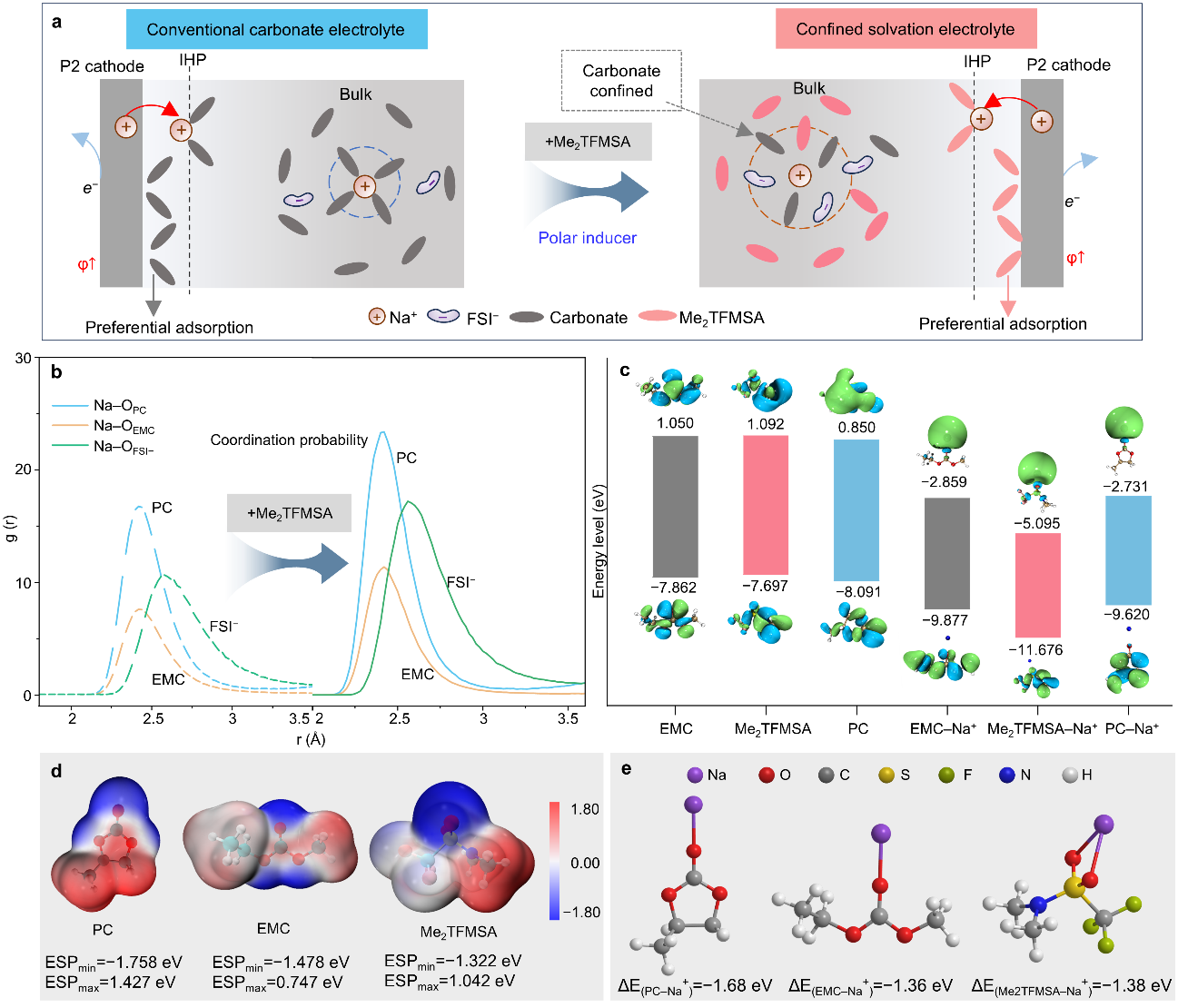
Figure 1. Design of the confined solvation electrolyte and regulation of the solvation structure
Paper Information:
Chenxi Liu, Ting Ma, Xue Han*, Yao Li, Ding Nan*, and Weijiang Xue*. Confined Solvation Electrolyte for 4.3-V-Class High-Voltage Sodium-Ion Pouch Cells. ACS Nano, 2026. DOI: 10.1021/acsnano.6c03000.
Article link: https://pubs.acs.org/doi/10.1021/acsnano.6c03000
About Professor Weijiang Xue, School of Materials Science and Engineering, Xi’an Jiaotong University:
Weijiang Xue is a professor and doctoral supervisor at Xi’an Jiaotong University. His research focuses on the molecular design of advanced electrolytes, metal anodes, and battery interfacial chemistry. As a first or corresponding author, he has published a series of studies in Nature Energy, Nature Communications, Advanced Materials, Angewandte Chemie International Edition, Energy & Environmental Science, Advanced Energy Materials, and ACS Nano. He has been continuously included in the Stanford–Elsevier World’s Top 2% Scientists list. He has led projects funded by the National Natural Science Foundation of China and several industry-sponsored research and development programs, and has served as the principal investigator of a participating institution in a Young Scientist Project under the National Key Research and Development Program of China.
Email address: xuewj@xjtu.edu.cn
Professor Weijiang Xue’s personal webpage
https://gr.xjtu.edu.cn/xueweijiang/zh_CN/zhym/985230/list/index.htm


