School of Materials Science and Engineering at Xi’an Jiaotong University Makes New Advances in the Reaction Mechanisms of Hydrogen-Based Green Ironmaking
Recently, Professor Xuyang Zhou of the School of Materials Science and Engineering at Xi’an Jiaotong University and collaborators from the Max Planck Institute for Sustainable Materials and the Ernst Ruska-Centre for Microscopy and Spectroscopy with Electrons in Germany reported new insights into the reaction mechanisms underlying hydrogen-based green ironmaking. The research team revealed an iron-cation-diffusion-mediated “displaced reaction–transformation” mechanism during the hydrogen-based reduction of magnetite. The findings were published in Advanced Science under the title “Cation Diffusion-Mediated Displaced Reaction-Transformation in Green Steelmaking.”
Research Background
Direct reduction of iron oxides with hydrogen instead of fossil carbon sources is an important technological route for the steel industry’s low-carbon transition. However, iron-oxide reduction involves multiple coupled processes, including surface chemical reactions, ion migration, interface motion, and crystal-structure transformation. How the reaction and phase transformation propagate from the material surface into its interior has long remained unclear.
Using time-resolved environmental scanning transmission electron microscopy, the research team observed in situ the reduction of magnetite (Fe3O4) over a temperature range of 200–1000 °C in a hydrogen environment of approximately 3 Pa. Together with bulk experiments and atomic-scale simulations, the team systematically analyzed the relationships among surface morphological reconstruction, iron-cation transport, and phase transformation.
Key Findings
In situ observations showed pronounced step growth and morphological reconstruction on magnetite surfaces under hydrogen. When hydrogen was introduced, the surface steps advanced continuously; once the hydrogen supply was stopped, step motion ceased immediately, indicating that the process was directly driven by the reduction reaction. At approximately 700 °C, Fe3O4 began to transform into Fe1-xO.
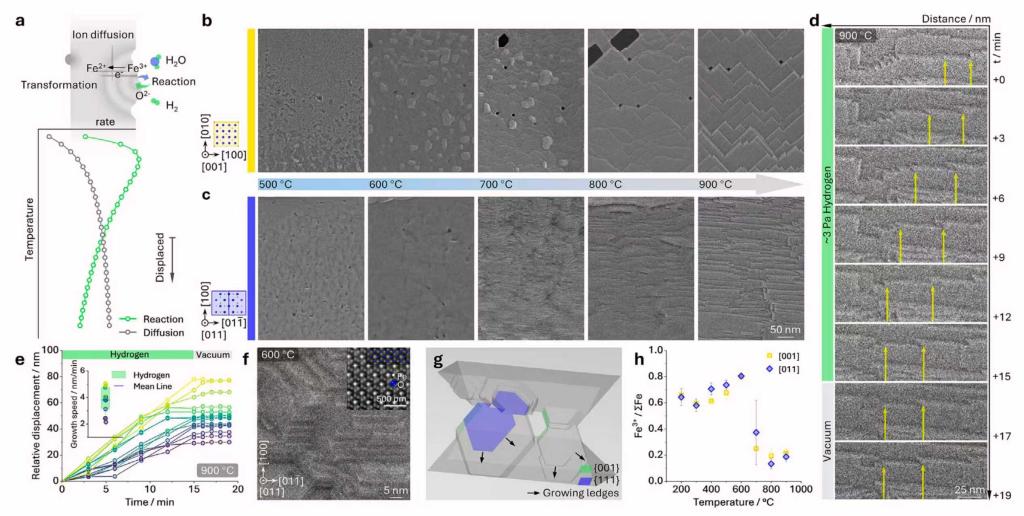
Figure 1. Surface step growth and dynamic reconstruction during the hydrogen-based reduction of magnetite. In situ environmental transmission electron microscopy shows that step structures form and advance on the Fe3O4 surface as the temperature rises; the steps continue to grow when hydrogen is introduced and stop moving immediately when the hydrogen supply is halted. Image source: Guo et al., Advanced Science, DOI: 10.1002/advs.76583.
The study found that hydrogen first removes oxygen from the material surface, causing iron-cation enrichment and rapid migration. When the cation diffusion rate exceeds the local reduction-reaction rate, the phase transformation is no longer confined to the surface reaction front but instead occurs in regions far from the initial reaction site. The research team termed this process a “displaced reaction–transformation.” At 727 °C, the spatial distance between the surface reaction site and the internal phase-transformation site was two to four orders of magnitude greater than the reaction-front thickness assumed in conventional models.
Cross-Scale Validation and Research Significance
Experiments on bulk magnetite further showed that Fe1-xO can form a three-dimensional network–plate structure extending tens of micrometers within Fe3O4. This demonstrates that the iron-cation-mediated displaced reaction–transformation is not limited to the nanoscale; it can span multiple scales and affect the reduction of actual iron ores.
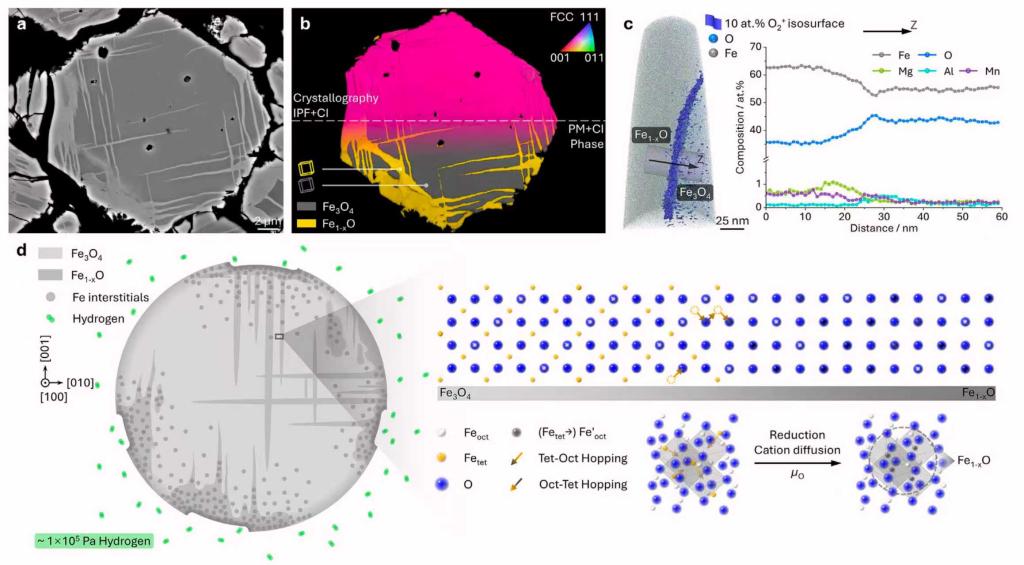
Figure 4. Three-dimensional network–plate Fe1-xO structures formed during the hydrogen-based reduction of bulk magnetite. Backscattered-electron imaging and electron backscatter diffraction reveal the spatial distribution of Fe1-xO within the Fe3O4 matrix; atom-probe results and a mechanistic schematic show that iron cations generated by surface deoxygenation diffuse into the material and locally drive the transformation of Fe3O4 into Fe1-xO. Image source: Guo et al., Advanced Science, DOI: 10.1002/advs.76583.
This study establishes the key role of cation transport in hydrogen-based reduction and provides a new theoretical basis for controlling iron-oxide reduction kinetics and microstructure and for optimizing green ironmaking processes. These insights also help in understanding solid-state redox processes such as iron–air batteries, metal combustion, and corrosion.
Paper Information
Paper title: Cation Diffusion-Mediated Displaced Reaction-Transformation in Green Steelmaking
Journal: Advanced Science
Paper link: https://doi.org/10.1002/advs.76583
Author information: Guangyi Guo is the first author. Baptiste Bienvenu, Professor Xuyang Zhou, and Professor Dierk Raabe are co-corresponding authors.
Profile of Professor Xuyang Zhou, School of Materials Science and Engineering, Xi’an Jiaotong University
Xuyang Zhou is a professor and PhD advisor at the School of Materials Science and Engineering, Xi’an Jiaotong University. He is an Alexander von Humboldt Fellow. He has published as a first or corresponding author in journals including Nature Synthesis, Nature Communications, Science Advances, Physical Review Letters, Advanced Materials, and Acta Materialia.
His research focuses on sustainable metallurgy, magnesium alloys, and materials processing. His group uses electron microscopy, atom probe tomography, and related experimental methods to investigate microstructural evolution and processing–structure–property relationships across multiple length scales. The group also explores data-driven and automated approaches to materials design, processing, and characterization, with an emphasis on resource-efficient manufacturing and broader engineering applications.
Professor Xuyang Zhou’s homepage: https://mse.xjtu.edu.cn/info/1111/9070.htm


